Accession No
2014.329
Description
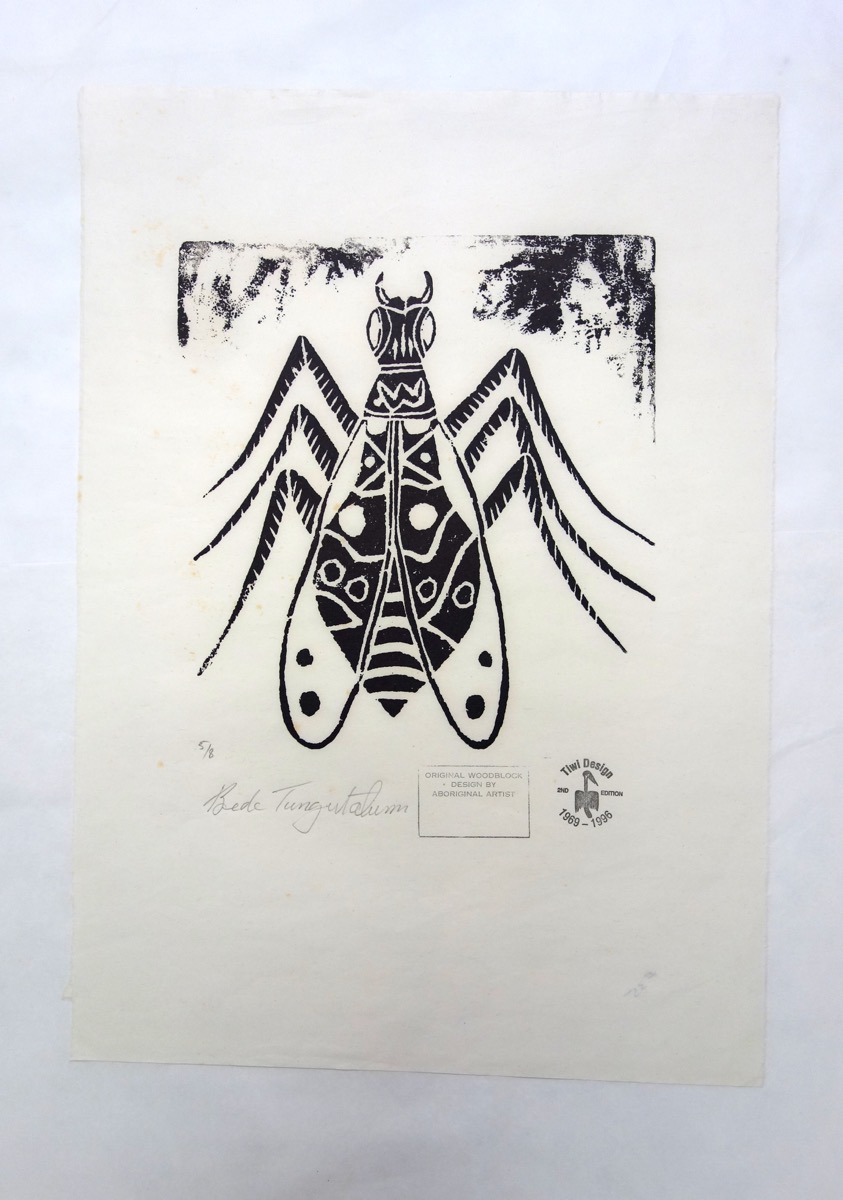
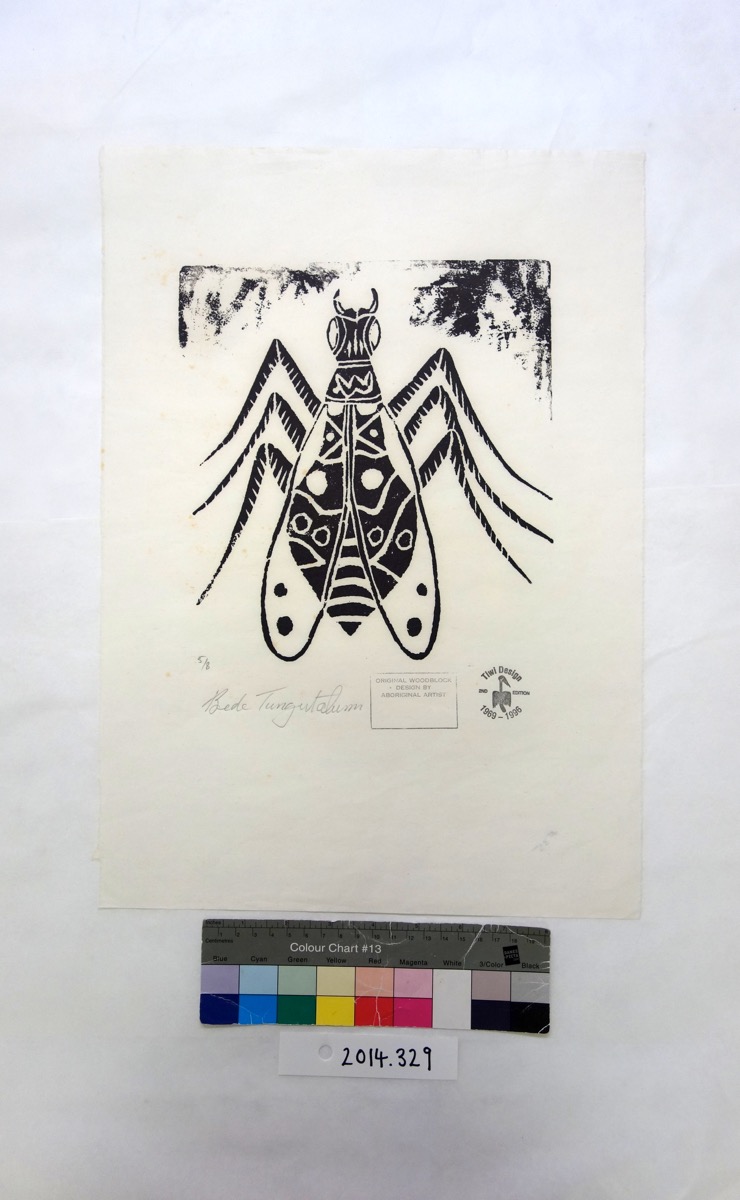
Untitled [Insect] Black and white woodblock print by Bede Tungatalum (aka Ampuruwaiuah), stamped 1996. Printed on rice paper, edition number 5/8, 1996, 2nd edition reprint from woodblocks dating to 1969-71. Signed by the artist in 2014 with the assistance of Prof Diana Wood Conroy
Place
Oceania; Australasia; Australia; Northern Territory; Bathurst Island
Period
Source
Tiwi Design [vendor]
Department
Anth
Reference Numbers
2014.329; 35
Cultural Affliation
Tiwi; Munupi; Yarinapinila (red ochre)
Material
Paper; pigment
Local Term
Measurements
316mm x 454mm
Events
Description (Labels & Markings)
Stamped beneath the image. One rectangular stamp reads 'ORIGINAL WOODBLOCK DESIGN BY ABORIGINAL ARTIST'.
The second stamp is a circular design in which reads 'Tiwi Design 2ND EDITION 1969-1996' with an image of a bird in the centre.
Event Date 2014
Author: rachel hand
Description (Labels & Markings)
The back of the print is marked '#35' in pencil.
Event Date 2014
Author: rachel hand
Description (Physical description)
Woodblock print in black ink by Bede Tungatalum, untitled [insect] and undated. Edition number 5/8. Signed by the artist in pencil 'Bede Tungutalum'.
Event Date 21/11/2014
Author: maa
Context (Field collection)
Purchased from Tiwi Design, Bathurst Island, through the Crowther-Beynon fund. Contact information: www.tiwidesigns.com
Event Date 21/11/2014
Author: maa
Context (Production / use)
Diana Wood Conroy who assisted with the acquisition of the Tiwi prints notes: ‘The Tiwi prints are dated twice: the woodblocks themselves date from 1969-71 as you have found out. These actual woodblocks were reprinted in 1996 on rice paper, with the Tiwi Designs stamp. In the 'Being Tiwi' catalogue that I sent to Nick [Nicholas Thomas, MAA’s director] you can see ones very similar to yours dated 1969/96. When I found these 1996 woodcuts, the ones that Nick purchased, in a folder in the rather chaotic Tiwi Design storeroom on Bathurst Island in 2014, they were not signed. In printing protocol they can be signed by the living artists or their descendants - this was a process that I oversaw. You do have prints by Giovanni Tipungwuti (Praxi Tipungwuti signed her father’s) and by Eddie Puruntatameri (Lorraine Purantatmeri signed her brother Eddie’s) , both long deceased, signed by their relatives.
Emeritus Professor Diana Wood Conroy, Faculty of Law Humanities and Arts, University of Wollongong
Event Date 29/3/2016
Author: Remke Velden
Context (Other owners)
Tiwi artist Bede Tungutalum (aka Ampuruwaiuah) (b. 1952 at Wurrumiyanga (Nguiu), Bathurst Island. His country is Munupi, Melville Island, skin group Yarrinapinilia (red ochre) and dance Train. He works across a range of media, including carved and painted wooden sculpture, etching and painting. Tungutalum learned carving from his father, the well-known sculptor Gabriel Tungutalum. He learnt how to cut woodblocks for printing at Xavier Boys School at Nguiu and refined and developed these techniques in the late 1960s and early 1970s.
His earliest prints date from the late 1960s. In 1969, with fellow Tiwi artist Giovanni Tipungwuti, he established the innovative and experimental Tiwi Design, an art centre dedicated to the production of hand-printed fabrics featuring Indigenous designs. He has become one of the most innovative figures of contemporary Tiwi art, particularly in the field of printmaking, which is intrinsically linked to his foundational carved sculptural practice
Event Date 2023
Author: rachel hand
Description (Physical description)
Untitled [Insect] Black and white woodblock print by Bede Tungatalum (aka Ampuruwaiuah), stamped 1996. Printed on rice paper, edition number 5/8, 1996, 2nd edition reprint from woodblocks dating to 1969-71. Signed by the artist in 2014 with the assistance of Prof Diana Wood Conroy
Event Date 5/12/2023
Author: rachel hand
Context (Production / use)
Located approximately 80 kilometres to the north of Darwin in the Northern Territory, at the juncture of the Arafura and Timor seas, the Tiwi Islands comprise Bathurst and Melville islands.
The landscape on the islands is rich in colour, with vivid green plants and red earth in blazing combination. The islands are home to the Tiwi people – the fiercely independent, culturally unique and traditional owners of the land. ‘Tiwi’ loosely translates as ‘one people’, and island culture is characterised by a shared belief in the need to keep Tiwi customs alive. The language and traditions of the Tiwi are distinct, setting them apart from Aboriginal cultures on mainland Australia. Within this context, Tiwi art has developed over time, across various genres, incorporating and expanding upon traditional motifs drawn from Tiwi people’s understanding of cultural cosmologies. (…)
Tiwi Designs, the oldest of the centres, was established by Bede Tungutalum and Giovanni Tipungwuti at Nguiu on Bathurst Island in 1970 (although art was made there from 1968). On Melville Island, at Milikapiti, Jilamara Arts & Crafts Association began informally in 1985 as an adult education centre specialising in fabric design. With the construction of a studio and the employment of a full-time coordinator the centre began operating in a more official capacity in 1989. The newest art centre on the islands was formalised in 1990 when the Yikiyikini Women’s Centre and Pirlangimpi Pottery were incorporated under the name Munupi Arts & Crafts Association. Munupi is situated at Pirlangimpi (Garden Point) on Melville Island.’ (http://www.mca.com.au/discover-being-tiwi/ accessed 01/02/2016).
For further information see Bullock, N. and Munro, K. eds. (2015) Being Tiwi, Sydney, Museum of Contemporary Art Australia.
Event Date 5/12/2023
Author: rachel hand
FM:267891
Images (Click to view full size):