Accession No
2014.230
Description
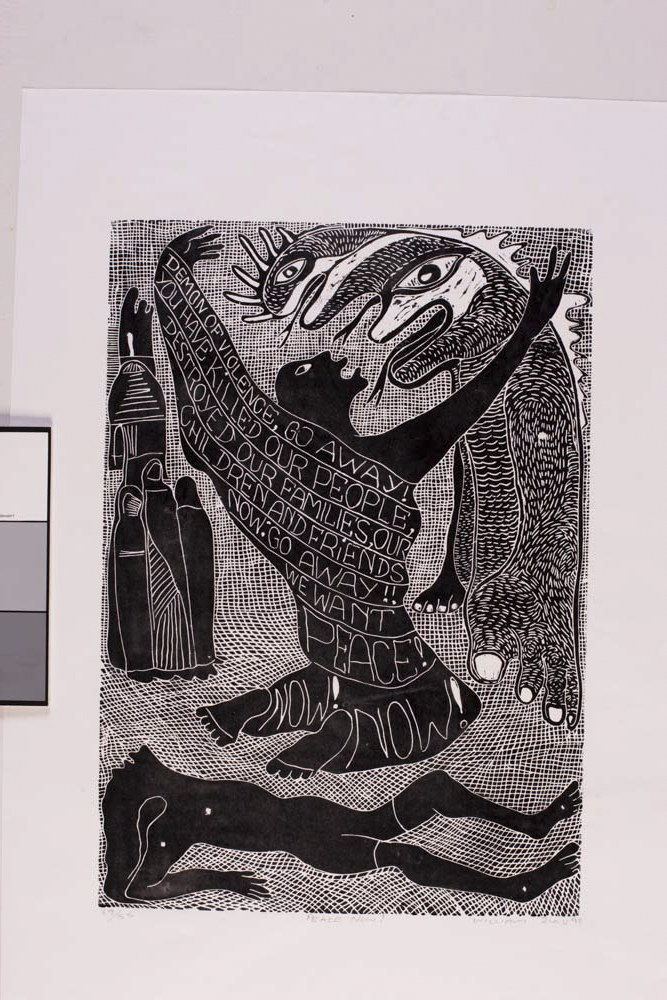
Linocut 'Peace now!', 1992 (9/55) by William Ndabenhle Zulu. Text on central figure reads 'DEMON OF VIOLENCE, GO AWAY!/ YOU HAVE KILL EDOUT PEOPLE, / DESTROYED OUR FAMILIES, OUR/ CHILDREN AND FRIENDS/ NOW: GO AWAY!!/. WE WANT/ PEACE/ NOW!'
Place
Africa; Southern Africa; South Africa; KwaZulu Natal; Rorke's Drift; Evangelical Lutheran Art and Craft Centre
Period
Source
Hobbs, Philippa Anne [collector and vendor]; Art Fund [monetary donor]; V&A Purchase Grant Fund [monetary donor]
Department
Anth
Reference Numbers
2014.230; 39/55
Cultural Affliation
Material
Paper; Pigment
Local Term
Measurements
420mm x 590mm
Events
Context (Auction / Sale)
Acquired directly from the artist by Hobbs in Emondlo, c.1997. One of the works made by Rorke's Drift artists post 1982. From an unpublished internal document, 'Comments on valuations of Rorke's Drift works in the Hobbs collection', by P. Hobbs, undated [2013].
This is a later work by this artist, which received some publicity as it was used for the poster for the touring exhibition Rorke's Drift: Empowering Prints.
See 2014.202 for this poster. From an unpublished internal document, 'PH Comments on artworks', by P. Hobbs, undated [2013].
Event Date 1997
Author: Remke van der Velden
Context (Display)
Collector Phillippa Hobbs noted that it was shown at public galleries 1997: Albany Museum, Grahamstown in the Eastern Cape Province, and Johannesburg Art Gallery.
Event Date 1997
Author: rachel hand
Context (References)
Featured in Hobbs and Rankin (2003). Rorke's Drift: Empowering Prints: Twenty Years of Print Making at the Elc Art and Craft Centre. Wetton, Cape Town: Double Storey Books, p.43 and 226.
'As we have seen in Zulu’s Peace Now!, the use of text inscribed into the print (despite the difficulty of having to carve it inverse) assures its status, and makes it apart of the design as well as the meaning of the work' (2003: 43)
Event Date 2003
Author: rachel hand
Context (Other owners)
'William Ndabenhle Zulu (1956-) was born at Nsengeni in the Vryheid district. He attended the Nsengeni Mission School. In 1968 he moved to Emondlo Township and attended the Ikhethelihle Lower Primary School where he became interested in drawing.
He also attended the Thabani Higher Primary School but was forced to leave as he had contracted TB.
After a spinal problem, which left him paralysed from the waist down, he went to the Nqutu CJM Hospital where he was discovered by an Occupational Therapist at the hospital who encouraged him to attend the ELC Art and Craft Centre, Rorke’s Drift. After spending two years in hospital, from 1974 to 1976, he went to the ELC Centre where he studied art from 1977 to 1978. He has also exhibited nationally and internationally and his work is represented in public and private collections in South Africa. In 1991 he exhibited his work at the international exhibition celebrating the unification of East and West Germany. Then in 1995 he held his first solo exhibition at the African Art Centre, Durban.
He was invited by Artists for Human Rights to contribute a linocut image to the 1996 Images of Human Rights Portfolio. He has art collections displayed at the Durban Art Gallery (South Africa), the Constitutional Court of South Africa in Johannesburg and at the MOMA (Museum of Modern Art) in the USA. At present he is working as a part-time artist and completing an autobiography entitled Spring will come.' [From http://www.sahistory.org.za/people/ndabenhle-william-zulu].
Event Date 13/8/2014
Author: Remke van der Velden
Description (Physical description)
Linocut by William Ndabenhle Zulu titled 'Peace now!', 1992. Edition: 39/55. A central kneeling figures confronts two snake like monsters with a prone figure in the foreground. Text on central figure reads 'DEMON OF VIOLENCE, GO AWAY!/ YOU HAVE KILL EDOUT PEOPLE, / DESTROYED OUR FAMILIES, OUR/ CHILDREN AND FRIENDS/ NOW: GO AWAY!!/. WE WANT/ PEACE/ NOW!' The figure's legs each incorprate the word 'NOW!'
Event Date 13/8/2014
Author: maa
Context (Acquisition Details)
The Hobbs' Rorke's Drift Collection was purchased from the collector, South African printmaker and art historian Philippa Anne Hobbs, with money from the Victoria and Albert Museum Purchase Grant Fund, The Art Fund and private donations. The collection included items received through a combination of gift and purchase.
From the early 1960s, one of the most important centres for new practice in southern Africa was the Evangelical Lutheran Art and Craft Centre, situated at the battlefield site of Rorke's Drift in what is now KwaZulu Natal. The project was led by teachers, Peder and Ulla Gowenius, graduates of the Konstfackskolan, a Bauhaus style modernist institute. They worked with patients recuperating from tuberculosis at the Ceza Hospital and saw crafts such as weaving essentially as therapeutic, but economic empowerment was also an aim, hence work was sold locally and through exhibitions in Sweden, a training programme was developed, and printmaking was introduced early in 1962. From the beginning, linocuts made by Azaria Mbatha (1941-) and Muziweyixhwala Tabethe were highly impressive; they embraced Biblical subjects, indigenous belief, and historical scenes related to Zulu identity.
In 1963 the ELC relocated to Rorke's Drift and expanded its activities. The Centre was virtually alone in providing a place during the Apartheid period in which black artists could train and produce work. In 1968 Otto and Malin Lundbohm arrived, bringing new expertise in textile screenprinting; Otto Lundbohm became principal in 1969 and led the school until 1975. Students who became major practitioners included Dan Rakgoathe (1937-), Vuminkosi Zulu (1948-1996), Charles Nkosi (1949), Tony Nkotsi (1955-), and Sam Nhlengethwa (1955-).
From the mid-1990s Philippa Hobbs collaborated with Elizabeth Rankin towards what is now the standard monograph, Rorke's Drift: Empowering Prints (2003). To facilitate her research she assembled a collection, purchasing some works from artists, and a substantial group from former principal, Otto Lundbohm, who had himself bought the prints directly from the artists. A total of 61 works fully represent the development of printmaking at Rorke's Drift. The collection includes the key early works by Mbatha and Tabete, dating from 1962, and prints by all the other significant Rorke's Drift artists. These are complemented by a further 22 prints made by Rorke's Drift artists after the centre closed in 1982; this group includes Joel Sibisi's 1994 print, Voting at Rorke's Drift, bringing the story into the post-Apartheid period. The Hobbs collection is the strongest of any private collection representing the ELC and these artists and incorporates the personal collection of a key figure, centre principal Otto Lundbohm.
The collection represents what is not only a chapter of foundational importance in South African art history, but a vital movement that exemplifies the emergence of local modernisms worldwide. With the encouragement of outside teachers, these Zulu and other artists embraced new techniques and styles and produced art that imagined a changing world and their place within it. This was an art that gave voice to visions of liberation as well as to customary belief, the local vision of history and the environment, and to the Christian theology that became and remains fundamental and empowering for many Africans today.
Event Date 13/8/2014
Author: maa
Loan (Exhibition)
On loan to Fitzwilliam Museum, Cambridge for 'Bearing Witness? Violence and Trauma on Paper' (10/1/2023 to 2/4/2023)
Event Date 10/1/2023
Author: rachel hand
FM:267824
Images (Click to view full size):