Accession No
2014.185
Description
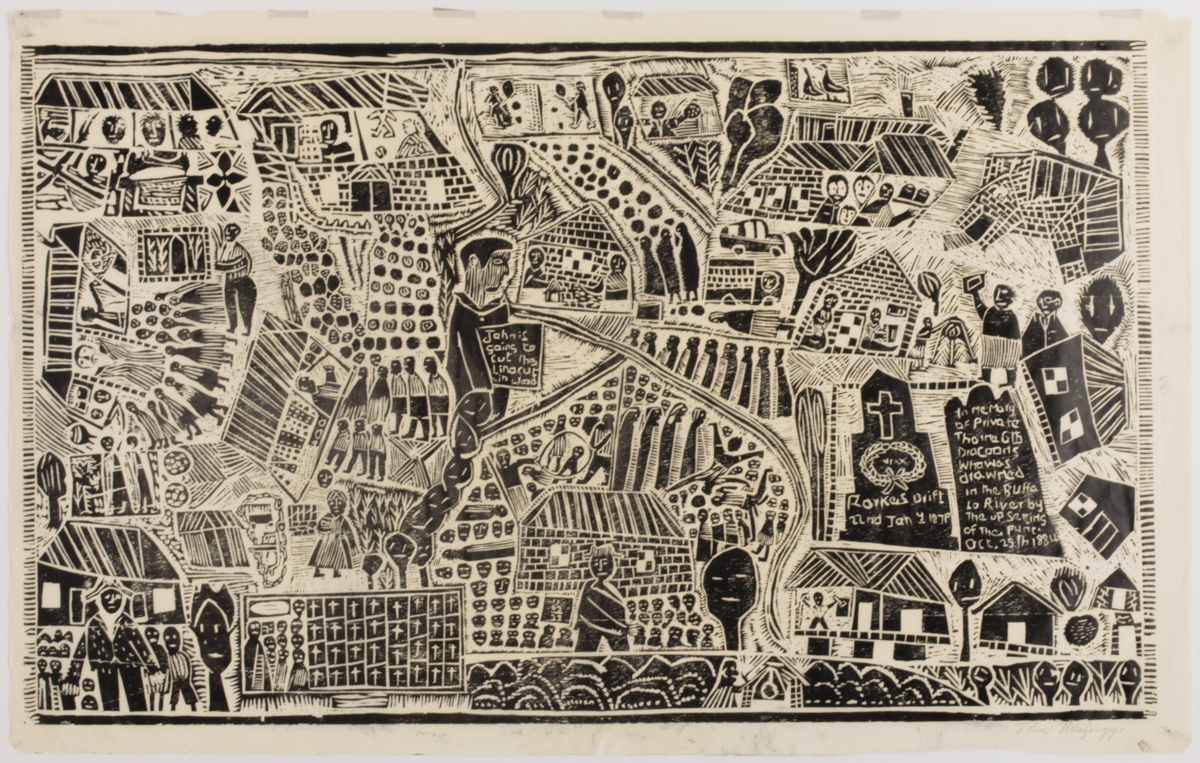
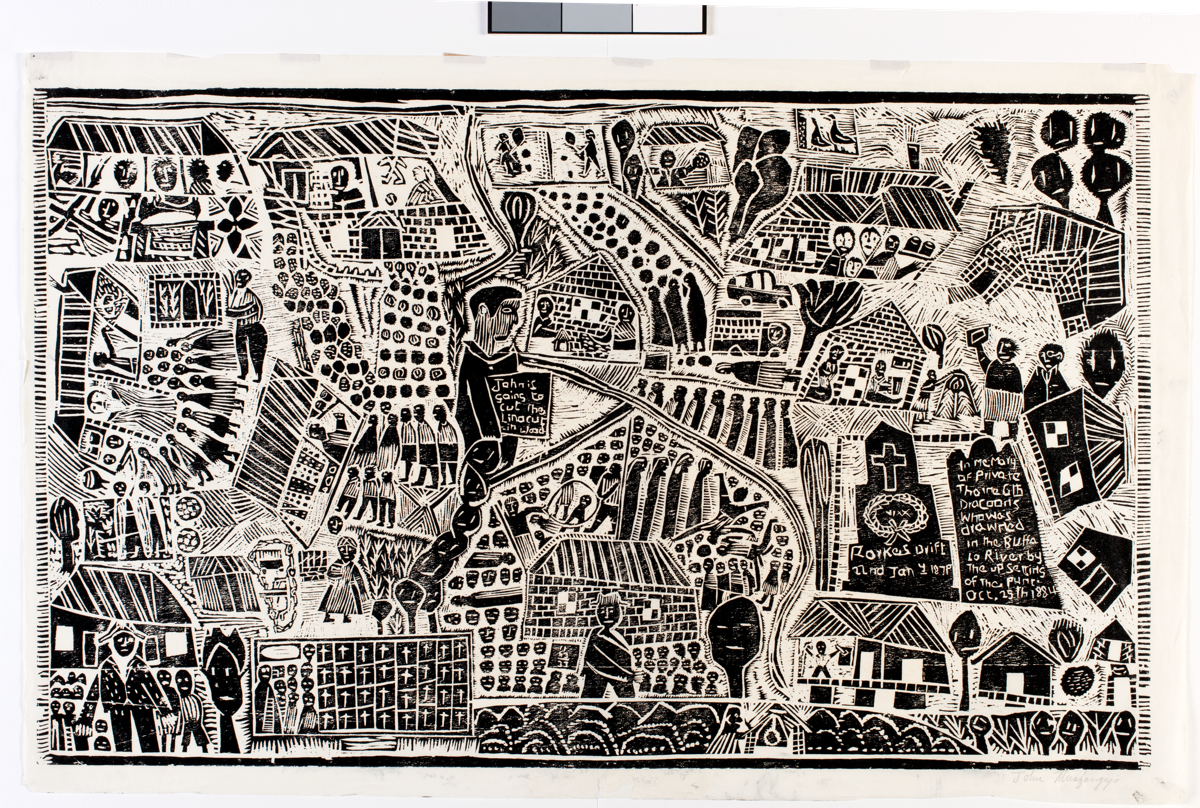
print; woodcut - Woodcut by John Muafangejo untitled ('Rorke's Drift School'), 1969. Edition: unnumbered. Signed and inscribed 'John Muafangejo'. A seminal large pictorial map of Rorke's drift. However there is a clumsy repair by the artist or his teacher, which should be professionally re-done. Tear and rip at base. Repair - piece missing. Tags/Tape across top for framing. Creased and nicked along the edge. Piece missing top right corner, tear in top right centre. Ink finger print in lower right corner and right centre. Condition: Fair.
Place
Africa; Southern Africa; South Africa; KwaZulu Natal; Rorke's Drift; Evangelical Lutheran Art and Craft Centre
Period
Source
Hobbs, Philippa Anne [collector and vendor]; Art Fund [monetary donor]; V&A Purchase Grant Fund [monetary donor]
Department
Anth
Reference Numbers
2014.185
Cultural Affliation
Material
Paper; Pigment
Local Term
Measurements
Events
Context (CMS Context)
(bio) John Muafangejo (1943-1987) is widely considered one of the most important African artists of the twentieth century. Born in Angola, he attended Anglican mission schools in Namibia, where his artistic ability was recognized. He completed a fine art certificate at Rorke's Drift over 1968-9, taught in Namibia for four years, and was again at Rorke's Drift in 1974. He produced powerful etched portraits and linocuts depicting Biblical scenes, foundational historic events such as the Battle of Rorke's Drift, evocations of black experience and work, and images of the art centre itself and its environment. Though his prints have been internationally celebrated, neither they nor Rorke's Drift artists generally are represented by more than a handful of works in any UK museum.
Muafangejo is well-represented by ten works, including the seminal print known as The Rorke's Drift School, a 1968 image of the centre in the context of the life of people around it, his powerful etched Self-portrait and Bishop, both of 1969, and a fine print of Jesus feeding his disciples, not known to the editors of the 1992 Muafangejo catalogue raisonné. The collection also includes iconic prints by Charles Nkosi and Dan Rakgoathe exemplifying the development of black consciousness and politics in the 1970s.
Event Date 21/7/2014
Author: Remke van der Velden
Context (CMS Context)
Acquired by Hobbs from Otto Lundbohm, in Hamburgsund, Sweden, 2006. Acquired by Lundbohm at Rorke's Drift 1969- 1975. Published in Orde Levinson catalogue Raisonne 'I was lonleyness: The complete graphic works of John Muafangejo', 1992. From an unpublished internal document, 'Comments on valuations of Rorke's Drift works in the Hobbs collection', by P. Hobbs, undated [2013]. Only a few copies are known to have survived. Levinson states that there are only two known prints. Since he wrote this a third (uninscribed) has appeared in the ELC collection when this cache of prints was discovered in 2000. The Hobbs copy would be a fourth. This is a very large woodcut – perhaps Muafangejo’s largest ever made and certainly exceptional in his Rorke’s Drift period. It is a pictorial map of the Rorke’s Drift school, so
historically important. Through discussions with former teachers Hobbs has been able to identify the studio activities and even some individuals in the image. From an unpublished internal document, ‘PH Comments on artworks', by P. Hobbs, undated [2013].
Event Date 21/7/2014
Author: Remke van der Velden
Context (CMS Context)
The Hobbs' Rorke's Drift Collection was purchased from the collector, South African printmaker and art historian Philippa Anne Hobbs, with money from the Victoria and Albert Museum Purchase Grant Fund, The Art Fund and private donations. The collection included items received through a combination of gift and purchase.
From the early 1960s, one of the most important centres for new practice in southern Africa was the Evangelical Lutheran Art and Craft Centre, situated at the battlefield site of Rorke's Drift in what is now KwaZulu Natal. The project was led by teachers, Peder and Ulla Gowenius, graduates of the Konstfackskolan, a Bauhaus style modernist institute. They worked with patients recuperating from tuberculosis at the Ceza Hospital and saw crafts such as weaving essentially as therapeutic, but economic empowerment was also an aim, hence work was sold locally and through exhibitions in Sweden, a training programme was developed, and printmaking was introduced early in 1962. From the beginning, linocuts made by Azaria Mbatha (1941-) and Muziweyixhwala Tabethe were highly impressive; they embraced Biblical subjects, indigenous belief, and historical scenes related to Zulu identity.
In 1963 the ELC relocated to Rorke's Drift and expanded its activities. The Centre was virtually alone in providing a place during the Apartheid period in which black artists could train and produce work. In 1968 Otto and Malin Lundbohm arrived, bringing new expertise in textile screenprinting; Otto Lundbohm became principal in 1969 and led the school until 1975. Students who became major practitioners included Dan Rakgoathe (1937-), Vuminkosi Zulu (1948-1996), Charles Nkosi (1949), Tony Nkotsi (1955-), and Sam Nhlengethwa (1955-).
From the mid-1990s Philippa Hobbs collaborated with Elizabeth Rankin towards what is now the standard monograph, Rorke's Drift: Empowering Prints (2003). To facilitate her research she assembled a collection, purchasing some works from artists, and a substantial group from former principal, Otto Lundbohm, who had himself bought the prints directly from the artists. A total of 61 works fully represent the development of printmaking at Rorke's Drift. The collection includes the key early works by Mbatha and Tabete, dating from 1962, and prints by all the other significant Rorke's Drift artists .These are complemented by a further 22 prints made by Rorke's Drift artists after the centre closed in 1982; this group includes Joel Sibisi's 1994 print, Voting at Rorke's Drift, bringing the story into the post-Apartheid period. The Hobbs collection is the strongest of any private collection representing the ELC and these artists and incorporates the personal collection of a key figure, centre principal Otto Lundbohm.
The collection represents what is not only a chapter of foundational importance in South African art history, but a vital movement that exemplifies the emergence of local modernisms worldwide. With the encouragement of outside teachers, these Zulu and other artists embraced new techniques and styles and produced art that imagined a changing world and their place within it. This was an art that gave voice to visions of liberation as well as to customary belief, the local vision of history and the environment, and to the Christian theology that became and remains fundamental and empowering for many Africans today.
Event Date 21/7/2014
Author: maa
Description (CMS Description)
Woodcut by John Muafangejo untitled ('Rorke's Drift School'), 1969. Edition: unnumbered. Signed and inscribed 'John Muafangejo'. A seminal large pictorial map of Rorke's drift. However there is a clumsy repair by the artist or his teacher, which should be professionally re-done. Tear and rip at base. Repair - piece missing. Tags/Tape across top for framing. Creased and nicked along the edge. Piece missing top right corner, tear in top right centre. Ink finger print in lower right corner and right centre. Condition: Fair.
Event Date 21/7/2014
Author: maa
Context (CMS Context)
Displayed under the title of 'Art Centre at Rorke's Drift' in 'The Power of Paper' exhibition.
Event Date 10/12/2015
Author: Remke van der Velden
Context (CMS Context)
Exhibited: The Power of Paper, Li Ka Shing Gallery, MAA, 14 February - 6 December 2015.
Event Date 20/2/2015
Author: Eleanor Wilkinson
FM:267757
Images (Click to view full size):