Accession No
2014.237
Description
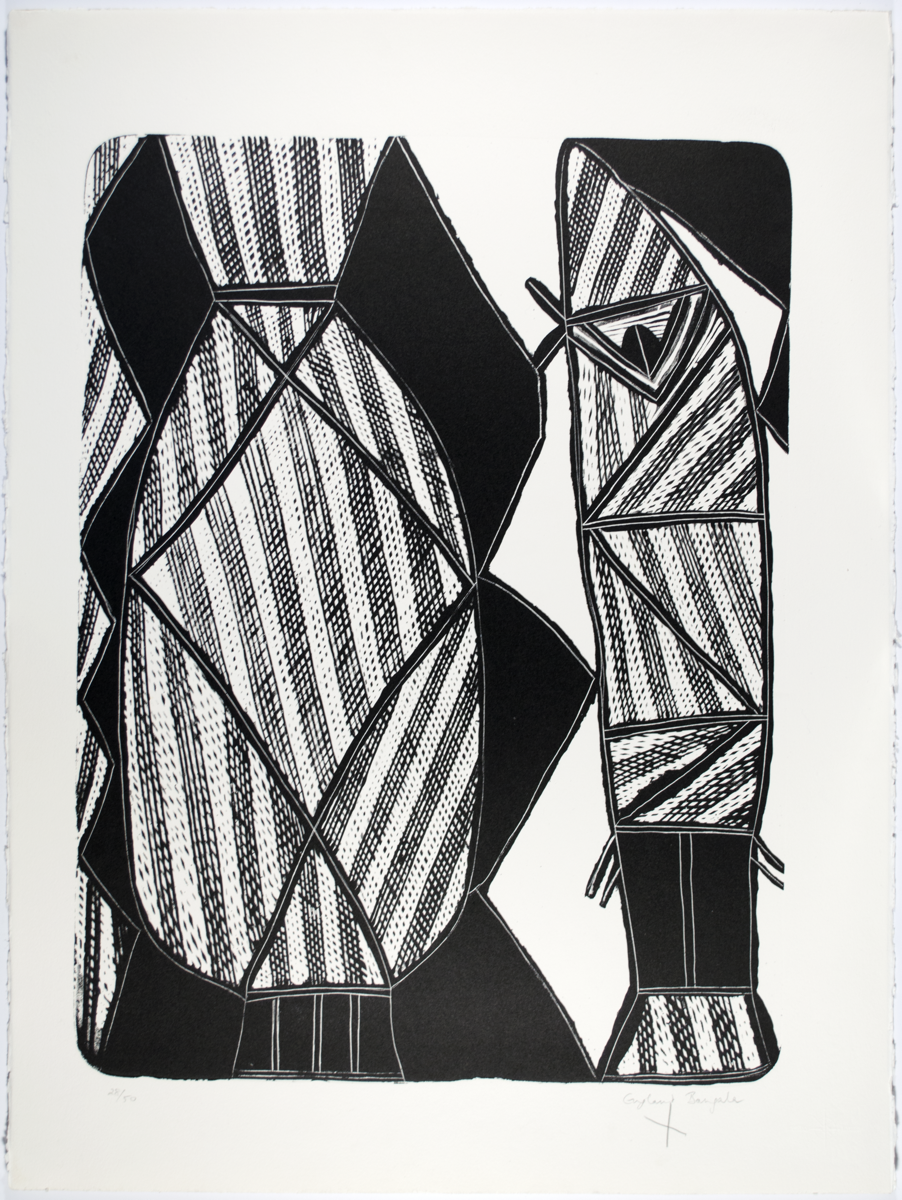
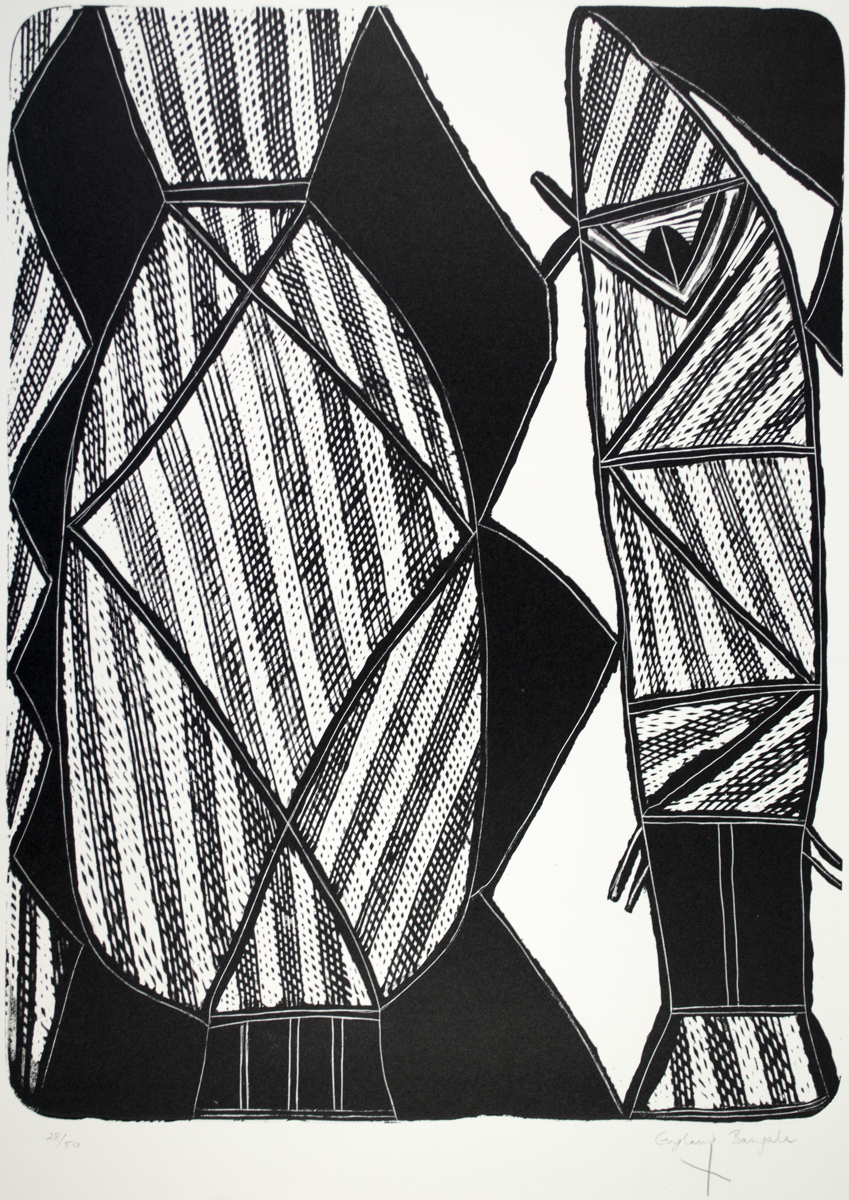
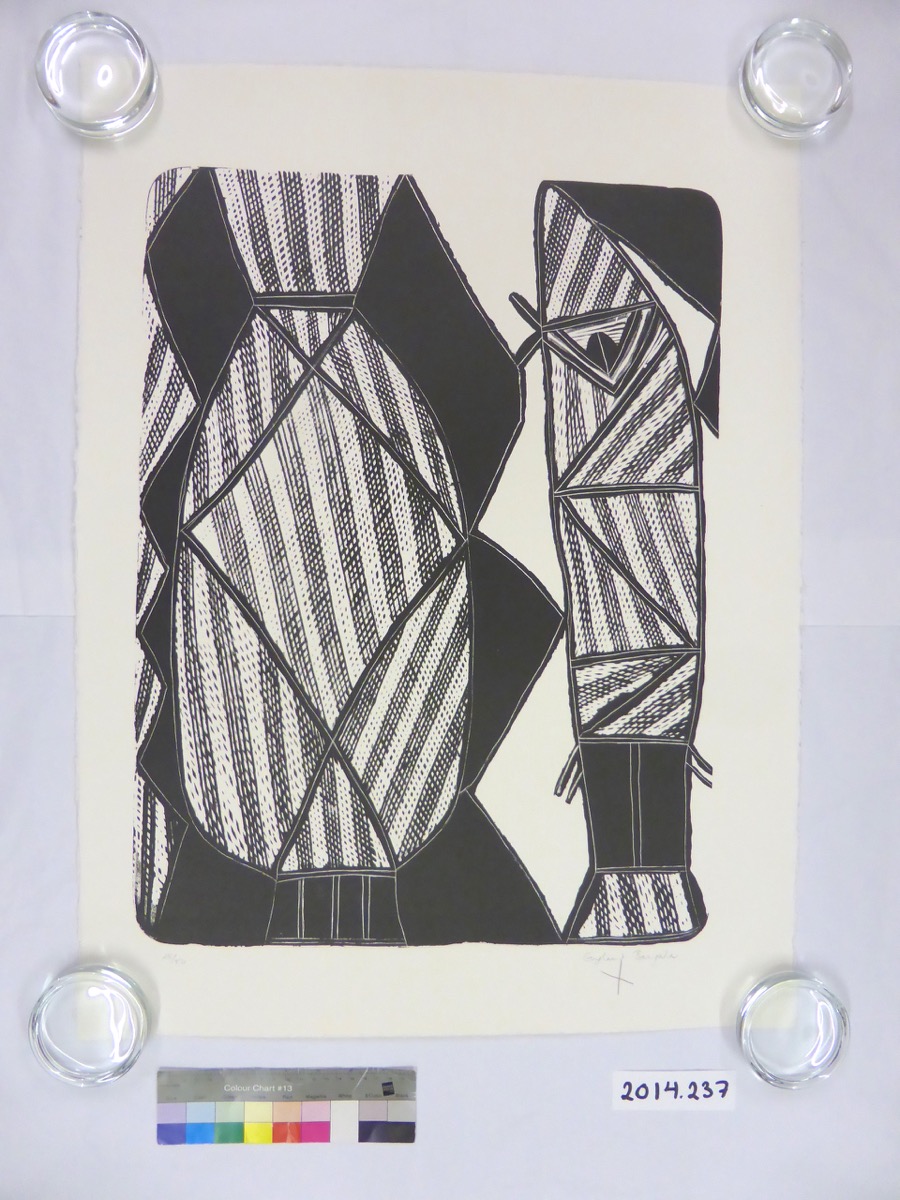
Lithograph by England Banggala, titled 'Rajarra and Wulakarra - Barramundi & Conical Fish Trap', 1999. Unnumbered- edition size 50
Place
Oceania; Australasia; Australia; Northern Territory; Arnhem Land
Period
Source
Australian Art Print Network [vendor]; Art Fund [monetary donor]; Esmée Fairbairn Foundation [monetary donor]
Department
Anth
Reference Numbers
2014.237; EB003 (AAPN id )
Cultural Affliation
Rembarrnga
Material
Paper; Pigment
Local Term
Measurements
Events
Context (CMS Context)
Artist's biography notes Banggala (b c.1925- 2001) was active from 1974: 'Aboriginal artist England Banggala's paintings and fine art prints reflect his important status within the prodigious traditional ceremonial program in which he is involved.
His pictorial style combines elements of the west and central Arnhem Land traditions. The organic forms he represents in his work often depict the elements of Gunardba women travelling across the land, creating sacred sites, law and language for the Gunardba people. These elements now reside in spirit form at sites specific to the An-ngulin clan.
A strong vigorous flow and graphic boldness is characterised in England Banggala's paintings and limited edition prints . The cross hatching is found within the figures and the schematic motifs of his work rather than in the background, as is more common to the Aboriginal art of Arnhem Land. The broad areas of colour, dotted subdivisions and plain background reflect England Banggala's association with the Rembarrnga.
Rembarrnga Aboriginal art is not easily classifiable because most artists of this group paint in distinctly individual and different ways. The most likely reason for this divergence is geographical. The Rembarrnga speaking people own land over a vast area of south- estern and south-central Arnhem Land, some of it inaccessible and therefore isolated. This has caused each small group to develop their particular traditions somewhat differently. The art of the group as a whole shares common themes of water and stone country and spirit figures.
Banggala is a versatile artist who has also ventured successfully into lithography and other forms of European printmaking. As printmaker Theo Tremblay says of England Banggala: "He has an innate graphic ability, a natural response and feeling for composition. A wholistic approach where the background - a song, air, earth has as much to do with the image as what flows in it." England Bangala passed way in 2001.
...
[Themes included] Ceremonial designs, designs associated with sites on clan lands, including jin-gubardabiya pandanus skirt and related dilly bag and mermaid designs, and ji-japum the snake creator being. Designs associated with the clan waterhole, mermaids and mermaid sites, the banaka digging stick', birlimurra 'leech' and burichparr 'weeping paperbark' and lorrkon 'hollow log coffin'. Other topics include the marrchila 'estuarine crocodile', rajarra 'barramundi' and the wulakarra 'conical fishtrap'. ' Taken from http://www.aboriginalartprints.com.au/indigenous_artists_details.php?artist_id=7
Event Date 7/3/2014
Author: Rachel Hand
Context (CMS Context)
Presented by The Art Fund and the Esmée Fairbairn Foundation. An acquisition project to build a collection of modern and contemporary work on paper from Australia, Canada and South Africa was undertaken over 2011-13 with the support of a grant under The Art Fund's RENEW programme. The collection was developed with the expert advice and generous assistance of Annie Coombes and Norman Vorano in relation to South African and Inuit artists respectively. Khadija Carroll, Anita Herle and Diana Wood Conroy also contributed to the selection process. Obtained from The Australian Art Print Network (Sydney Gallery, 68 Oxford St, Darlinghurst, NSW 2010, Australia).
The story behind the image is described as 'The designs senior Arnhem Land artist England Banggala depict belong to the country that lies near the outstation known as Gochan Jiny-jirra. Here lies a network of creeks and billabongs which during the dry season are a rich hunting area, especially for barramundi.
The fish are caught, in large numbers, in fishtraps woven from pandanus or sedge grass. The barramundi are also hunted with spears and lures in billabongs and streams where they shelter from the sun under fallen logs. This lithograph depicts a 'rajarra' barramundi together with a conical fish trap. Information sourced from Maningrida Arts and Culture.' Taken from http://www.aboriginalartprints.com.au/works_enlargement.php?work_id=414
Event Date 7/3/2014
Author: maa
Description (CMS Description)
Lithograph by England Banggala, titled 'Rajarra and Wulakarra - Barramundi & Conical Fish Trap', 1999. Unnumbered- edition size 50. Printed on BFK Rives paper. Condition: excellent
Event Date 7/3/2014
Author: maa
FM:267549
Images (Click to view full size):