Accession No
2014.233
Description
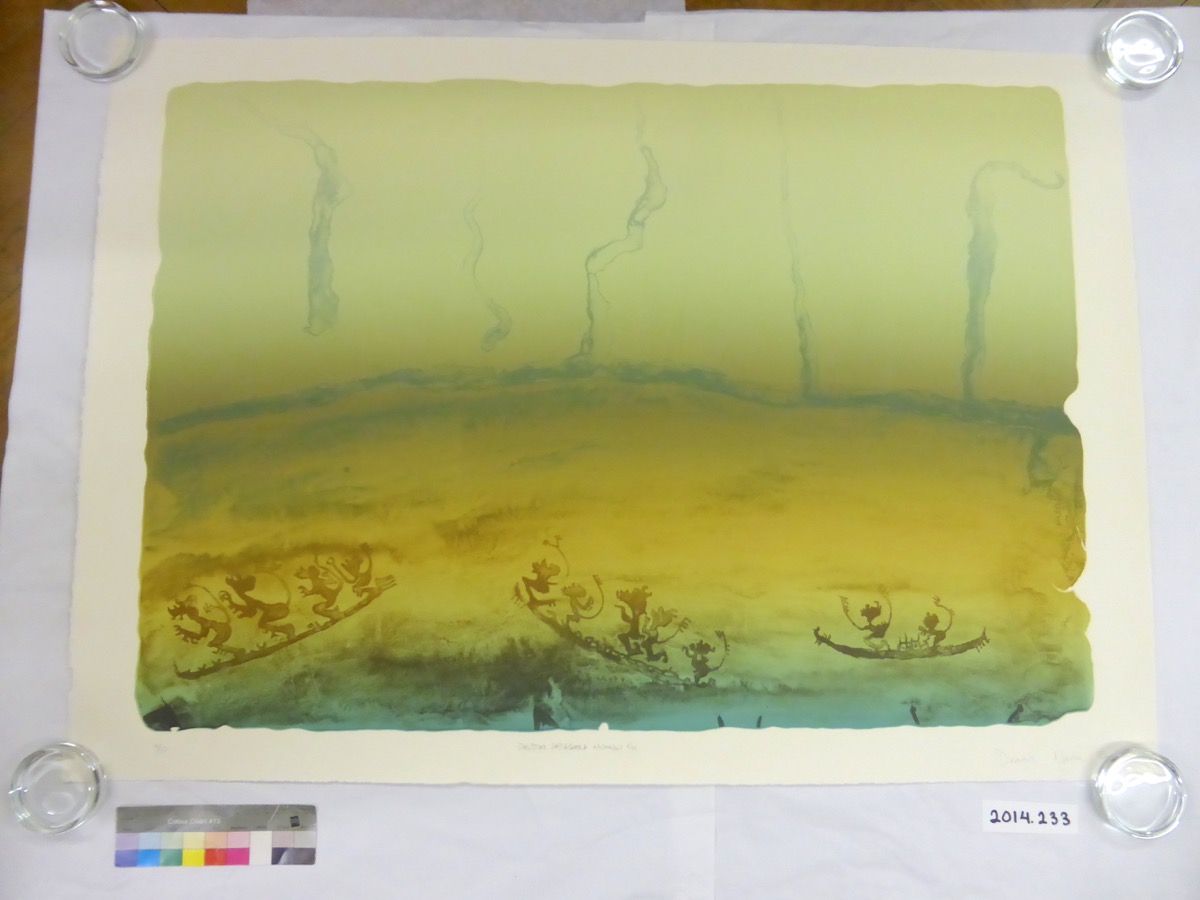
Lithograph by Dennis Nona titled 'Daudai Dadagara Muingu Tu', 2012. Unnumbered- edition size 10.
Place
Oceania; Australasia; Australia; Torres Strait
Period
Source
Australian Art Print Network [vendor]; Art Fund [monetary donor]; Esmée Fairbairn Foundation [monetary donor]
Department
Anth
Reference Numbers
2014.233; DN207 (AAPN id:)
Cultural Affliation
Torres Strait Islander
Material
Paper; Pigment
Local Term
Measurements
Events
Context (CMS Context)
Nona's biography on the Australian Art Print Network notes 'Dennis Nona is widely acknowledged as one the most important Torres Strait Islander artists.
Born on Badu Island in 1973 he was taught as a young boy the traditional craft of woodcarving. This skill has been developed and translated into the incredibly intricate and beautiful linocuts, etchings and sculptures created by the artist since the commencement of his art practice in 1989.
The artist holds a Diploma of Art from Cairns TAFE, a Diploma of Visual Arts in Printmaking from the Institution of Arts, Australian National University, Canberra and is currently completing a Master of Arts degree in Visual Arts at Queensland College of Art, Griffith University, Brisbane.
His work can be seen in the collections of most of the major Australian art institutions and in several important overseas collections. These include the National Gallery of Australia; Queensland Art Gallery; National Gallery of Victoria; Art Gallery of New South Wales, Art Gallery of South Australia; Museum of Contemporary Art, Sydney; Victoria and Albert Museum, London; Cambridge University Museum UK and the Museum of American Indian Arts, USA.
Nona pioneered the development of the highly intricate linocut prints unique to the Torres Strait Islands. He has documented, in a vivid visual form, the ancient myths and legends of his island and the wider Torres Strait that had previously been transmitted by oral story telling and dance.
He uses a more graphic way of storytelling. Instead of a work based on a single image like that of the traditional Torres Strait Islander art, he introduced many, following what was being done by mainland Aboriginal artists. In this way he could relate an entire narrative in one single work with all the characters and events in one image. To link the work he introduced a matrix of delicately lined clan patterning, so binding the entire story to its place of origin. Since this breakthrough, the intricate designs and bold figurative imagery created by printmakers like Nona, have given local culture a vital reinvigoration. Today they are central to a cultural revival and elders now refer to them to help them to relate ancient stories to others. These were fast fading from common knowledge and being lost to new generations of Islanders suffering the cultural dislocation often imposed by the impact European settlement and influence.
Within Nona's work there is a celebration of island myths and legends, of how humans, animals, plants and landscape took their meaning from epic or magical events in the past. It was a culture where fighting was glorified and warriors were held in high esteem. Legendary heroes wore distinctive local headdress and masks. They played drums and used objects associated with their ritual ceremonies and dances. It was a culture of head hunters, cannibalism and raiding parties that attacked homes built in tree tops. It was a society where men, women, sorcerers and witches came to their final grief by being transformed into sea creatures or cast into the sea to become the islands and rocky outcrops evident throughout the Western Torres Strait Islands today.
The attraction of Nona's work lies in the way he has drawn on the rich traditions of Torres Strait Islander carving which he has transferred to linocut and more recently etchings and sculpture. Far more flexible in their visual reference and expressive means than that of traditional work from the Torres Strait Islands, his works are highly skilled compositions. Each work expresses a powerful materiality that comes from exquisitely crafted hand-made surfaces, a complex of finely chiselled hand made lines which are then coloured before printing.
Curator of Australian Prints at the National Gallery of Australia, Roger Butler, says that Nona's work represents a trend by artists to explore the physicality of the print making process instead of just the instant art making of digital processes: He comments: "He (Nona) sits there with a lot of lino and with a very sharp little chisel and cuts out those incredibly detailed little lines and gouge marks... That's really taking it back to the processes of (German Renaissance artist) Albrecht Durer, a simple technique that makes VERY complex images."
... Denis's linocuts, etchings and sculptures derive from his wood-carving experiences on Badu Island. He is inspired by coastal life, family, traditional medicines and the myths and legends of the Torres Strait. Details taken from http://www.aboriginalartprints.com.au/indigenous_artists_details.php?artist_id=102#artist_story
Event Date 7/3/2014
Author: Rachel Hand
Context (CMS Context)
Presented by The Art Fund and the Esmée Fairbairn Foundation. An acquisition project to build a collection of modern and contemporary work on paper from Australia, Canada and South Africa was undertaken over 2011-13 with the support of a grant under The Art Fund's RENEW programme. The collection was developed with the expert advice and generous assistance of Annie Coombes and Norman Vorano in relation to South African and Inuit artists respectively. Khadija Carroll, Anita Herle and Diana Wood Conroy also contributed to the selection process. Obtained from The Australian Art Print Network (Sydney Gallery, 68 Oxford St, Darlinghurst, NSW 2010, Australia).
Dennis Nona writes 'This print is about the important and long tradition of trading between Torres Strait Islanders and their Papuan New Guinea neighbours to the north.
The words in the title of the print are taken from a traditional song about what is depicted in the print.
Columns of smoke are seen rising from the villages along the PNG coastline. These were an aid to navigation and when the smoke combined with certain atmospheric conditions it caused a misty fog that was often observed when approaching the PNG mainland. This phenomenon is reflected in the soft tonal qualities of the print.
The Torres Strait islanders traded Kuik (skulls), Mai (pearl shell) and Kuls (stone) mainly for canoe hulls, which could not be sourced on the islands.
On the left of the print is a canoe is seen heading back to the islands and on the right two canoes approaching the PNG coastline.
Tips of canoe paddles are seen at the very bottom on the print.
The yellow and brown depict the silt carried down by the huge PNG rivers that colours the waters of the coastline. This fades into blue reflecting the clear waters further out to sea.' Details taken from http://www.aboriginalartprints.com.au/works_enlargement.php?work_id=1070
Event Date 7/3/2014
Author: maa
Description (CMS Description)
Lithograph by Dennis Nona titled 'Daudai Dadagara Muingu Tu', 2012. Unnumbered- edition size 10. Printed on Arches Velin paper. Condition: excellent
Event Date 7/3/2014
Author: maa
FM:267545
Images (Click to view full size):