Accession No
2005.82
Description
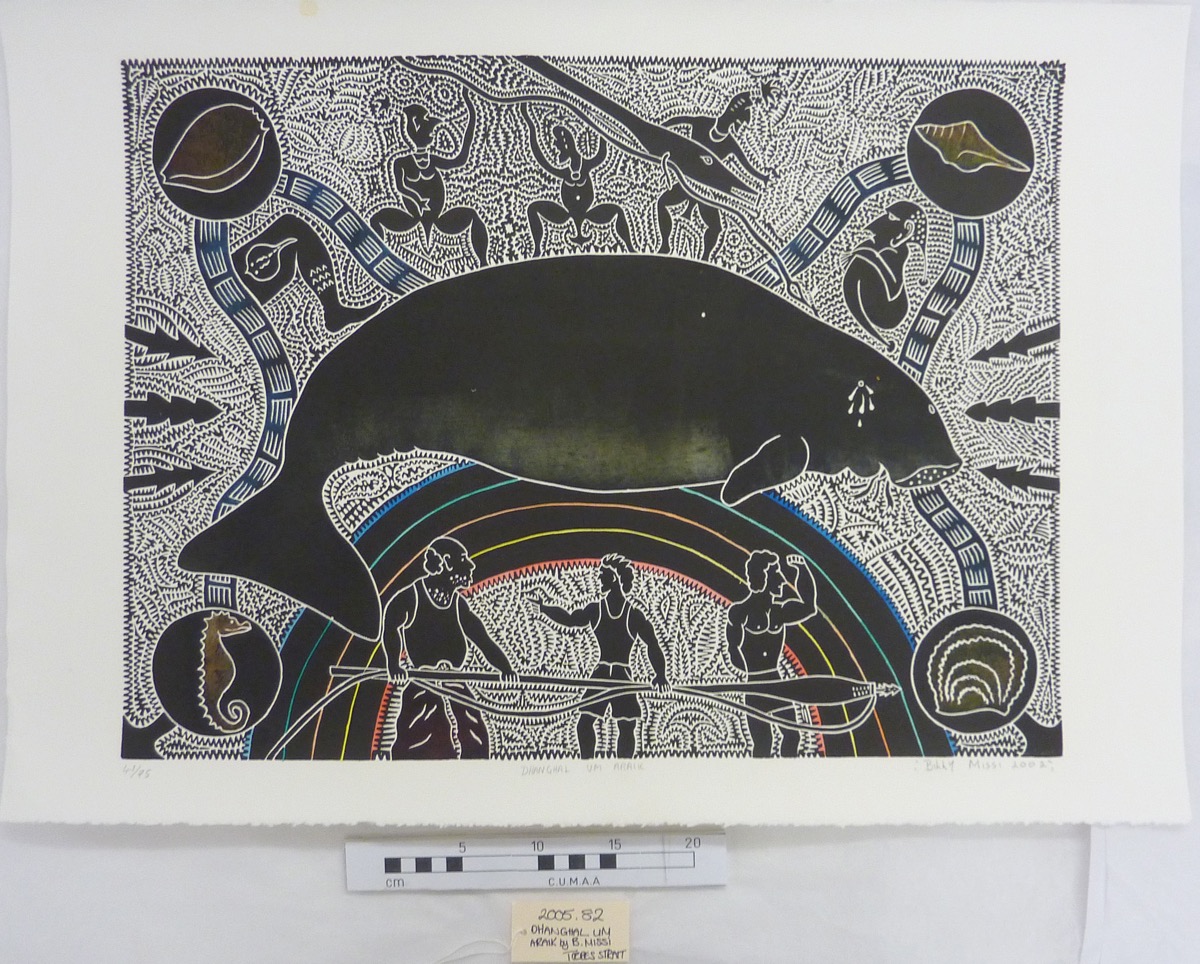
Linocut print by Billy Missi [alt. Missy] entitled DHANGMAL UM ARAIK. Limited edition 41/75, 2002. Missi reflects on his concern about dugong hunting practises in the Torres Strait. Sea grass pastures were used by their forefathers to hunt only for special occasions such as initiation, or for health and healing purposes. Today, these sacred creatures are under threat of extinction from over hunting and environmental factors
Place
Oceania; Melanesia; Australia; Torres Strait; Mua Island; Moa Island; Kubin
Period
early 21st century
Source
Missi, Billy [artist and vendor]; Herle, Anita (Professor) [field collector]; Crowther-Beynon Grant [monetary donor]
Department
Anth
Reference Numbers
2005.82
Cultural Affliation
Torres Strait Islander
Material
Pigment; Paper
Local Term
Measurements
527mm x 764mm
Events
Context (References)
“This print was highly commended at the Fifth national Heritage Art Awards held in Canberra in 2000. To accompany each entry the artists were asked to write about the heritage influence of their work.
Event Date 2000
Author: rachel hand
Context (References)
Alfonso, C. & Kershaw, M. (2001) 'Gelam Nguzu Kazi - Dugong My Son'. Mua Island: Torres Strait via Thursday Island. The Australian Art Print Network, pp.53-54.
Event Date 2001
Author: Guey-Mei Hsu
Context (References)
The first exhibition of limited edition linocuts by the artists of the Mualgau Minaral Artist Collective from Mua Island in the Torres Strait. Organised for the Kubin Community Council by The Australian Art Print Network. Catalogue entry 32 will illustration, pp. 53-4.)
Event Date 2001
Author: rachel hand
Context (Analysis)
Artist Billy Missi’ statement reads, 'The purpose of creating this picture is to show my concern about present dugong hunting practises in the Torres Strait. This is due to the fact that this region also has the most extensive sea grass beds in the world. In the past, these areas were used by our forefathers to hunt only for special occasions such as initiation, or for health and healing purposes. Nowadays, I feel these wonderful and sacred creatures are under threat of extinction from over hunting as well as environmental factors, with the destruction of their environment. The symbols in the corners represent resources commonly found in these dugong feeding grounds.
The ancestral beings at the top are traditional hunters. The figure with these hunters represents the reason hunting was performed, for the sick and during initiation ceremonies. The six darts pointing towards the dugong, from either side represent the over-hunting of the dugong. The hunter on the right is searching in vain for the creature. The central figure depicts a yonger generation of hunters confusingly asking older hunters why there are no dugongs to be found. Interweaving pathways represent dugongs travelling to various feeding grounds in the area. Unending arrows, in the bottom corners, show the uncertain future of dugong sustainability. The rainbow means peace for dugong as they swim freely somewhere else.' (See 'References').
Event Date 2002
Author: rachel hand
Context (Acquisition Details)
Purchased by Anita Herle in 2002 from the artist at the Mualgau Minaral art workshop at Kubin, but not received by the Museum until 2005.
Event Date 19/2/2013
Author: maa
Description (Physical description)
Lino-cut print entitled DHANGMAL UM ARAIK. Limited edition 41/75 with signature artist Billy Missu. Central profile figure of a dugong with tears coming from its eye, surrounded by hunters. 4 circular motifs containing sea shells and a sea-horse at each corner. Excellent condition. See artist’s statement in notes.
Event Date 19/2/2013
Author: maa
FM:266778
Images (Click to view full size):