Accession No
2008.18
Description
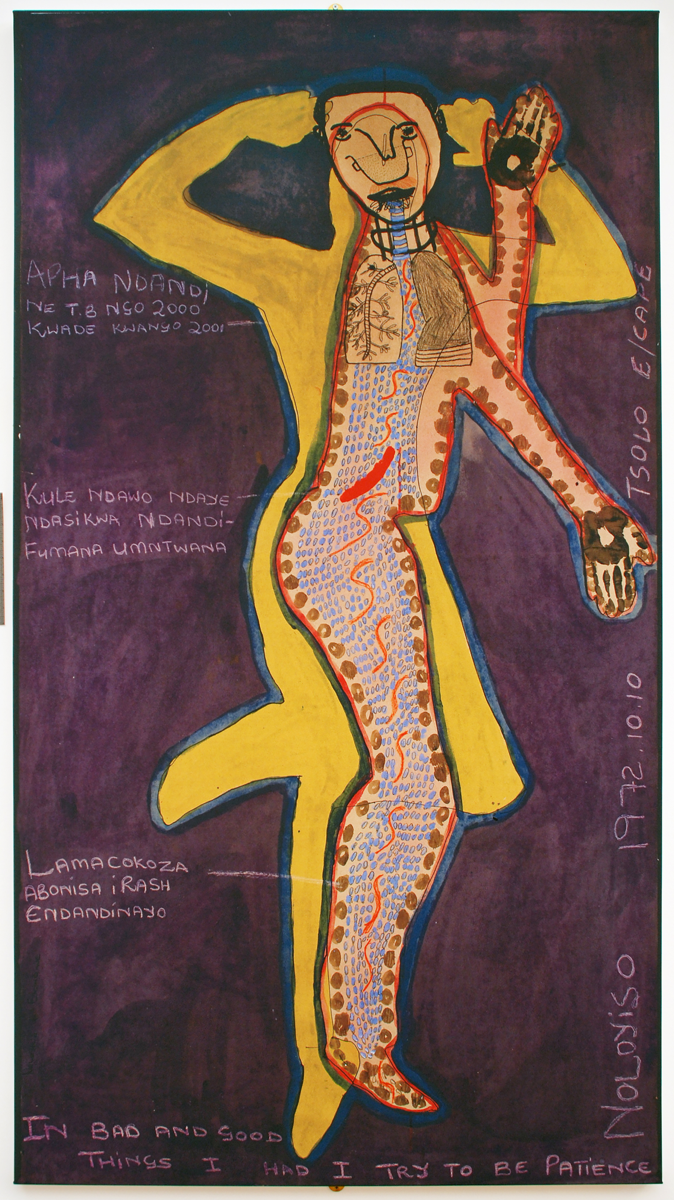
Print of the original acrylic body map by Noloyiso Balintulo, 2003. The life-size outlines of the artist's body is filled with colourful depictions of the effects of the HIV virus on her life.
Place
Africa; Southern Africa; South Africa; Cape Town; Cape Flats; Khayelitsha
Period
early 21st century
Source
Bambanani Woman’s Group [vendor]
Department
Anth
Reference Numbers
2008.18
Cultural Affliation
Material
Canvas; wood; ink
Local Term
Measurements
990mm x 1800mm
Events
Context (Field collection)
Customised print commissioned by MAA from Noloyiso Balintulo's original acrylic painting, 2003.
The Bambanani Women’s Group formed in 2002 to participate in the creation of memory books and boxes aimed to help people come to terms with their diagnosis, to disclose their HIV - status to their families and children and to begin the planning for the future. The group went on to work on the Longlife Project which created 'body maps', life-size outlines of the artists' bodies filled with colourful depictions of the effects of the HIV virus on their life
The Longlife Project recorded the life stories of the women who were participating in a Medésins Sans Frontières (MSF) pilot antiretroviral programme and raised awareness and campaigned for antiretroviral treatment to be made available in the South African public healthcare sector. The Longlife Project marked a shift from ‘preparing for death’ with the creation of memory boxes to ‘fighting for life’ as antiretroviral therapy was made available in public clinics and hospitals in late 2003.
The body maps published in the book Longlife: Positive HIV Stories together with interviews of people working on the project and limited edition fine art prints of the original body maps were exhibited locally and internationally at conferences, fundraising events and in art galleries.
After the Longlife Project the Bambanani Women’s group went on to be trained as field researchers and worked on surveys conducted by the Centre for Social Science Research at University of Cape Town. Some members of the group have continued to do Memory Book and Body Map workshops and presentations for organisations such as VSO, Tateni Home Based Care, Red Cross, Médecins Sans Frontières and medical students at the University of Cape Town.
Event Date 2003
Author: rachel hand
Context (References)
Jonathan Morgan & Bambanani Women's Group (2003).Longlife: Positive HIV Stories. Cape Town: Double Storey Press, p. 62-93
Event Date 2003
Author: rachel hand
Description (Physical description)
Print of the original acrylic body map by Noloyiso Balintulo, 2003.
Event Date 16/12/2009
Author: maa
Context (Production / use)
Noloyiso says, 'I grew up in Tsolo. There is no treatment there. There were three children when I grew up but my mother told me there were ten. Seven died. In those days it was not AIDS that was killing people and children, just other diseases.
I met my boyfriend Babs in the street. He was a good looking guy and his height was longer and his body was thin like me. He asked me to be his girlfriend and I agreed because I did like him.
That year in standard nine, in 1989, I fell pregnant and I had to leave school to have the baby. This was the same year when my boyfriend died. He also never knew about the baby. I did not notice that I was pregnant before he died. I do have boyfriends on and off but it is him I miss.
I show lungs on my painting because it's when I was tested for TB. In my painting the black one is full of water but one is clear from treatment.
My story is similar to the other women in this book. Get pregnant young, don't finish school, find out we are positive, lucky to find work, like that.
These big dots on my painting represent the rash that I had. These small dots, the blue ones and these red lines, represent how is HIV in me.
HIV, it's like one word but lots of sickness. I represent HIV like a storm. If a storm comes there is heavy rain, thunder, storms, lightning and wind. I represent HIV like that. I did have rash, thrush, falling of hair, coughing and headaches.
About the pot symbol on my painting. I like to cook. In that pot is the food, the veg, the green, me and healthy food. I want to dish for everyone who want food. And fire represents me. The way I like people and I have that warmth in my body. My symbol of power I put in my head because the first thing I must do is think, before I do anything.'
Details taken from http://www.memorybox.co.za/index.php?option=com_content&task=view&id=28&Itemid=40. Accessed 5/2/2013
Event Date 16/12/2009
Author: maa
Context (Display)
Exhibited in Assembling Bodies: Art Science & Imagination, MAA, March 2009- November 2010,with the following details, 'I show lungs on my painting because it's when I was tested for TB. I had to eat my tablets for six months the black [lung] is full of water but one is clear from treatment. The big dots represent the rash that I had. These small dots the blue ones and these red lines represent how HIV is in me. HIV s like one word but lots of sickness. The blue dots represent the thrush that comes all the way from my throat. Small red lines is the way I feel my body pains and the big red one is the mark where I have a caesarean for my baby (Noloyiso 2003).'
Event Date 7/3/2010
Author: Rachel Hand
Description (Physical description)
Digital print from a body map painting by Noloyiso Balintulo, 2003, of the outline of a body with writing around it, purple background. Printed on canvas, stretched and framed.
Event Date 30/4/2025
Author: Rachel Hand
Conservation (Assessment Only)
CON.2025.6185 | Assessment Only
Event Date 30/4/2025
Author: Stephanie De Roemer
FM:265792
Images (Click to view full size):