Accession No
2001.21
Description
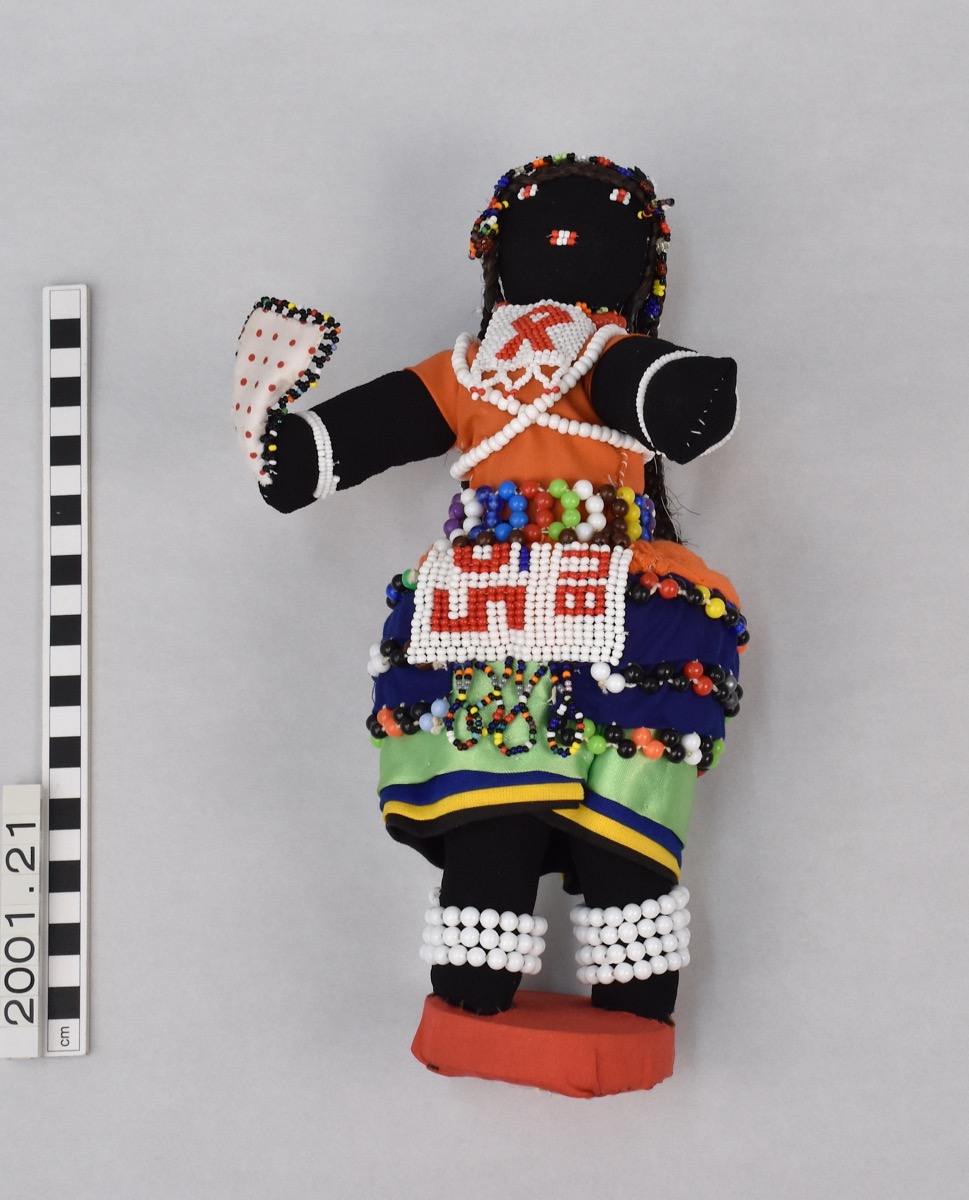
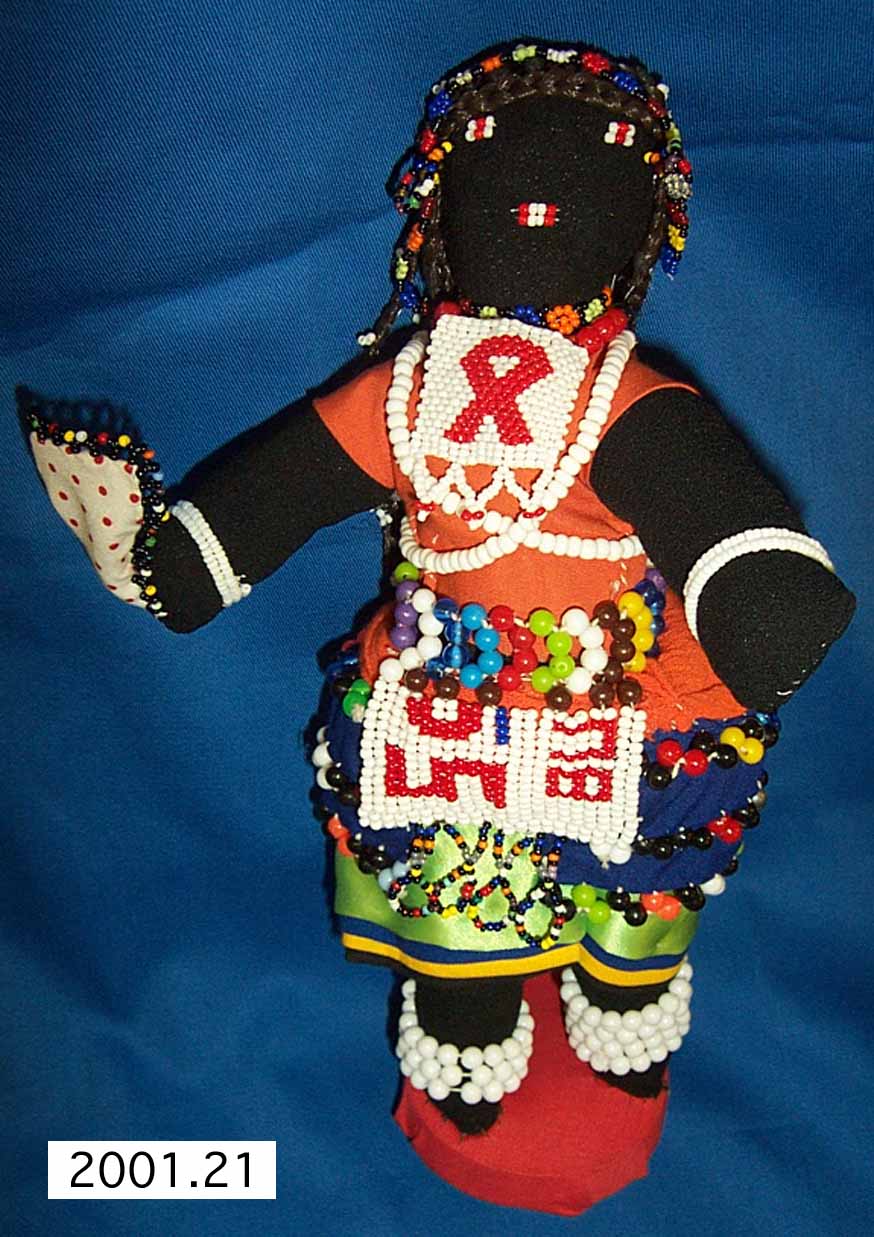
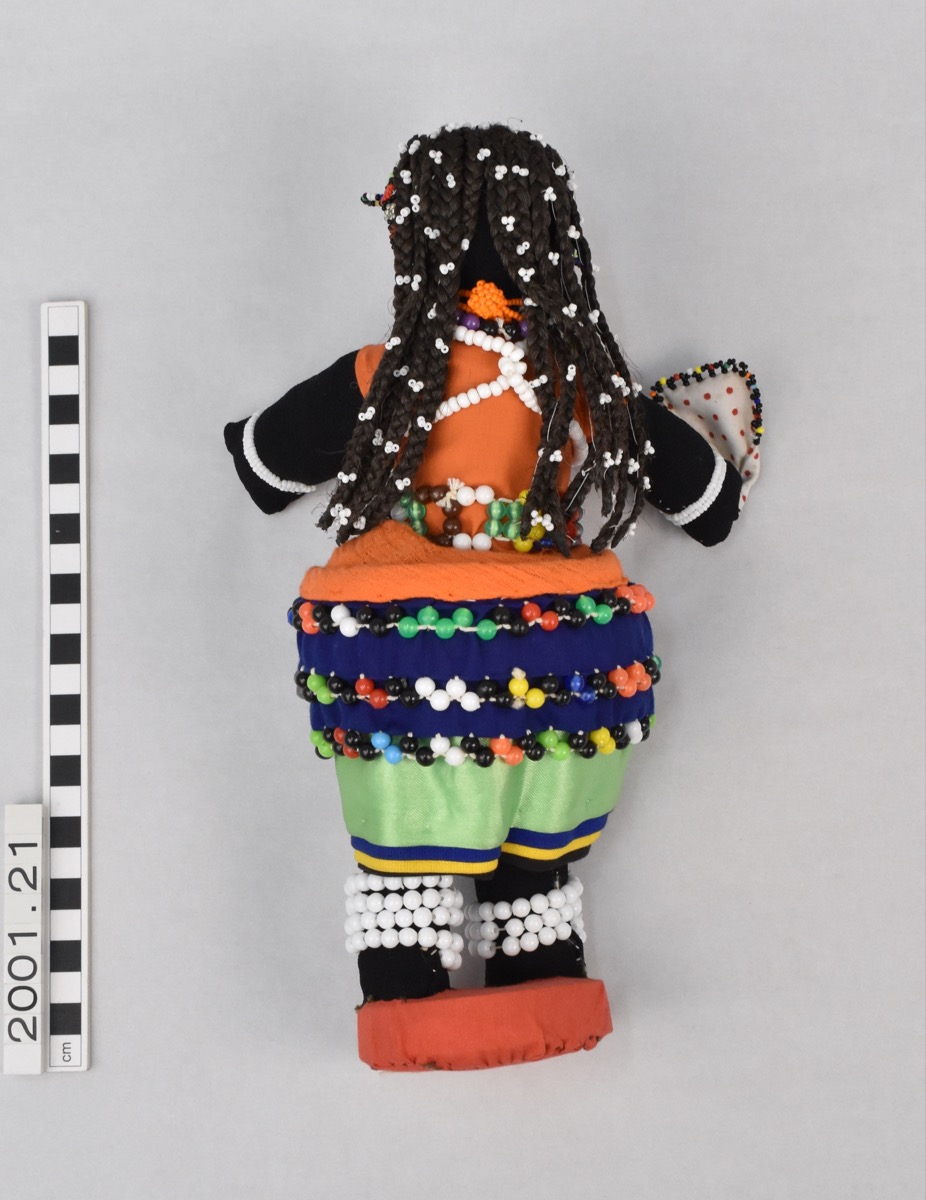
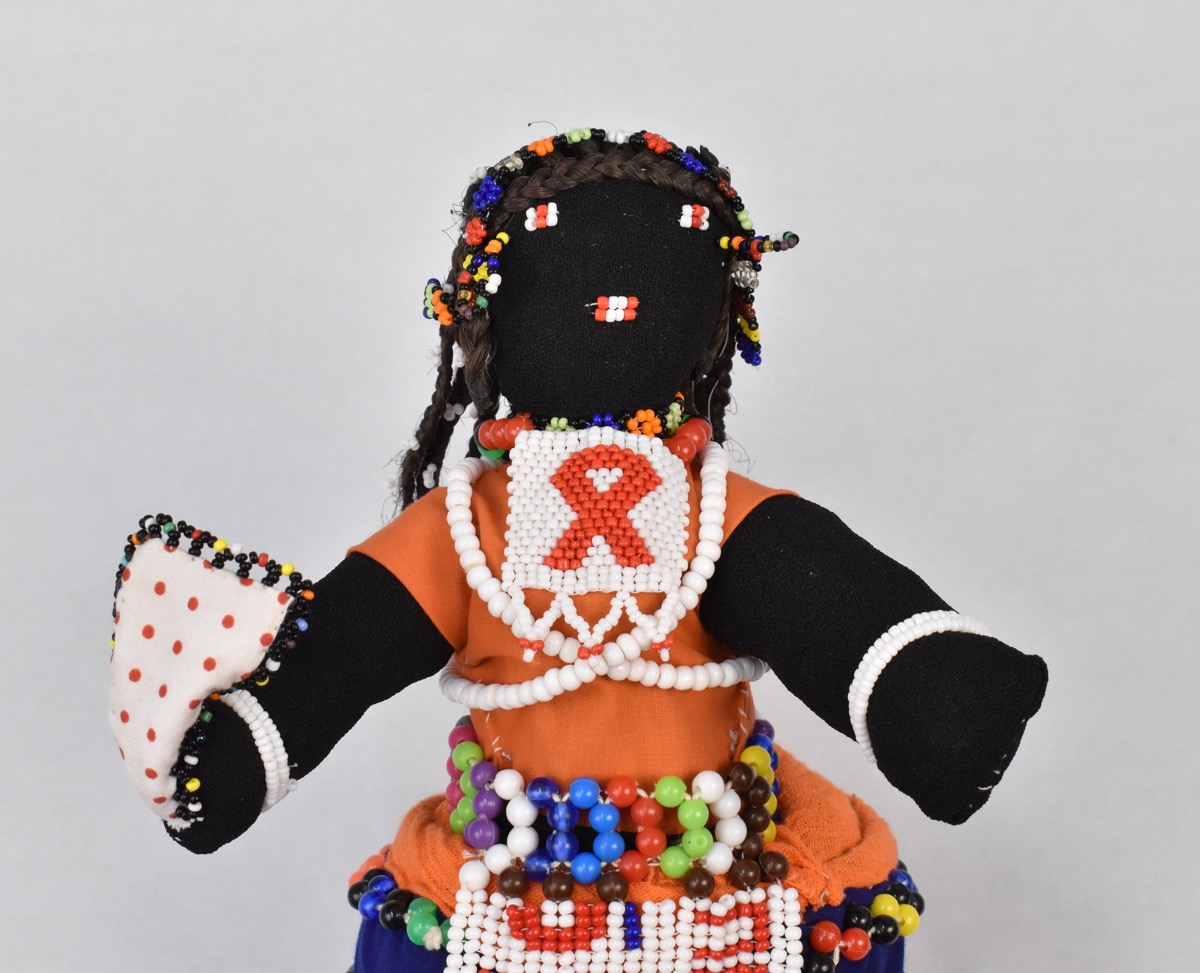
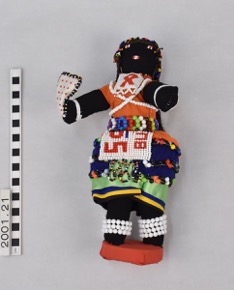
A doll made by Celani Nojiyeza. A cloth and beadwork doll on a small circular pedestal, rendered in a standing position with arms stretched forward. It represents a female sangoma (traditional healer). The doll wears several rows of white beads around the ankles, wrists and across the shoulders, as well as a red beadwork AIDS brooch around her neck. Other adornment includes a flower-pattern beaded necklace and headband, and multi-coloured bead earrings. Her clothing consists of an orange blouse and a skirt composed of layers of orange, blue, green, yellow and black materials. The upper three layers of the skirt are decorated with multi-coloured beads. A multi-coloured beaded waistband supports an apron of white, red and four blue beads. Four loops of beaded tassels hang from the bottom of the apron. Long plaits of hair are decorated at intervals with white beads. Small groups of white and red beads depict the eyes and mouth. A handkerchief with a beaded edge is held in her right hand.
Place
Africa; Southern Africa; South Africa; Durban; 160 Pine Street; Old Station Building; Tourist Junction; African Art Centre
Period
Source
Nojiyeza, Celani [maker]; Tanner, Julia [collector]; Crowther-Beynon Grant [monetary donor]
Department
Anth
Reference Numbers
2001.21
Cultural Affliation
Zulu
Material
Cloth; Glass; Plastic
Local Term
Measurements
295mm
Events
Context (Related Documents)
African Art Centre leaflet reads: 'African Art Centre is a non-profit development project, that began in 1960. We aim to: promote the traditional and contemporary artistic heritage of African people; provide incentives for artists and craftspeople; assist individuals and self-help projects to provide an income for rural and urban people. The African Art Centre encourages young people and established artists in their pursuit of Fine Arts ie. painting, drawing, graphics and sculpture, by means of exhibitions, competitions and workshops'.
A collection of similar modern cloth and bead dolls was on display at the South African Museum, Cape Town, at the time of research (March-May 2000). The collection was assembled by Professor E. Preston-Whyte and depicted dolls in a variety of scenes. These included a jockey on horseback, a bride offering food to her mother-in-law, a woman holding a hand mirror, a mother and twins in hospital, a woman collecting wood, a mother bathing her baby, a diviner and client, and a mat-maker. The text accompanying the display read as follows: 'Made for the Market - Contemporary Bead and Cloth Figures. During the 1980s, Zulu-speaking women living in the Valley of a Thousand Hills near Durban started making beaded cloth figures of people, animals and objects observed in their local environment. These figures, made for sale, are an innovative, creative response to market opportunities as well as a subtle form of social commentary by women on the experiences in their everyday lives'. At the Killie Campbell Museum in Durban another display showed Zulu art-craft dolls from Ndwedwe. This display discussed the originality of the dolls which were produced in an area with no doll making tradition. The dolls were described as social documents providing an insight into the life of their creators.
A poster of the project that produced this doll reads as follows: 'Rural Crafts and HIV/AIDS Awareness KwaZulu Natal - a partnership in rural women's development. More than 100 rural craftswomen from KwaZulu Natal have participated in workshops combining HIV/AIDS awareness with craft skills development. Funded by the United Kingdom's Department for International Development (DFID) and managed by the British Council, this project is an important outcome of the Higher Education (HE) link between design departments at the ML Sultan Technikon, Durban and Middlesex University, London. The project aims to raise awareness about HIV/AIDS in KwaZulu Natal, one of the worst affected regions in Southern Africa. The focus is upon changing attitudes and notions towards people living with AIDS at the same time as imparting information that will contribute to prevention and behavioural changes among the communities within which the rural craftswomen live. The women are encouraged to express their new awareness and prevention messages through their crafts. This project extends the initial collaboration between the ML Sultan Technikon and Middlesex University to include the Durban City Health Department, the National Association of People Living with AIDS (NAPWA), the African Art Centre and Kuyasa Devoted Artists - a drama group who specialise in AIDS awareness work. 'Izingane zami ziya lalela' - 'My children are listening', a quote by a workshop participant.'
(The poster can be found in UCMAA's archives).
The 13th International AIDS Conference was held in Durban, South Africa, in July 2000. South Africa has an estimated 4.2 million HIV infections, making it the world's largest infected population. Furthermore, it also has the fastest growing infection rate. For more information about HIV/AIDS in South Africa see the official web site of the HIV/AIDS and Sexually Transmitted Disease Directorate of the Department of Health: www.health.gov.za/hiv_aids/index.htm. Links are also provided to related local, African and international web sites. For further statistics see: www.redribbon.co.za, www.statssa.gov.za, www.mrc.ac.za; www.nrf.ac.za/sada/index.stm; www.polity.org.za; www.unaids.org; www.aids2000.co.za and www.who.int/emc-hiv/fact_sheets/. (See related newspaper articles and documentation in UCMAA's archives).
Event Date 2000
Author: maa
Context (Field collection)
This doll was purchased on 27 April 2000 from the African Art Centre, 1st Floor, Tourist Junction, Old Station Building, 160 Pine Street, Durban.
This object was collected by Julia Tanner while undertaking fieldwork in South Africa from March-May 2000. The fieldwork was financed by MAA's Crowther-Beynon Fund, in order to research and update MAA's South African collections.
Event Date 27/04/2000
Author: Annie Tomkins
Context (Production / use)
Information about Celani Nojiyeza as provided via personal correspondence by Anthea Martin of The African Art Centre: 'She also makes beaded bags and bead jewellery and attended the module on beadcloth sculptures and jewellery at two workshops held last year to promote AIDS AWARENESS. These were funded by the British Council and run by Kate Wells, Head of the Design Department of M.L. Sultan Tecknikon in Durban in conjunction with the African Art Centre. Born: 1957/03/02 Ndwedwe, KwaZulu Natal. Celani was encouraged by one of her family to start beadworking at a young age. She started making beaded spectacle holders and Jo Thorpe of the African Art Centre encouraged her to make rope beaded bangles. She became very innovative and started making different types of beaded animals, dolls and small scenes. Some of her favourite subjects are mothers with children, pushing them in swings, in prams. Other favourites are nativity scenes, Easter crucifixtion scenes, christmas trees and illustrating Zulu folk tales. Exhibitions: 1992 - All Things Bright and Beautiful, African Art Centre, Durban; 1993 - Yesterday, Today and Tomorrow, African Art Centre, Durban; 1993 - African Art Centre Christmas Exhibition; 1997 - FNB Vita Crafts Now exhibition, Pretoria; 1998 - FNB Vita Crafts Now exhibition, Cape Town; 1999 - Smithsonian Folklife Festival, Washington D.C., U.S.A., where Celani demonstrated her skills; 2000 - Senzenjani - Breaking the Silence about AIDS, African Art Centre, Durban. Collections: The Killie Campbell Collections, Durban'.
Event Date 2001
Author: Lucie Carreau
Description (Physical description)
A cloth and beadwork doll on a small circular pedestal, rendered in a standing position with arms stretched forward. It represents a female sangoma (traditional healer). The doll wears several rows of white beads around the ankles, wrists and across the shoulders, as well as a red beadwork AIDS brooch around her neck. Other adornment includes a flower-pattern beaded necklace and headband, and multi-coloured bead earrings. Her clothing consists of an orange blouse and a skirt composed of layers of orange, blue, green, yellow and black materials. The upper three layers of the skirt are decorated with multi-coloured beads. A multi-coloured beaded waistband supports an apron of white, red and four blue beads. Four loops of beaded tassels hang from the bottom of the apron. Long plaits of hair are decorated at intervals with white beads. Small groups of white and red beads depict the eyes and mouth. A handkerchief with a beaded edge is held in her right hand.
Event Date 26/1/2011
Author: maa
Description (Physical description)
A doll made by Celani Nojiyeza. A cloth and beadwork doll on a small circular pedestal, rendered in a standing position with arms stretched forward. It represents a female sangoma (traditional healer). The doll wears several rows of white beads around the ankles, wrists and across the shoulders, as well as a red beadwork AIDS brooch around her neck. Other adornment includes a flower-pattern beaded necklace and headband, and multi-coloured bead earrings. Her clothing consists of an orange blouse and a skirt composed of layers of orange, blue, green, yellow and black materials. The upper three layers of the skirt are decorated with multi-coloured beads. A multi-coloured beaded waistband supports an apron of white, red and four blue beads. Four loops of beaded tassels hang from the bottom of the apron. Long plaits of hair are decorated at intervals with white beads. Small groups of white and red beads depict the eyes and mouth. A handkerchief with a beaded edge is held in her right hand.
Event Date 11/1/2023
Author: Annie Tomkins
FM:263639
Images (Click to view full size):