Accession No
Z 2538
Description
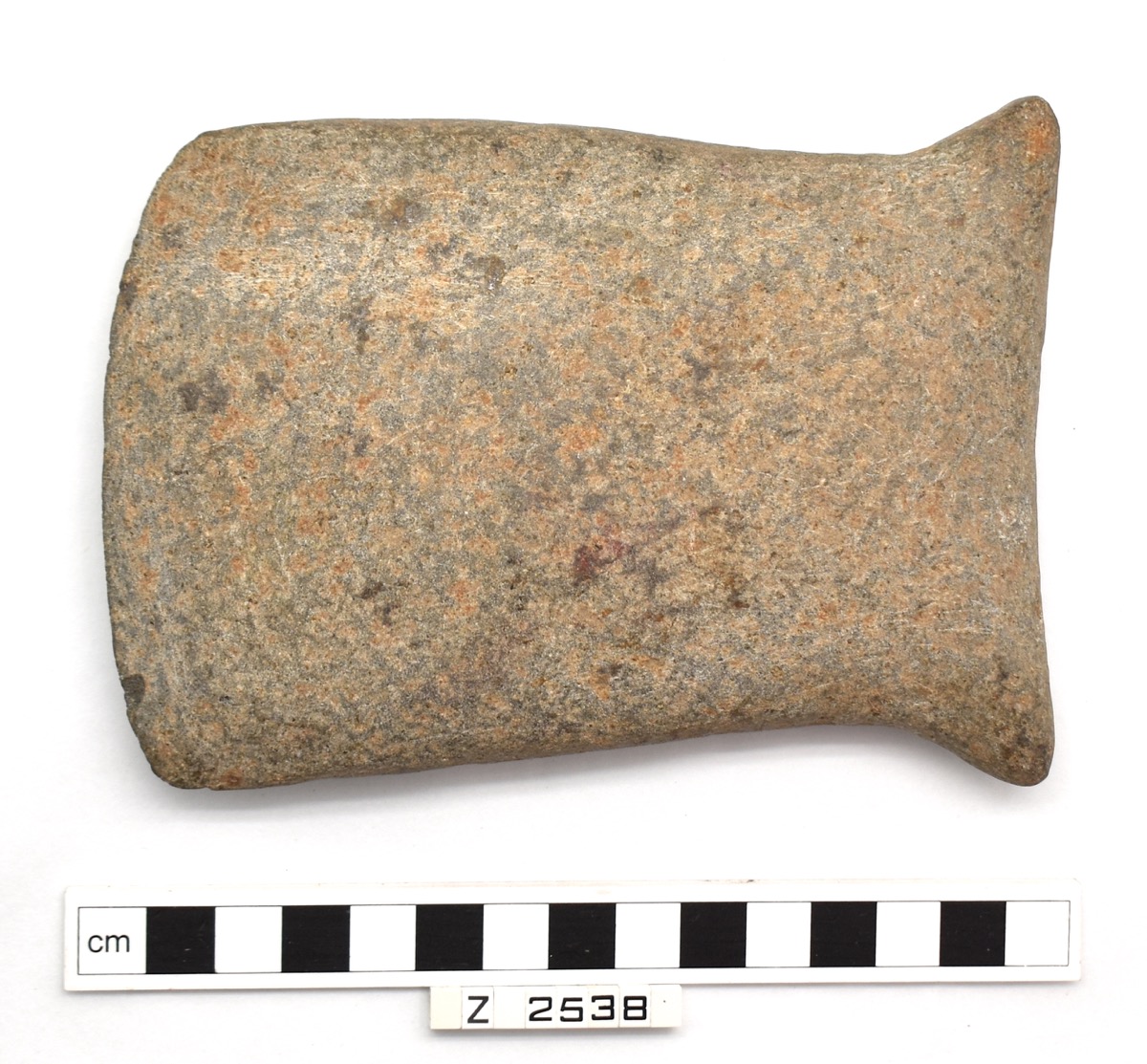
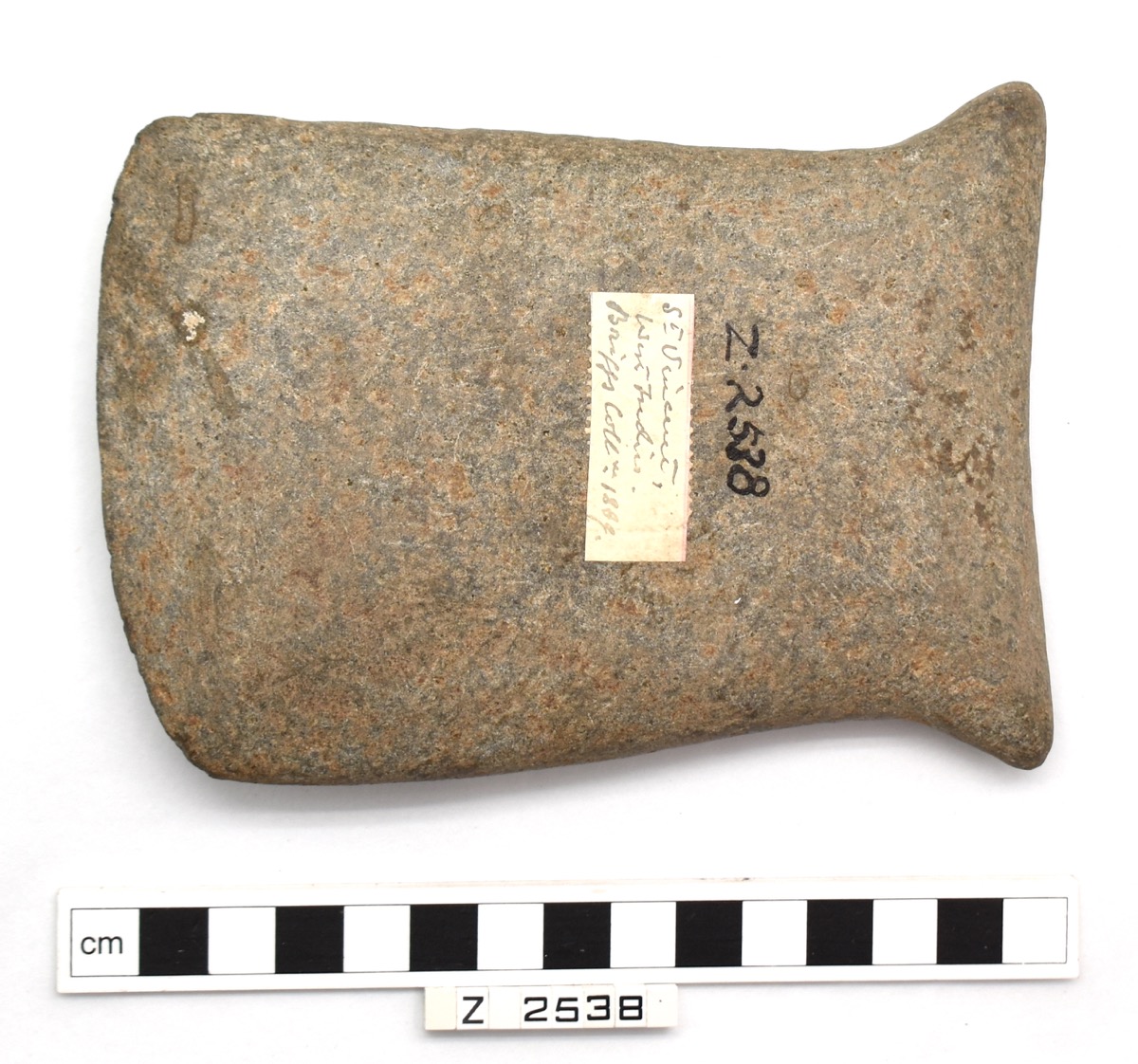
A ground axe made from a grey coloured volcanic stone, possibly basalt or andesite. Blade is rectangular with a lenticular cross-section and a slightly rounded cutting edge. Butt is expanded with a pointed protrusion on each side and a slightly concave end.
Place
Americas; Caribbean; Saint Vincent and the Grenadines; Saint Vincent
Period
Pre-Columbian/Pre-Hispanic
Source
Briggs, Thomas Graham (Sir) [collector]; Kenrick Gibbons, C. [vendor]; ?Maudslay, Alfred Percival [monetary donor]; ?Foster, Walter Kidman [monetary donor]
Department
Arch
Reference Numbers
Z 2538; MAA: ?1889.10; ?AR 1889.60; ?1889.213; ?E 1890.1
Cultural Affliation
Material
Stone; Volcanic; ?Basalt; ?Andesite
Local Term
Measurements
102mm x 137mm
Events
Context (Related Documents)
Original catalogue card has sketch of object.
Event Date
Author: Imogen Gunn (admin)
Description (Labels & Markings)
Handwritten label adhered to object reads: 'St Vincent, West Indies. Briggs Colln 1889.' in black ink.
Event Date
Author: Lizzy Peneycad
Description (Physical description)
Catalogue card: 'Stone axe with expanded shoulders; Ground.'
Event Date
Author: maa
Context (Display)
Exhibited: Leicester Museum Caribbean Exhibition 1986 to 1986.
Event Date 1986
Author: Imogen Gunn (admin)
Context (Analysis)
I cannot find an 1889.10 in any of the early books. The only place the number appears is on certain Z cards for W.K. Foster stone items. Except that it is one item short (?see Z 2552, d.d. 'unknown') it could well be a mistake for AR 1889.60, '9 stone celts and 4 grinders, West Indian Islands, W.K. Foster'. But E 1889.213 is listed as 'AR 1889.60, Nine stone celts and four grinders, Briggs collection, W.K. Foster', on one of Joan Cunning's cards.
Event Date 11/11/1988
Author: maa
Context (Amendments / updates)
The reference above to '1889.10' may have been a mis-transcription of '1890.1'. Accession register entry for E 1890.1 notes 'Twenty-one celts and one grinder/ West Indies/Briggs Collection £6.0.0' [Annotated later in pencil] 'Apparently 28 were bought & are in the museum 25.5.1936/ *A.P. Maudslay M.A.F. [?] -- [illegible]'
The 'M.A.F' appears to refer to the Museums Accession Fund, to which Maudslay was the monetary donor for the objects.
While the Z register series Z 2509- 2528 A-E includes only 25 items from Briggs this seems the most likely candidate. Source field was noted as W.K. Foster based on the reference above to E 1889.213. I have added "A.P.Maudslay' to the source field based on the potential link to E 1890.1 and the fact that others from this Z series are already connected to Maudslay.
Carib stone tools collected by British planter and legislator Sir Graham Briggs (1833-1887) who owned the Farley Hill Estate on Barbados. His collections were purchased after his death from C. Kenrick Gibbons.
This is probably Charles Kenrick Gibbons (1856-1918), potentially the son of Lt Col. William Barton Gibbons (1892- 1872), J.P. Barbados, who was part of a family group was compensated for the Sandford’s estate in Barbados following the abolition of slavery.
The National Museum of Ireland (1889), the British Museum (1889) and the Pitt Rivers Museum, Oxford (1890 & 1915), and Glasgow Museum (1890) also acquired Carib tools from Gibbons. According to letters from Gibbons the material was exhibited in 1889, presumably to potential buyers, in London at the Baker St Bazaar, Lady Brigg's Room, Kings St Entrance.
Event Date 5/11/2020
Author: Lizzy Peneycad
Description (Physical description)
A ground axe made from a grey coloured volcanic stone, possibly basalt or andesite. Blade is rectangular with a lenticular cross-section and a slightly rounded cutting edge. Butt is expanded with a pointed protrusion on each side and a slightly concave end.
Event Date 6/6/2024
Author: Lizzy Peneycad
FM:137826
Images (Click to view full size):