Accession No
1918.92
Description
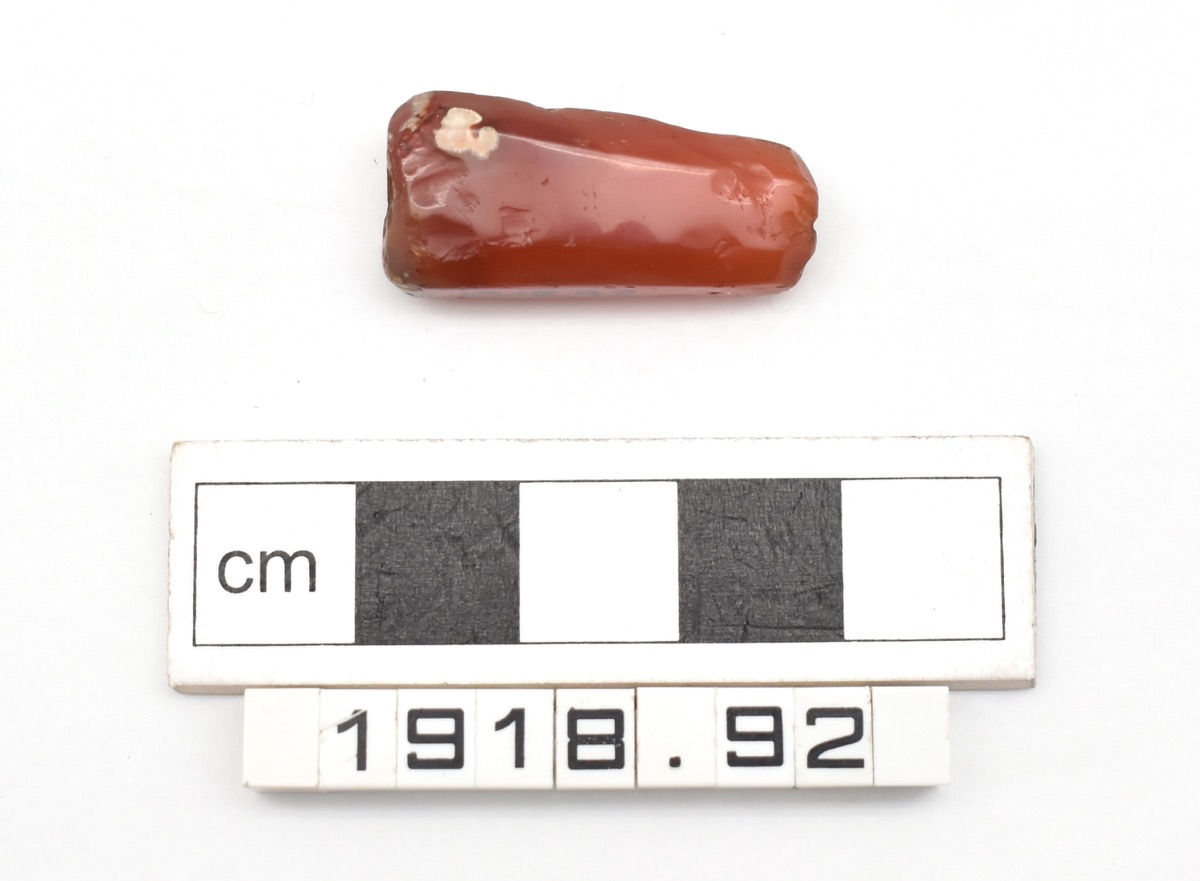
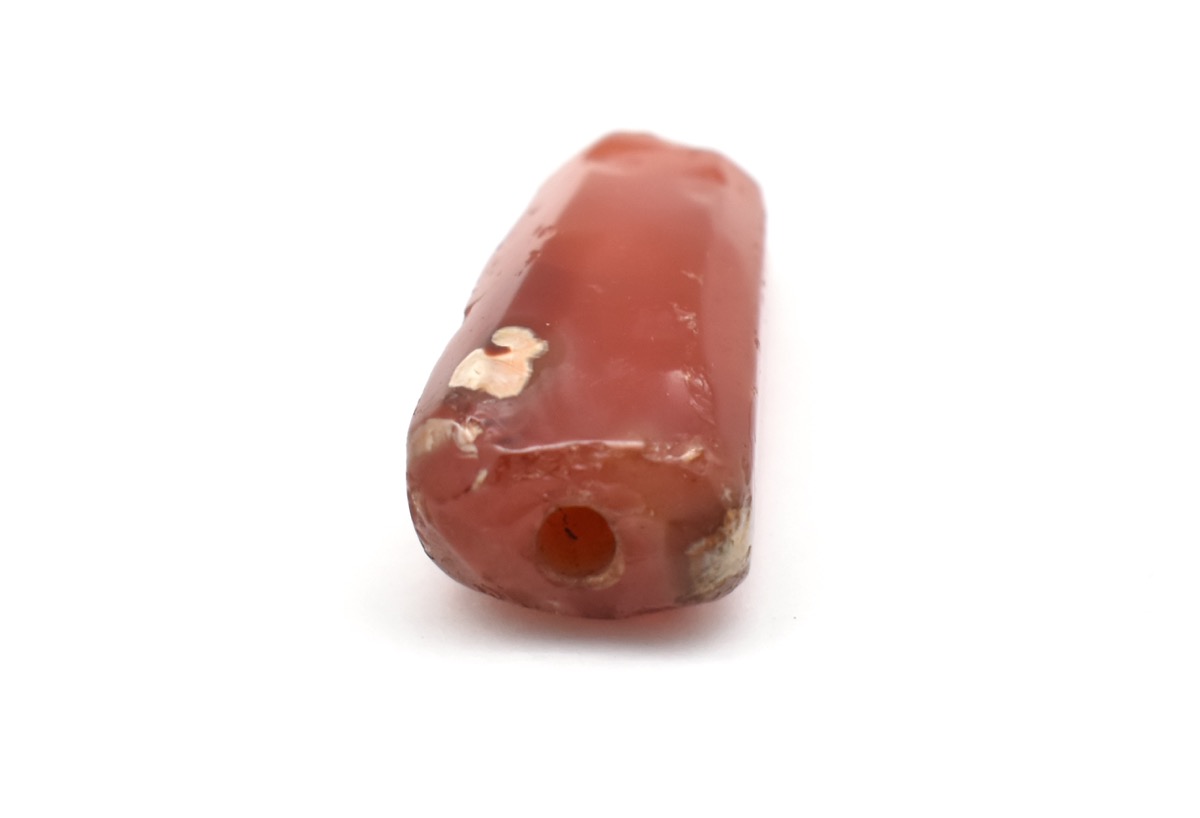
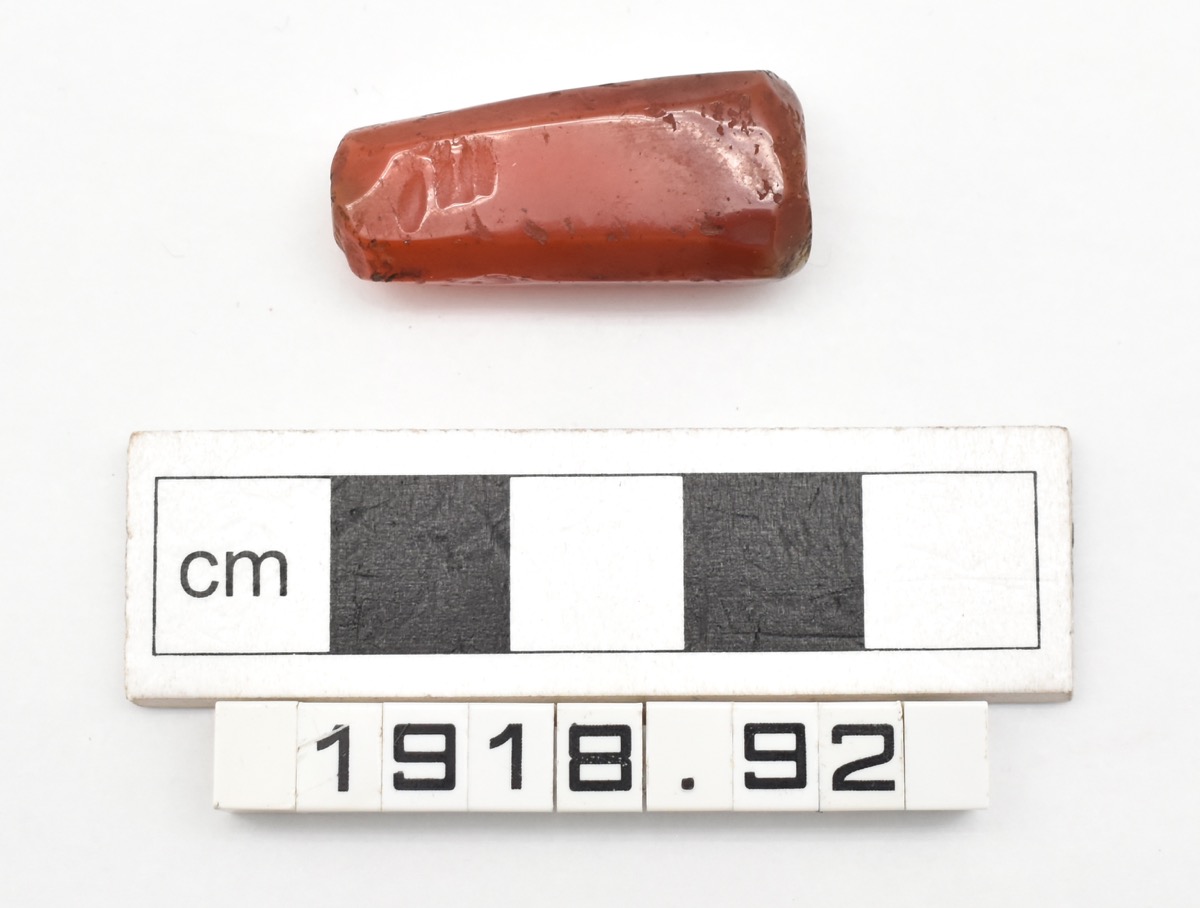
Polished bead made of dark orange stone, possibly carnelian. Sub-cylindrical in shape with one end slightly tapered. Eight chiselled sides and slightly bevelled ends. Latitudinally perforated hole through the centre of the bead for suspension.
Place
Americas; Caribbean; Saint Vincent and the Grenadines; Saint Vincent
Period
?Pre-Columbian/Pre-Hispanic Carib
Source
Griffith, William (Rev.) [collector]; Griffith, Arthur Foster [donor]
Department
Arch
Reference Numbers
1918.92
Cultural Affliation
Material
Stone; ?Carnelian
Local Term
Measurements
27mm
Events
Description (Physical description)
Bead, oblong, chamfered and polished. Orangey-red stone; Polished
Event Date
Author: maa
Context (Field collection)
Found: Owian Carib Country in 1872 or 1873
Event Date 1872
Author: maa
Context (Display)
Likely part of the 'large collection of the implements' exhibited by Rev. Griffith's paper during the 24 November 1873 meeting of the Cambridge Antiquarian Society. (see PCAS vol 3(4)).
Event Date 24/11/1873
Author: Imogen Gunn (admin)
Context (References)
Griffith, W. (1879). ‘Notes on Charib Implements in Barbados and the Neighbouring (West Indian) Islands’. Proceedings of the Cambridge Antiquarian Society, vol. 3(4). pp. 295-302
Event Date 1879
Author: Imogen Gunn (admin)
Context (Acquisition Details)
Rev. William Griffith's Caribbean collection was collected between 2 October 1872 and 2 July 1873, whilst he was acting tutor at Codrington College, Barbados. It was donated to the museum in 1918 by his brother, Arthur Foster Griffith, likely following the death of Rev. Griffith that same year.
Event Date 1918
Author: Imogen Gunn (admin)
Description (Physical description)
Accession Register: 'A bead, oblong, chamfered and polished.'
Event Date 1918
Author: Alana Edgeworth
Context (Display)
Exhibited: Andrews Gallery, "The Americas 1492", 15 June 1992 to 24 September 1994.
Event Date 15/6/1992
Author: Imogen Gunn (admin)
Description (Physical description)
Polished bead made of dark orange stone, possibly carnelian. Sub-cylindrical in shape with one end slightly tapered. Eight chiselled sides and slightly bevelled ends. Latitudinally perforated hole through the centre of the bead for suspension.
Event Date 6/6/2024
Author: Alana Edgeworth
Context (Analysis)
Cf. Handler, Jerome S. (2007), 'From Cambay in India to Barbados in the Caribbean: Two Unique Beads from a Plantation Slave Cemetery'. African Diaspora Archaeology Newsletter, vol. 10, article 1.
Event Date 6/6/2024
Author: Alana Edgeworth
FM:137823
Images (Click to view full size):