Accession No
1901.1
Description
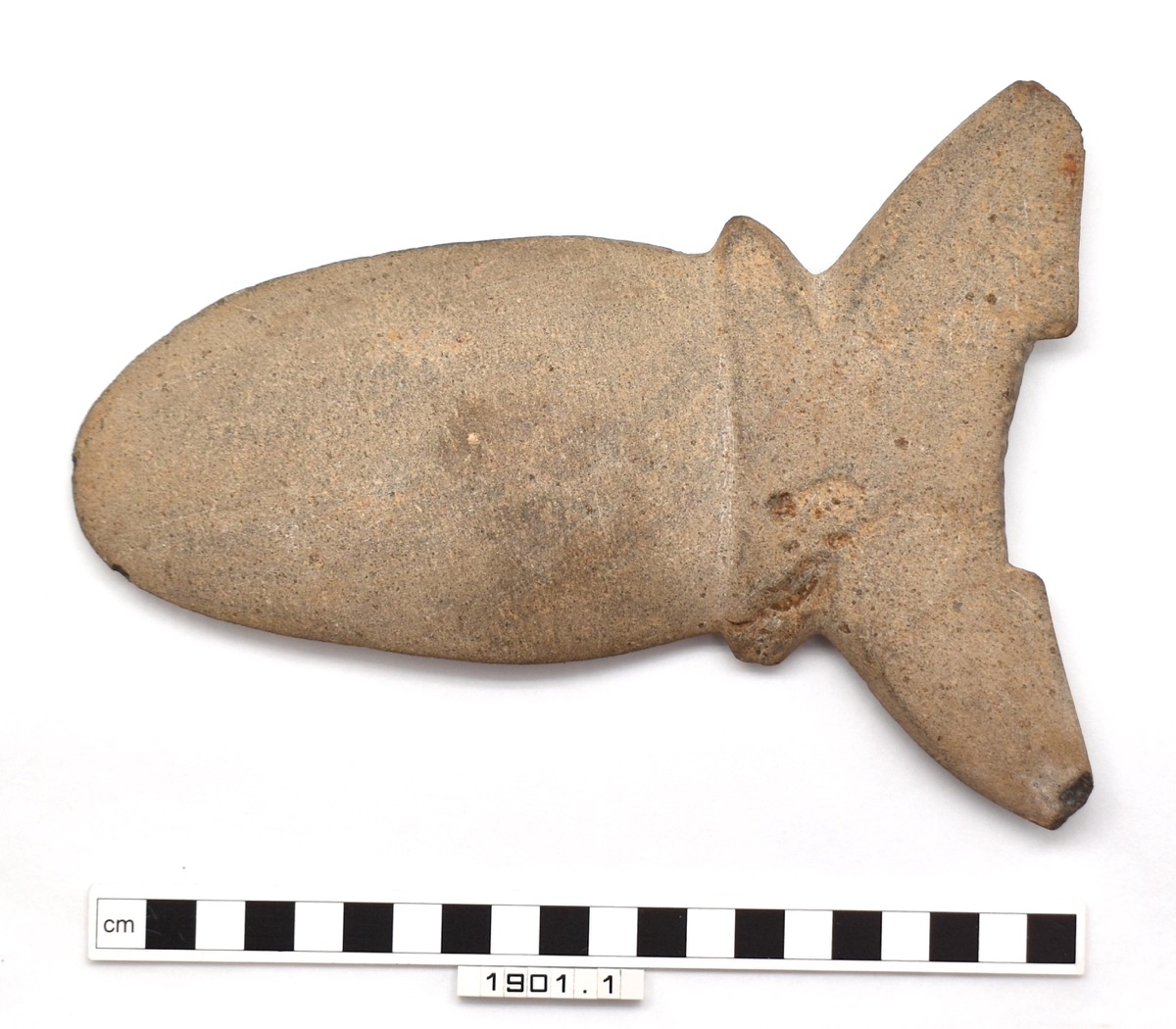
A large, eared axe made of ground basalt. Blade is a thin, elongated lobe of lenticular cross-section. Butt end is in the form of a fish tail: shoulder is slightly expanded with a point and a notch on each side, flaring to a crescent-shaped tail with a rectangular notch in the centre.
Place
Americas; Caribbean; Saint Vincent and the Grenadines; Saint Vincent
Period
Pre-Columbian/Pre-Hispanic
Source
Cave, Charles John Philip [collector and donor]; Brown (Mrs) [vendor]; Brown (Mr) [collector]
Department
Arch
Reference Numbers
1901.1
Cultural Affliation
?Carib
Material
Stone; Basalt
Local Term
Measurements
152mm x 207mm
Events
Description (Labels & Markings)
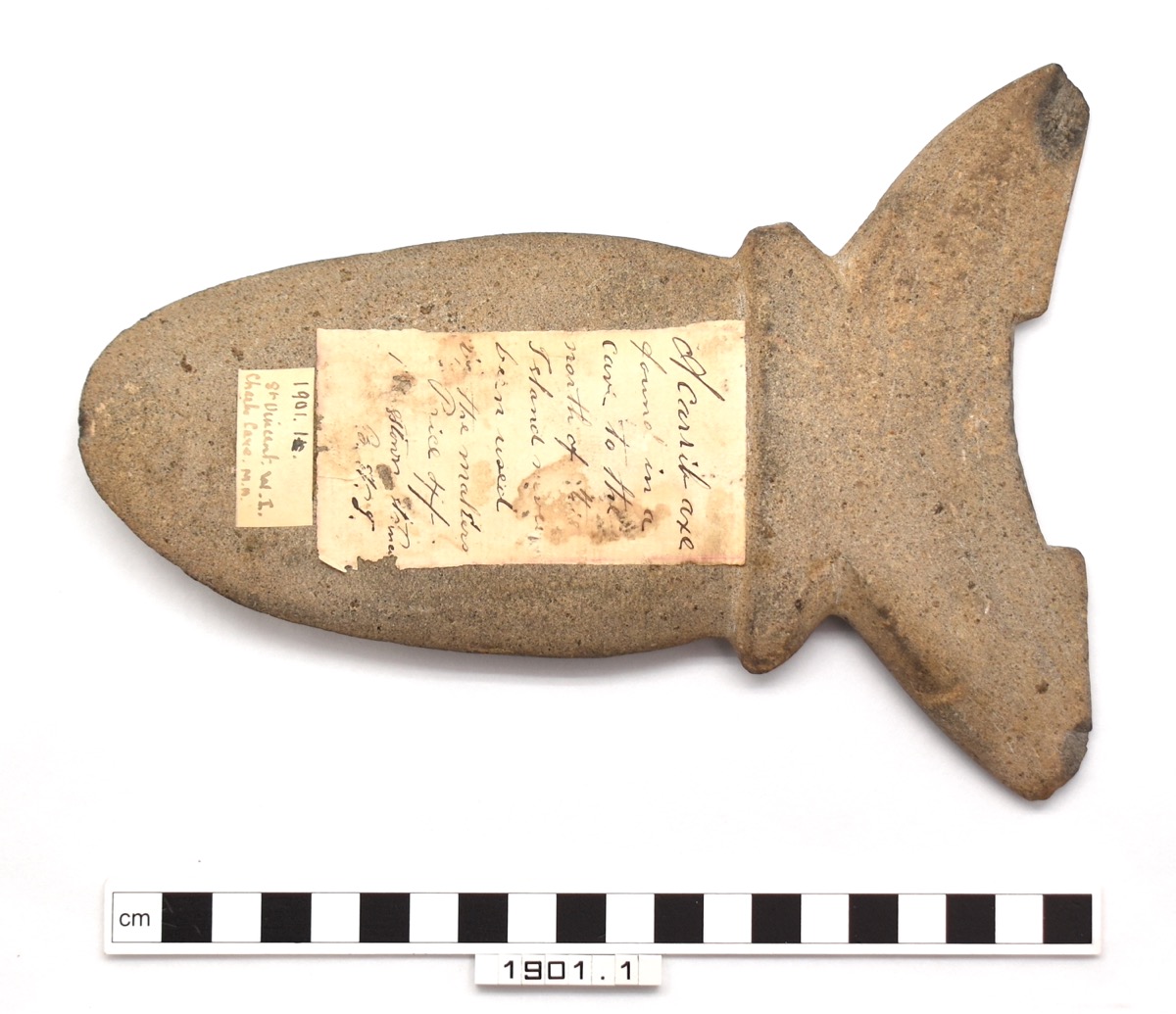
First handwritten label pasted to object: 'A Carrib [sic] axe found in a cave to the north of this Island. Never been used by the makers. Price 4/- Kingstown, St. Vincent, B.W.I.'
Event Date
Author: maa
Description (Labels & Markings)
Second handwritten label pasted to object: ‘1901.1. St Vincent W.I. Charles Cave, M.A.’
Event Date
Author: Mark Elliott
Context (Other owners)
Accession Register: ‘Collected by Brown of Bellair from whose wife the donor bought them in St Vincent in 1900.’
Event Date 1900
Author: Mark Elliott
Description (Physical description)
Catalogue card: 'Flat stone implement like acorn in profile, with sharp-sided blade, notched haft; Ground.'
Event Date 1901
Author: maa
Description (Physical description)
Accession Register: ‘(1) One flat implement in outline like an acorn: the blade with sharp sides representing the nut, the haft the cup, the ban of which greatly expands and is notched. (L. 8”)’
Event Date 5/1901
Author: Mark Elliott
Context (Display)
Leicester Museum Caribbean Exhibition 1986
Event Date 1986
Author: Mark Elliott
Context (Display)
CUMAA Maudslay Hall, West Indies Case until 1986
Event Date 1986
Author: Mark Elliott
Context (Display)
Exhibited in 'The Americas 1492', Andrews Gallery, 15 June 1992 to 24 September 1994.
Event Date 15/6/1992
Author: Mark Elliott
Description (Physical description)
A large, eared axe made of ground basalt. Blade is a thin, elongated lobe of lenticular cross-section. Butt end is in the form of a fish tail: shoulder is slightly expanded with a point and a notch on each side, flaring to a crescent-shaped tail with a rectangular notch in the centre.
Event Date 5/6/2024
Author: Lizzy Peneycad
FM:137787
Images (Click to view full size):