Accession No
2002.93
Description
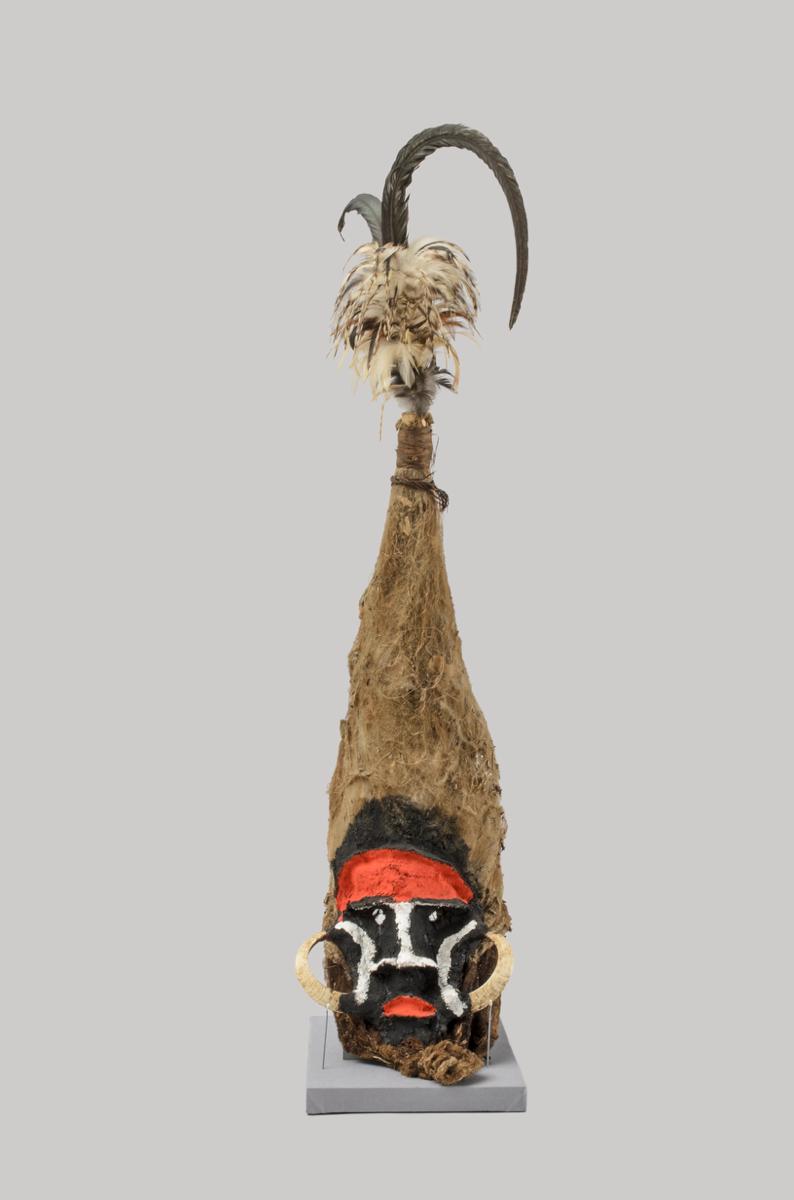
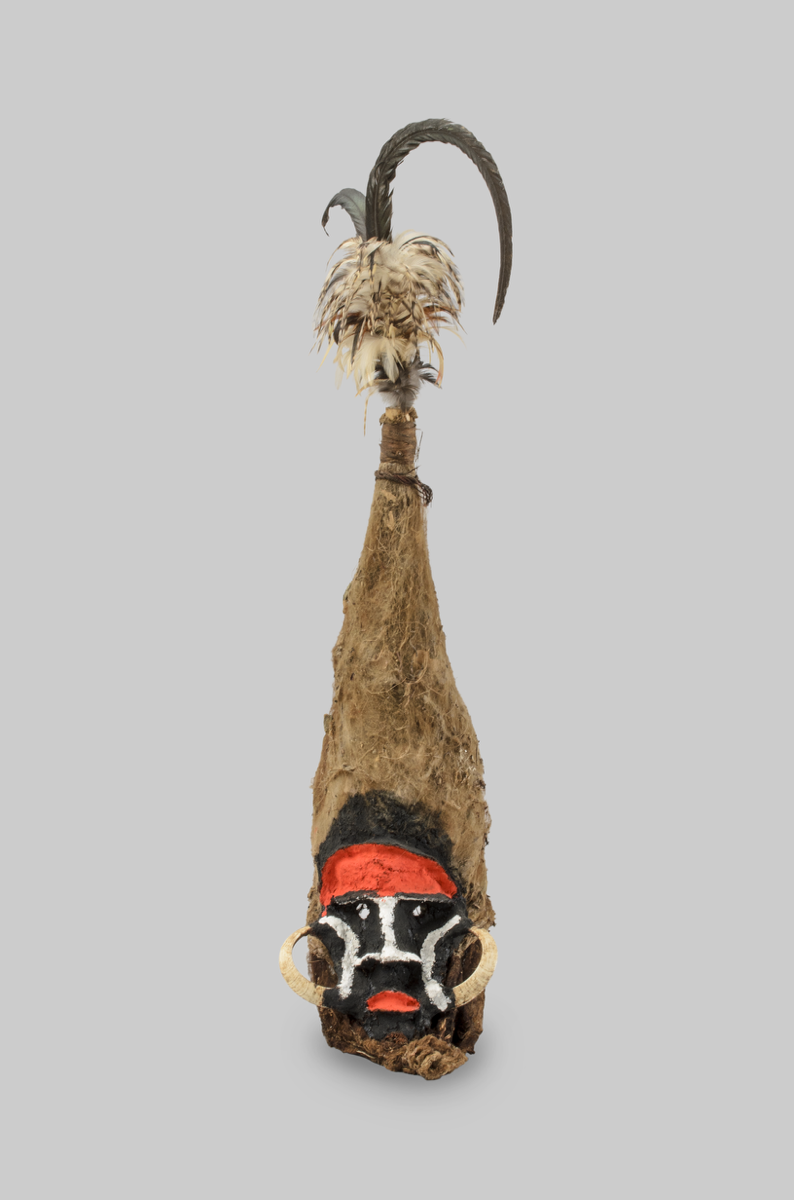
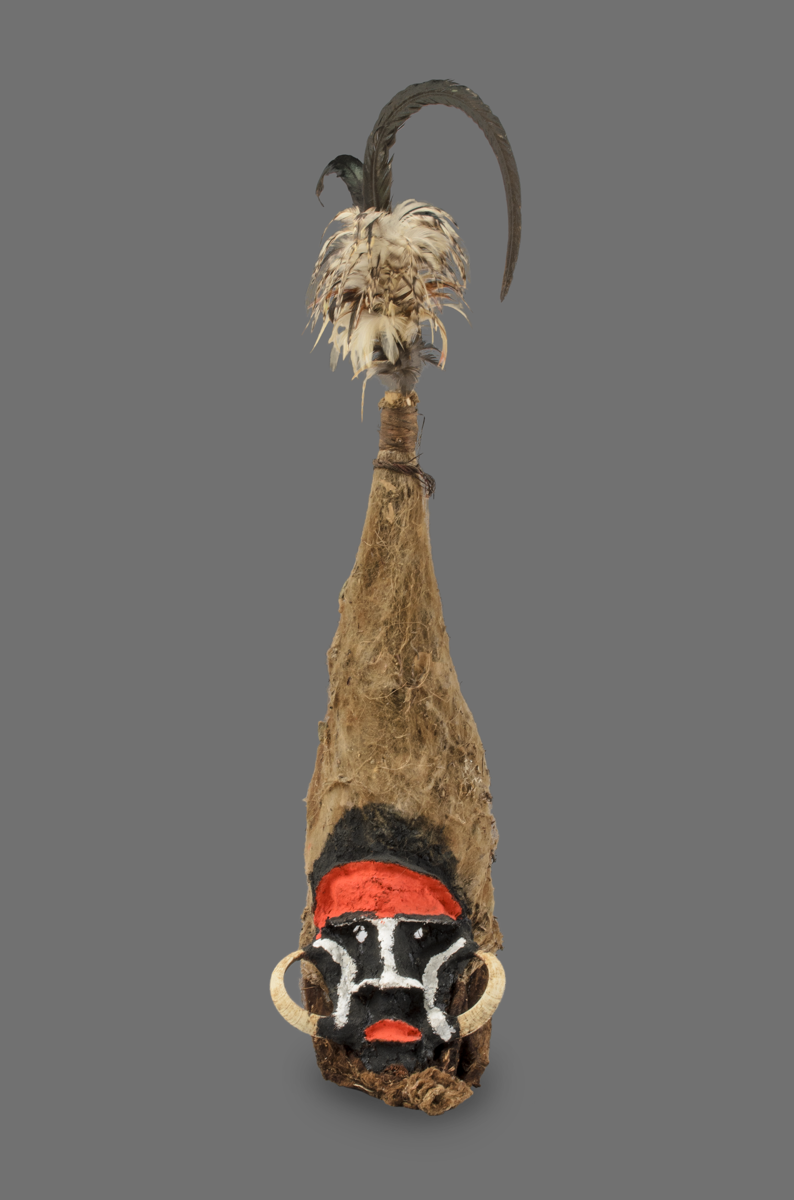
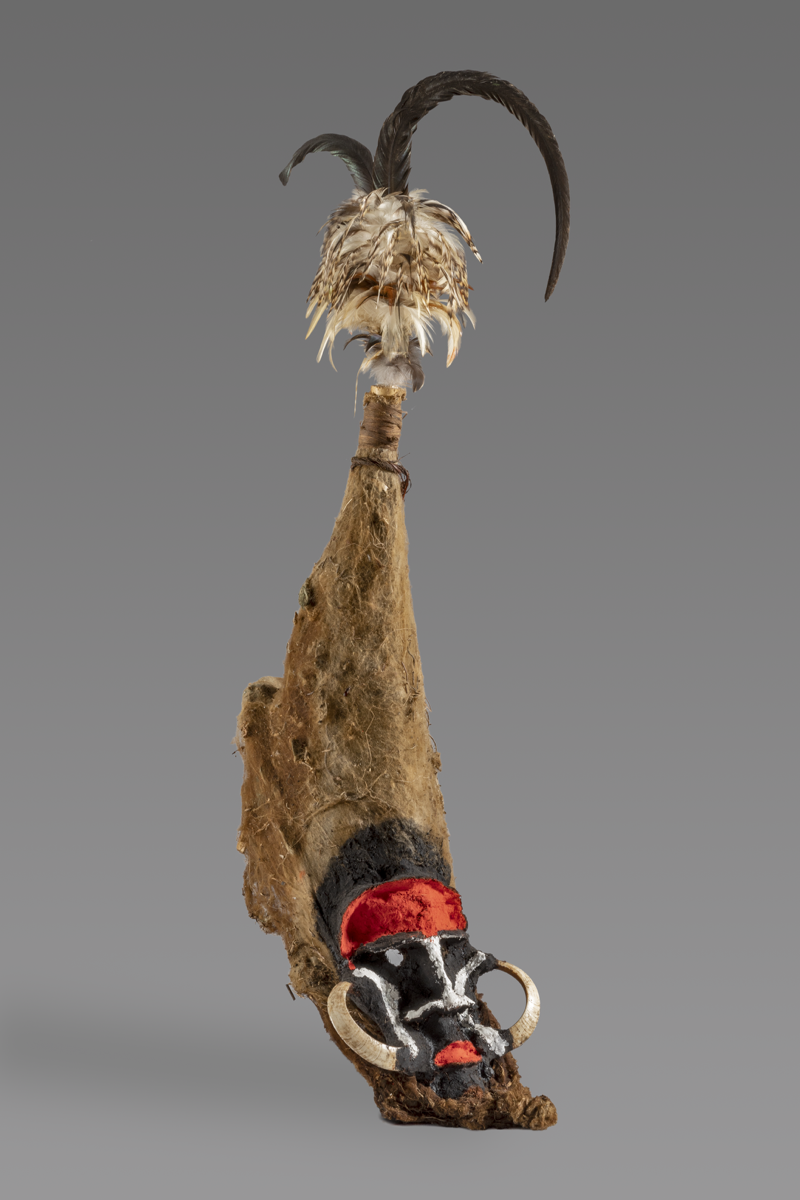
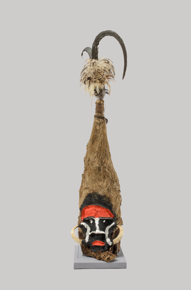
Luan Veuv mask made by Richard Abong (1999). The face is sculpted from hardened vegetable paste and decorated with black, white and red pigments. A circular pig's tusk protrudes from each side of the face. The elaborate headdress is made of spider webs crowned with chicken feathers.
Place
Oceania; Melanesia; Vanuatu; Malekula; Lamap
Period
20th century
Source
Richard Abong [artist and donor]; Geismar, Haidy [collector]
Department
Anth
Reference Numbers
2002.93
Cultural Affliation
Ni-Vanuatu
Material
Cane; Pigment; Plant; Fibre; Earth; ?Spider web
Local Term
Measurements
370mm x 980mm x 240mm
Events
Exhibition (Maudslay Gallery)
EXH.2018.4 | Pacific Currents
Event Date
Author: Remke Velden
Context (Auction / Sale)
Geismar (2009:85) "Richard Abong is keen to forge strong ties between Pnoab and foreign museums and for that reason refused to accept monetary payment for the two UCMAA masks. Instead he asked for support and help when needed in future research, and for a set of wood-carving tools to be used by the entire group. This enabled any proit made through such economic interactions around kastom to be used to beneit the community."
Event Date 2001
Author: rachel hand
Context (Field collection)
Purchased in 2001 with funds from the Crowther-Beynon Grant (awarded 2000). Collected by Haidy Geismar during Phd fieldwork as part of a study of the work of the Vanuatu National Museum and Cultural Centre (VCC) in the context of the growing commodity market for cultural property.
Marcellin Abong, then a curator at the VCC, himself from Lamap, offered advice in making a small collection of contemporary material and introduced Geismar to his brother Richard Abong.
Event Date 2001
Author: rachel hand
Description (Physical description)
Luan Veuv mask made by Richard Abong in 1999. With elongated head, terminating in a hollow piece of cane. The cane is bound at the end with strips of bark. The face is sculpted from mud and decorated with black, white and red pigments. A tusk protrudes from each side of the face, attached to the mask at each end. The clay attaching the right-hand (when facing the object) tusk to the mask is broken away, but the tusk is still attached to the mask's fibre fringe. The mask's head is covered with what appears to be spider-web or very fine plant-fibre, which also forms the mask's 'beard'.
Event Date 12/12/2002
Author: maa
Context (Display)
'Exhibited in " Vanuatu Stael: Kastom and Creativity" , 12 february 2003- February 2006 with following label " Headress: Nalawan Luan Veuv (Daughter of Luan) Bamboo and vine frame covered in unfired clay, spider webs, chicken feathers and painted with natural pigment. Made by Richard Abong, of Pnoab Nasara, Lamap, South Malakula, 2000.Collected by Haidy Geismar, Lamap, Malakula, 2001. UCMAA 2002.93"
Event Date 2003
Author: maa
Context (Production / use)
Geismar (2009:85) "This is a "copy of the Luan Veuv mask which had been revived earlier as described above. Until their donation they were used repeatedly in dances, originally in the dancing-ground for the ceremony of which they are an intrinsic part, and then in performances to raise money from tourists.
As the work to revive every step of Nimangki self-consciously takes the form of a research project, Richard has kept the masks he made for various ceremonies as ‘examples’, rather like museum pieces, instead of destroying them or hiding them away as past convention would demand. This allows them to be incorporated after their initial use into the tourist economy and also means that they can be shared with other museums, where they will be conserved for future generations, just like the masks Marcellin found in Paris. These masks are therefore seen as demonstrations of cultural practice not to be lost again, made not only to be used but preserved.
Due to such experiences as working with the Arts of Vanuatu exhibition, many villagers in Lamap are aware that museums are ideal places to deposit such cultural valuables."
Event Date 2009
Author: rachel hand
Context (References)
Illustrated in Haidy Geismar (2009) 'Contemporary Traditions: Museum artifacts and creativity in Vanuatu' in Representing Pacific Art, pp. 70-88, p. 83, fg, 8 (right). "The Abong family has been a driving force in the revival of Nimangki, the local male ceremonial complex of status achievement, initiated by the re-construction of their nasara [dancing ground/sacred space] in the village..... In 1996, Marcellin Abong accompanied the Arts of Vanuatu travelling exhibition from Port Vila to Paris where he was able to explore museum collections and view objects that had not been sent to Port Vila for the Paciic tour of the show. There, he found two masks from Port Sandwich dating back over one hundred years. This discovery enabled a second reconstruction of the masks in Lamap, alongside the revival of the associated dances and rituals according to renewed criteria of authenticity. Richard was able to recreate two masks, Gulong and Luan Veuv, from photographs Marcellin sent back to Malakula. The label for the Luan Veuv mask made by Richard currently on display in the VCC describes the role of museums in this explicit process of revival and the distinction between objects revived from photographs and from oral tradition.
Richard Abong and the Pnoab nasara gave two of these masks to the Cambridge museum"
[NB Caption notes the mask was made in 2000 not 1999 as recorded in the Museum's documentation]
Event Date 2009
Author: rachel hand
Conservation (Remedial)
CON.2017.3963 | Remedial
Event Date 3/10/2017
Author: Dipika Nadkarni
FM:133085
Images (Click to view full size):