Accession No
1925.68
Description
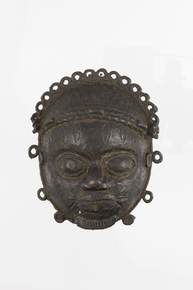
Uhunmwu-Ẹkuẹ. Pendant mask of bronze. Tribal marks over each eye. Wears a headdress and small beard. The eyes are unusually large.
Place
Africa; West Africa; Nigeria; [Kingdom of Benin]; Edo State; Benin City
Period
15th- 19th century
Source
National Commission for Museums and Monuments, Nigeria [owner and lender]; British Colonial Military Campaign on Benin [field collector]; Clarke, Louis Colville Gray [donor]
Department
Anth
Reference Numbers
1925.68
Cultural Affliation
Edo
Material
Metal; Copper Alloy; ?Bronze
Local Term
Uhunmwu-Ẹkuẹ [Edo]
Measurements
11mm x 129mm x 45mm Weight 0.393kg
Events
Description (Physical description)
Rough bronze maskette. Tribalmarks over each eye. Wears a headdress and small beard. The eyes are unusually large
Event Date
Author: maa
Context (Field collection)
Presumed taken on the British Colonial Military Campaign on Benin, February 1897. There is no information on how Clarke acquired this object, but given that such objects on the market in the early twentieth century reached Britain through the Expedition, and the likely sale room or auction acquisition, this is presumed to be the most likely route.
Event Date 2/1897
Author: Katrina Dring
Context (Related Documents)
Correspondence between Major C.T. Lawrence, Exhibition Commissioner for the Nigeria pavilion at the British Empire Exhibition, Wembley, 1924, clarifies that Clarke was ‘in a position to loan or obtain the loan of 4 Bronze Benin Heads and an ivory mask’ for the Benin display.
Major C.T. Lawrence to L.C.G. Clarke, 29 October 1923, MAA letter boxe (1923)
Event Date 19/10/1923
Author: rachel hand
Context (Display)
Lent by Louis Clarke for exhibition in the Nigerian Pavilion at the British Empire Exhibition, Wembley Park, London, 23 April 1924 to 31 October 1925. The Nigerian Pavilion featured Nigerian artists as living displays, historic material and a replica altar from the Oba, Aiguobasinwin Ovonramwen, Eweka II, which featured painted wooden representations of the original bronze and ivory artworks.
Event Date 23/4/1924
Author: maa
Context (Related Documents)
Register notes 'Rough ditto [bronze mask]. Clarke Gift. See index card. Exhibited: Wembley Exhibition 1924.'
Event Date 1925
Author: rachel hand
Context (Related Documents)
Catalogue card reads, in black ink: "25.68 | Benin / West Africa / Rough bronze mask. Tribal marks over eyes. Marks [diagram in pen] beside lips. Wears head-dress and small beard. The eyes are unusually large. / Exhibitedby Donor at Brit. Empire Exhib. at Wembley 1924"
Event Date 1925
Author: Katrina Dring
Context (Analysis)
In January 2017, Prof. Marcos Martinon-Torres and Agnese Benzonelli, UCL Institute of Archaeology, tested this idno using a portable XRF as part of a programme of base metal analysis of Benin material. The object was tested twice and the results are as follows: 1) Cu: 63.897%; Zn: 17.65%; Sn: 5.67%; Pb: 12.16%. 2) Cu: 63.62%; Zn: 17.86%; Sn: 66.11%; Pb: 11.74%. It was noted that Pb-rich alloy appears in patches on the sides of the eyes, towards the back as though it may have been soldered onto something else however this is hard to determine.
Event Date 27/1/2017
Author: Eleanor Wilkinson
Context (Amendments / updates)
The note created during transcription of the catalogue card in 2001 recorded that it was unclear if 'Edo is the province or language group, and whether Benin refers to the city of Benin'.
The Register noted only 'Benin, West Africa'. As the catalogue card was written before the creation of Edo State in 1991, 'Edo' would have referred to the Edo people and has been removed from the place field.
The narrow term 'Benin' has been used within the museum and more widely to refer to the both Benin City as well as the Kingdom of Benin and both terms have therefore been added to the place field in brackets to show the original provenance e.g., 'Benin [?Kingdom of Benin; ?Benin City]'.
Event Date 2/10/2018
Author: Rachel Hand
Context (Amendments / updates)
Presumed to have been acquired in the attack on Benin City by British forces in 1897.
The phrase 'British Colonial Military Campaign on Benin' has been added to the source field based on the recommendations of Digital Benin. This explicitly links the object to the capture of Benin City by British Navy Forces and members of the Nigerian Coast Protectorate Forces on 18 February 1897.
The queries have been removed from this field.
Queries have also been removed from the place field and the terms 'Kingdom of Benin' and 'Benin City'.
The maker and artist field has been updated with the 'Igun Eronmwon (royal guild of brass casters)'. The period field has been updated to the '15th-19th century'.
(https://digitalbenin.org/provenance/139; accessed 10.3.2023)
Event Date 10/3/2023
Author: Rachel Hand
Context (Analysis)
Analysed using XRF instrumentation by Dr Agnese Benzonelli, University of Cambridge, as part of research by Prof. Marcos Martinon-Torres and Dr Agnese Benzonelli into Benin material at MAA
Event Date 13/3/2023
Author: rachel hand
Context (Analysis)
There is an existing drill hole at the base of the pendant mask on the rear. Now in-filled with a bright red substance. This appears to have been made to remove material for analysis. No records of the analyst or the results of this are known
Event Date 13/3/2023
Author: rachel hand
Context (References)
Part of the Digital Benin project website. Available at >https://digitalbenin.org/catalogue/28_192568>
Noted as: 'Uhunmwu-Ẹkuẹ (pendant masks) is a general term, however each mask has a different name depending on the subject depicted. For example, if an Uhunmwu-Ẹkuẹ depicted Iy’ọba Idia it would be called ‘Uhunmwun-Idia’.
Uhunmwu-Ẹkuẹ are one of the best-known categories of Benin artworks. A range of human and animal heads are depicted, hence the term ‘mask’, although they were not used to cover the face. Sometimes known as ‘hip masks’, they may be worn on the belt or hung at the hip as seen cast on relief plaques and in the carved motifs on altar tusks. Many pendant masks have a series of eyelets around the edge of the lower portion, to which small crotal bells were attached, and as the wearer moved they would have chimed.
The material – ivory or brass – and the iconography depicted were important factors in who was able to wear the masks and why. For example, leopard-head pendant masks may be worn by warriors and those involved in the military, and ivory masks only by the high-ranking Ezomo or Iyase (Blackmun in Plankensteiner, 2007, p.363). Meanwhile, brass crocodile-head pendant masks were the preserve of the Ọba, and he wore them in a set of three along the front of his belt (Blackmun in Plankensteiner, 2007, p.365).
Oftentimes, pendant masks also depict human faces, usually but not always, male. Although scholars do not agree, it has been argued these may depict the Ọba, or perhaps defeated chiefs (Blackmun in Plankensteiner, 2007, pp.358, 362). The faces of Portuguese men are also identifiable by their straight hair and beards, and attest to the importance of relationships between the Benin Kingdom and Portugal in the 16th century. The beautiful Queen Idia pendant masks, carved in ivory and which went on to become emblematic of FESTAC ‘77, are the notable exception to the predominantly male depictions on pendant masks.
Event Date 13/3/2023
Author: rachel hand
Description (Physical description)
Uhunmwu-Ẹkuẹ. Bronze pendent mask, also known as a hip-pendant, depicting a male human head wearing a coral headdress. Scarification marks over each eye. An irregular series of eyelets around the edge of the face would enable small crotal bells to be attached.
Event Date 27/3/2023
Author: Rachel Hand
Context (Other owners)
In July 2022, the University of Cambridge agreed to repatriate 116 artefacts, including this object, taken from Benin City by the British military in February 1897. A legal transfer of ownership to the National Commission for Museums and Monuments, Nigeria, took place on 27 January 2026.
The source field has been updated accordingly.
Event Date 27/1/2026
Author: Jan-Henrik Hartung
Context (Other)
One of 99 objects on deposit from the National Commission for Museums and Monuments (NCMM), Nigeria (pending a physical return to Nigeria).
Event Date 27/1/2026
Author: Jan-Henrik Hartung
FM:128127
Images (Click to view full size):