Accession No
E 1905.537
Description
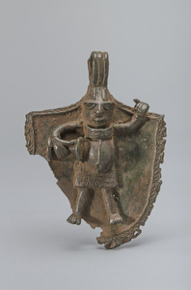
Pendant plaque. Small ancient shield shaped pendant of bronze, bearing a standing human figure in relief. This shield represents a pot-bellied figure holding a ?drum.
Place
Africa; West Africa; Nigeria; [Kingdom of Benin]; Edo State; Benin City; Oba's Palace
Period
14th - 19th century
Source
British Colonial Military Campaign on Benin [collector]; Webster, William Downing [vendor]
Department
Anth
Reference Numbers
E 1905.537; MAA: AR 1905.545; 1709 [Webster Coll.]; 11683 [Webster Coll.]; 688 [Webster Sale number; written on label]; 668 [Webster Lot number on label]
Cultural Affliation
Edo
Material
Metal; Copper Alloy; ?Bronze
Local Term
Measurements
100mm x 139mm x 19mm Weight 0.1933kg
Events
Context (Field collection)
Presumed taken on the British Colonial Military Campaign on Benin, February 1897, as Webster became the pre-eminent dealer in looted Benin material
Event Date 2/1897
Author: Katrina Dring
Description (Labels & Markings)
Label attached to object reads: 'E 1905.537. Bronze pendant. Benin. Bt Websters Sale, Nov. 30th 1904. Lot 668. Purchased 1905.'
Event Date 1905
Author: Lucie Carreau
Description (Physical description)
Catalogue card reads: "Three small ancient shield shaped pendants (imperfect) of bronze, bearing standing human figures in relief. Two male (one with helmet) and one female, (head missing)."
Added in different handwriting "E 1905.537 represents a pot-bellied figure holding a [see catalogue card for pen drawing] (drum?)"
Event Date 7/6/2000
Author: maa
Context (Auction / Sale)
Catalogue card reads "Purchased Webster Sale 1904"
Event Date 7/6/2000
Author: maa
Description (Labels & Markings)
The numbers '1709' and '11683' have both been written on the back of the object. The number '668' is a Webster Lot number and has been written on the label.
Event Date 25/1/2017
Author: Eleanor Wilkinson
Context (Analysis)
In January 2017, Prof. Marcos Martinon-Torres and Agnese Benzonelli, UCL Institute of Archaeology, tested this idno using a portable XRF as part of a programme of base metal analysis of Benin material.
Event Date 27/1/2017
Author: Eleanor Wilkinson
Context (Amendments / updates)
Replacement catalogue gives the provenance only as 'Benin' and places it within Nigeria, referencing the Kingdom of Benin. There is no mention of Benin City and thus the provenance of Benin City has been retained but queried. However the figures on E 1905.536-8 are all similar to those used on hip pendants that were seized in the looting of Benin City in 1897 and Webster is a known dealer in these items. It is likely they were acquired on the 1897 Expedition but there is no documentation at present.
Event Date 3/6/2019
Author: rachel hand
Context (Related Documents)
Catalogue card reads, in black biro: "1905 E 536-538 | AFRICA | WEST AFRICA / NIGERIA / Three small ancient shield-shaped PENDANTS (imperfect) of bronze, bearing standing human figures in relief: Two male (one with helmet) and one female (head missing). / Benin / Purchased / Webster's Sale 1904. | R. 1906.544-546."
In second hand, blue biro: "1905 E 536. represent a warrior wearing a helmet. / 1905 E 537 represents a pot-bellied figure holding a [diagram]-shaped object (drum?) / 1905 E 378 represents a woman."
Red circular sticker in bottom right of card.
Event Date 27/8/2020
Author: Katrina Dring
Context (Amendments / updates)
Photograph attached to rear of catalogue card.
Event Date 27/8/2020
Author: Katrina Dring
Context (References)
Part of the Digital Benin project website.
Available at https://digitalbenin.org/catalogue/28_E1905537>
Noted as 'Pendant plaques, like pendant masks, can be cast in brass or carved in ivory, and were worn as part of ceremonial regalia by members of the royal palace societies. Pendant plaques are typically U-shaped, with a suspension loop or loops at the top. Crotal bells would have been attached to the small round eyelets that decorate the bottom half. Many different motifs are shown; some common ones include images of horses and riders and Portuguese men, or just their heads, hinting at the close ties between Benin Kingdom and Portugal during the sixteenth and seventeenth centuries. Additionally, the Ọba is supported on either side by kneeling attendants in a triad or trinity form, a position often seen as part of festivals and ceremonies in Benin City today (Plankensteiner, 2007, p.369).'Part of the Digital Benin project website
Event Date 13/3/2023
Author: rachel hand
Context (Analysis)
Analysed using XRF instrumentation by Dr Agnese Benzonelli, University of Cambridge, as part of research by Prof. Marcos Martinon-Torres and Dr Agnese Benzonelli into Benin material at MAA
Event Date 13/3/2023
Author: rachel hand
FM:128111
Images (Click to view full size):