Accession No
E 1902.457
Description
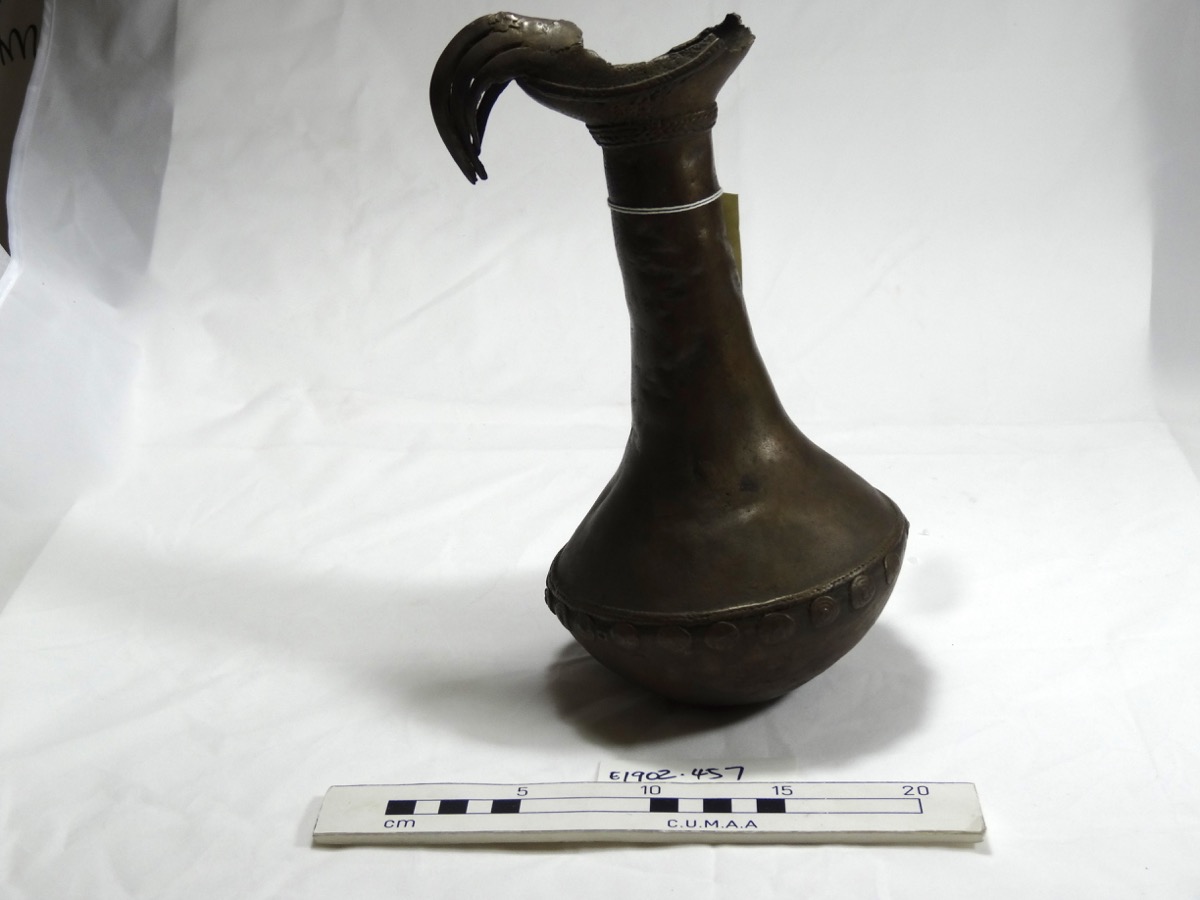
Uru. Jug of finely cast bronze . The decorated globular body slims to a long thick neck, which features the tail feathers of a cockerel. The rest of the body is missing.
Place
Africa; West Africa; Nigeria; [Kingdom of Benin]; Edo State; Benin City
Period
?15th century
Source
National Commission for Museums and Monuments, Nigeria [owner and lender]; British Colonial Military Campaign on Benin [collector]; Webster, William Downing [donor]
Department
Anth
Reference Numbers
E 1902.457; MAA: AR 1903.271; 9374 [Webster sale no.]; Fig. 84
Cultural Affliation
Edo
Material
Metal; Copper Alloy; ?Bronze
Local Term
Uru [Edo]
Measurements
151mm x 299mm x 160mm Weight 1.2kg
Events
Context (References)
Webster, W.D. (1900). "Catalogue No. 24, of Ethnographical Specimens in Bronze, Wrought Iron, Ivory and Wood, from Benin City, West Africa, taken at the fall of the City in February 1897, by the British Punitive Expedition under the command of Admiral Rawson." Illustrated Catalogue of Ethnological Specimens. European and Eastern Arms and Armour. Prehistoric and Other Curiosities, Vol. 4, No. 24.
Illustrated as Plate 17; figs 84-90. No. 84. (9374) Bronze vase ornamented with a cock on top (the head and neck are missing), 11-3/4 inches high, 6-1/4 inches diameter. £4.0.0.
Event Date 1900
Author: maa
Description (Physical description)
Catalogue card notes: "A finely cast bronze or brass jug: the globular body having in relief a double-plait fillet with concentric ring-pendants, merges into a thick tall neck with a fillet under the projecting oval mouth which represents the body of a cock. (Upper part defective)"
Event Date 6/6/2000
Author: maa
Description (Physical description)
Upper part of cockerel missing. Copper corrosion on shoulder. Small hole from casting error in base of neck with tail feathers and on proper left side of the bird's belly.
Event Date 10/5/2001
Author: Katrina Dring
Context (Display)
Exhibited in the Open Storage display of Benin material in Andrews gallery, from 19 July 2016, on the upper level.
Label noted:
Red Gold of Africa
When the Portuguese first arrived in on the West African coast in the fifteenth century, they quickly came to realise how important copper and bronze were for local people. It has been argued that these metals were more valued more highly than gold.
Europeans began producing copper and brass in the standardised form of the manilla to trade for slaves, ivory and gold. For around 400 years, manillas were central to the trade between Europe and West Africa.
Imported European brass replaced locally made bronze as the raw material used for casting. The proportion of zinc used to make brass increased in the 19th century. This change makes it possible to approximately date brass objects from Benin.
Individual label noted:
'Long necked jug. The top of this unusual jug seems to have been made in the shape of a cockerel, the tail feathers of which are all that remain. Analysis of its metal composition suggests that it is a tin bronze, containing no zinc. It is similar in composition to one thousand year old bronzes discovered at Ibo Ukwu, and could predate the arrival of the Portuguese in West Africa. Presented by W.D. Webster (E 1902.457)'
Event Date 19/7/2016
Author: Rachel Hand
Description (Labels & Markings)
The number '9374' has been written on the base of object. This is the Webster sale number which is also noted in the Accession Register.
Event Date 25/1/2017
Author: Eleanor Wilkinson
Context (Analysis)
In January 2017, Prof. Marcos Martinon-Torres and Agnese Benzonelli, UCL Institute of Archaeology, tested this idno using a portable XRF as part of a programme of base metal analysis of Benin material. The object was tested twice and the results are as follows: 1) Cu: 88.74%; Sn: 10.39%; Pb: 0.40%. 2) Cu: 88.64%; Sn: 10.56%; Pb: 0.38%. It was noted as Riederer ally A or Willett 1. It was noted that this object if of tin bronze with no Zn, As>Sb. It is broadly comparable to heads of Dark 1 and hence among the earliest (early 15th century) and also similar to Igbo Ukwu bronzes. But, of course, Sn-bronzes kept being used in Europe and as such it could be much later. Indeed the cast seems relatively crude, which might indicate a later date according to received wisdom. Therefore an early date is suggested but this is tentative.
Event Date 27/1/2017
Author: Eleanor Wilkinson
Conservation (Remedial)
CON.2017.3730 | Remedial
Event Date 7/2/2017
Author: Kirstie Williams
Context (Amendments / updates)
Given Webster's acquisition of much of the spoils of the Benin West Africa 1897 Expedition, and the early date of 1902-3, it is likely his personal donation of Benin material was also collected on the 1897 Punitive Expedition. This has therefore been added to the source field with queries to indicate the lack of available data for a definite provenance.
The note created during transcription of the catalogue card in 2001 added that it was unclear if 'Edo is the province or language group, and whether Benin refers to the city of Benin'. The Register noted only 'Benin, West Africa'. As the catalogue card was written before the creation of Edo State in 1991, 'Edo' would have referred to the Edo people and has been removed from the place field.
The narrow term 'Benin' has been used within the museum and more widely to refer to the both Benin City as well as the Kingdom of Benin and both terms have therefore been added to the place field in brackets to show the original provenance e.g., 'Benin [?Kingdom of Benin; ?Benin City].
Event Date 2/10/2018
Author: rachel hand
Context (Amendments / updates)
Catalogue card reads, in blue biro: "1902 E 457 | AFRICA | WEST AFRICA / NIGERIA / A finely cast bronze or brass JUG: the globular body [?having] in relief a double-plait fillet with concentric ring-pendants, merges into a thick tall neck with a fillet under the projecting oval mouth which represents the body of a cock (upper part defective) 12" x 6" / Benin W. Africa / Mr W.D. Webster | R 1903 271"
Red circular sticker in bottom right of card.
Event Date 24/8/2020
Author: Katrina Dring
Context (Amendments / updates)
Photograph attached to rear of catalogue card.
Event Date 24/8/2020
Author: Katrina Dring
Context (Other owners)
In July 2022, the University of Cambridge agreed to repatriate 116 artefacts, including this object, taken from Benin City by the British military in February 1897. A legal transfer of ownership to the National Commission for Museums and Monuments, Nigeria, took place on 27 January 2026.
The source field has been updated accordingly.
Event Date 27/1/2026
Author: Jan-Henrik Hartung
Context (Other)
One of 99 objects on deposit from the National Commission for Museums and Monuments (NCMM), Nigeria (pending a physical return to Nigeria).
Event Date 27/1/2026
Author: Jan-Henrik Hartung
FM:128094
Images (Click to view full size):