Accession No
E 1902.99
Description
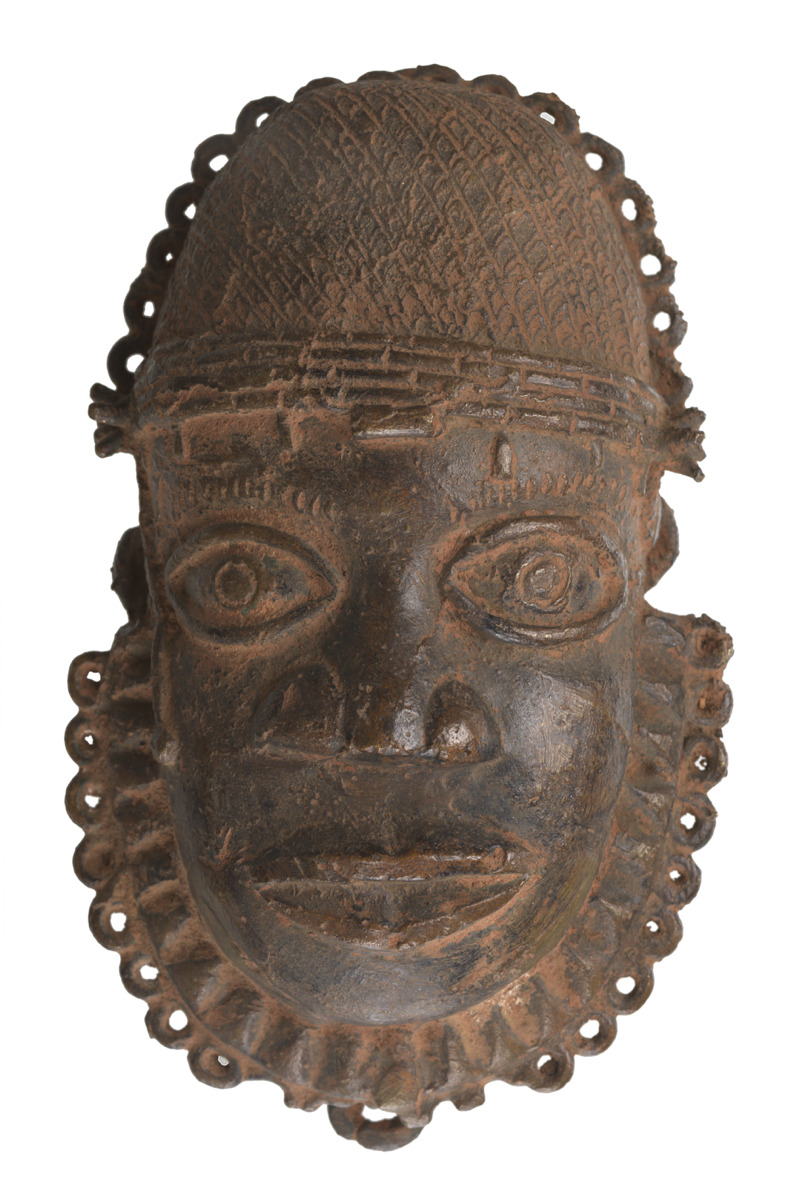
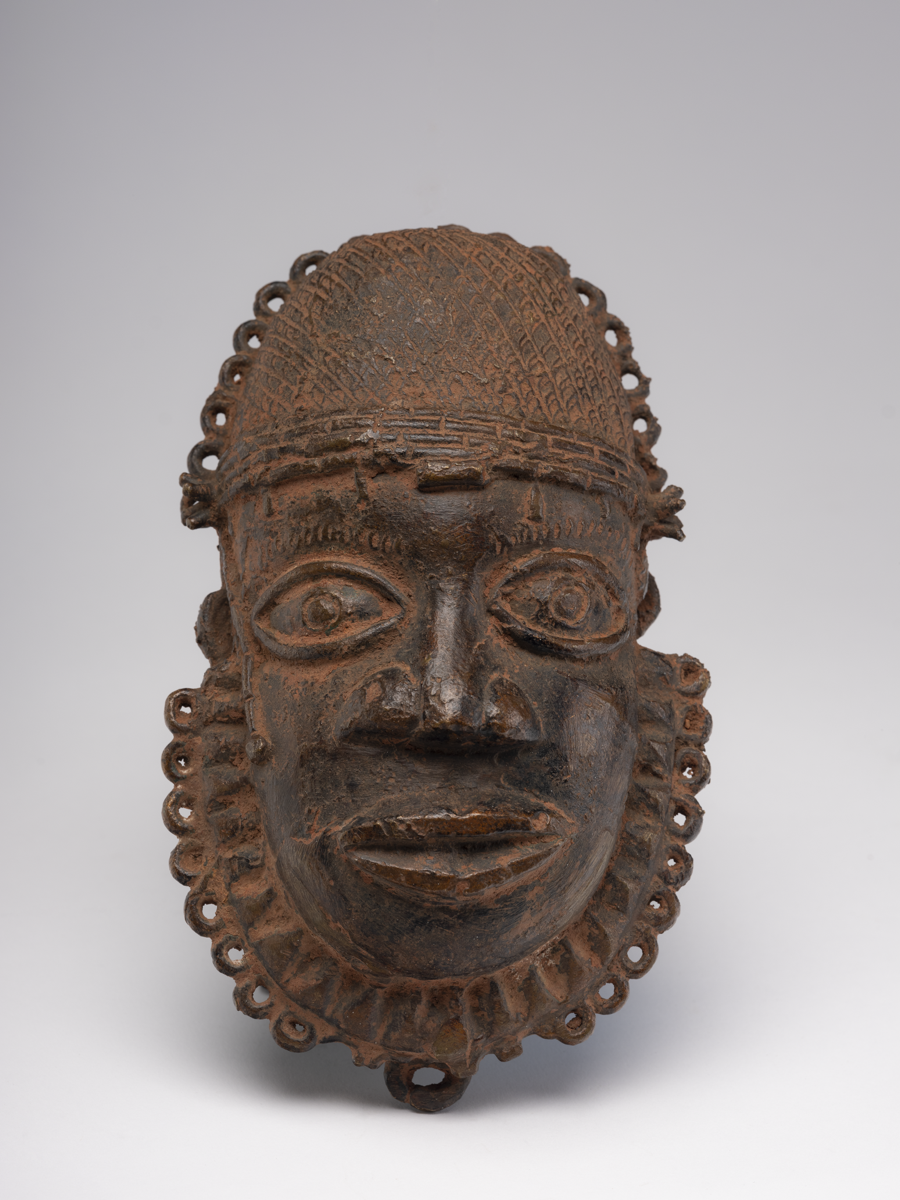
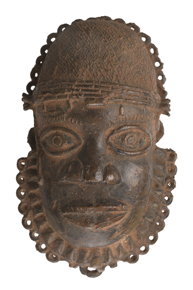
Uhunmwu-Ẹkuẹ. Pendant mask, worn on the hip, made of brass with reticulated headdress, tribal marking over the eyes and coral fronted bands.
Place
Africa; West Africa; Nigeria; [Kingdom of Benin]; Edo State; Benin City; Oba's Palace
Period
14th - 19th century
Source
National Commission for Museums and Monuments, Nigeria [owner and lender]; British Colonial Military Campaign on Benin [collector]; Stevens Auction Room [vendor]; Bevan, Anthony Ashley (Prof.) [monetary donor]
Department
Anth
Reference Numbers
E 1902.99; MAA: AR 1903.258; 12140 [on object]
Cultural Affliation
Edo
Material
Metal; Copper Alloy; ?Brass; Iron
Local Term
Measurements
109mm x 180mm x 55mm Weight 0.6kg
Events
Context (Field collection)
Taken on the British Colonial Military Campaign on Benin, February 1897
Event Date 2/1897
Author: rachel hand
Context (Related Documents)
E 1902.94- 115 are recorded in the Accession Register as acquired on the 'Benin, West Africa 1897 Expedition’ indicating they formed part of the spoils taken during the looting of Benin City.
Event Date 1902
Author: Rachel Hand
Description (Physical description)
Catalogue card E 1902.97-99 reads "Three human masks of brass with reticulated headdress (two decorated with rosettes, one open pattern), tribal marking over the eyes and coral fronted bands. In one the pupils of the eyes are inlaid with iron. Benin West Africa 1897 Expedition"
Event Date 4/6/2000
Author: maa
Context (Auction / Sale)
E 1902.93- 115 are annotated in the Register as 'B. Stevens *Prof Bevan' indicating they were purchased at an undated 1902 auction at J.C. Stevens saleroom, 38 King Street Covent Garden, London, with money donated to the Museum’s Accessions Fund by Prof. Anthony Ashley Bevan.
Event Date 4/6/2000
Author: maa
Context (Analysis)
In January 2017, Prof. Marcos Martinon-Torres and Agnese Benzonelli, UCL Institute of Archaeology, tested this idno using a portable XRF as part of a programme of base metal analysis of Benin material.
Event Date 27/1/2017
Author: Eleanor Wilkinson
Context (Amendments / updates)
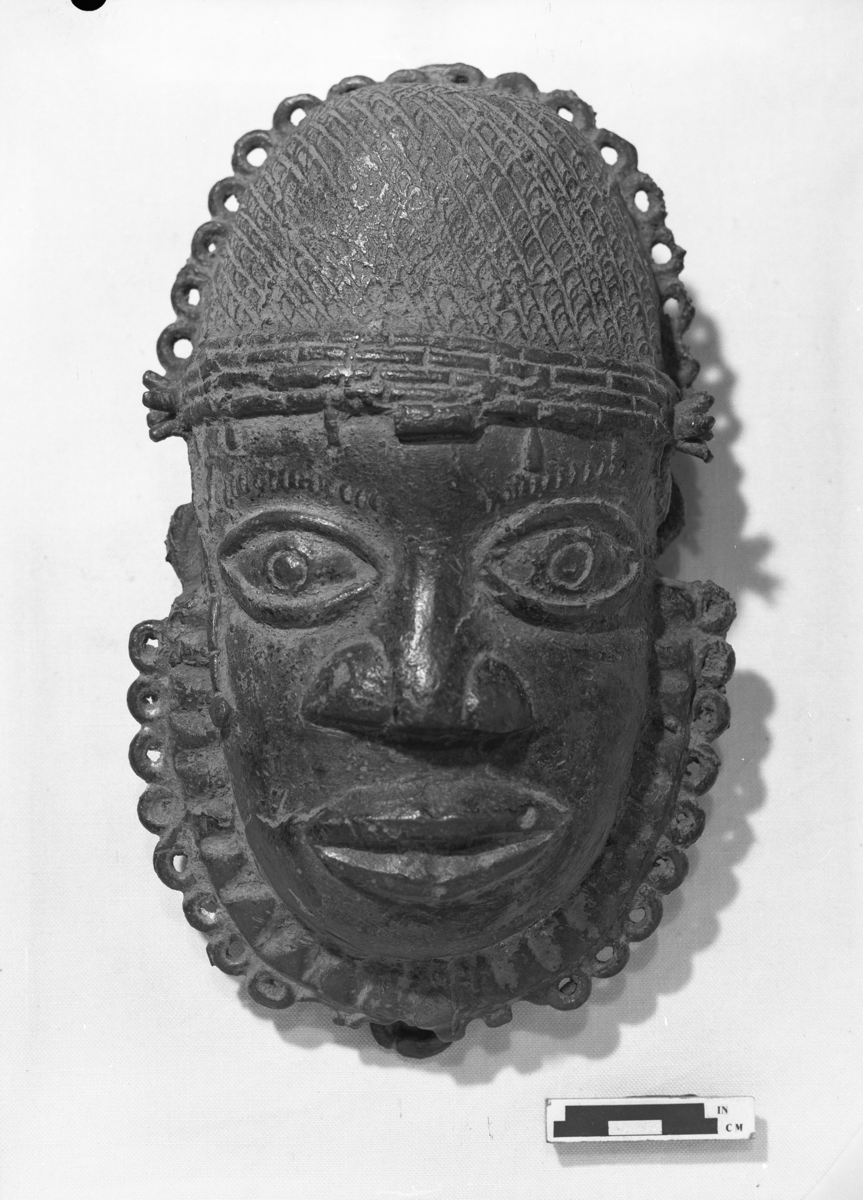
Photographs of E 1902.98 & E 1902.99 attached to rear of catalogue card.
Event Date 24/8/2020
Author: Katrina Dring
Context (Related Documents)
Catalogue card reads, in blue biro: "1902 E 97-99 | AFRICA | WEST AFRICA / NIGERIA / Three human MASKS of brass with reticulated headdess (two decorated with rosettes, one open pattern), tribal marking over he eyes and coral frontal beads. In one the pupils of the eyes are inlaid with iron. / 7" x 4.7", 7.2" x 4.4", 8" x 4.3" / Benin, West Africa 1897 Expedition. / purchased Stevens / Professor Bevan's donation | R. 1903 256-258"
Red circular sticker in bottom right of card.
Event Date 24/8/2020
Author: Katrina Dring
Conservation (Remedial)
CON.2022.5452 | Remedial
Event Date 11/10/2022
Author: Katerina Theodoraki
Description (Labels & Markings)
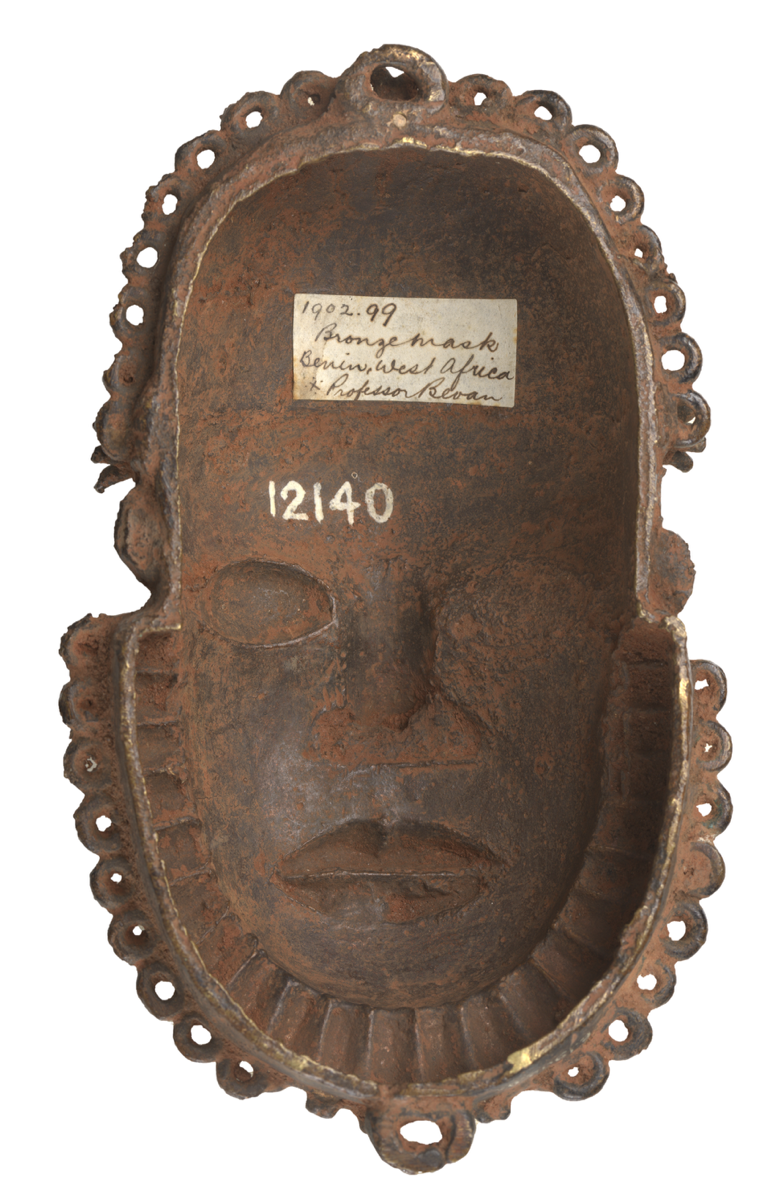
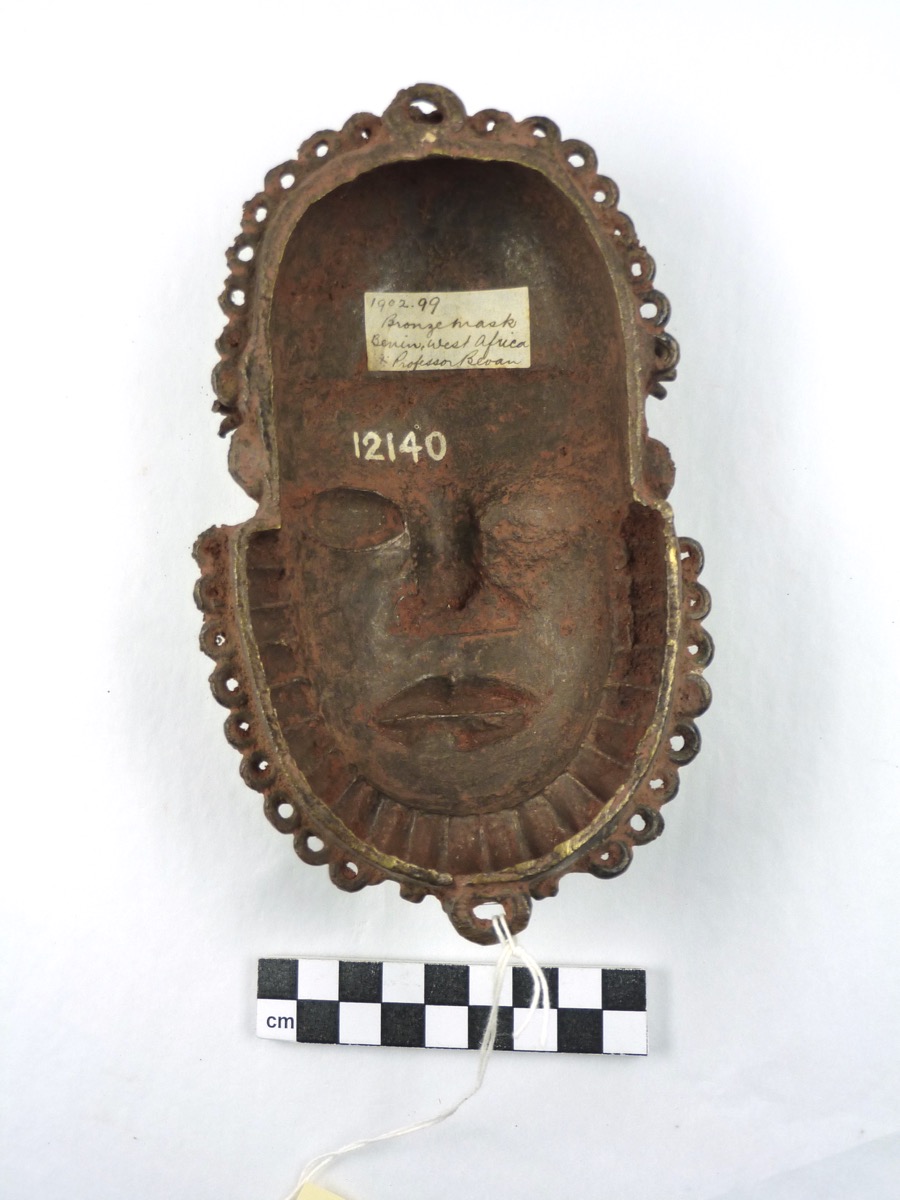
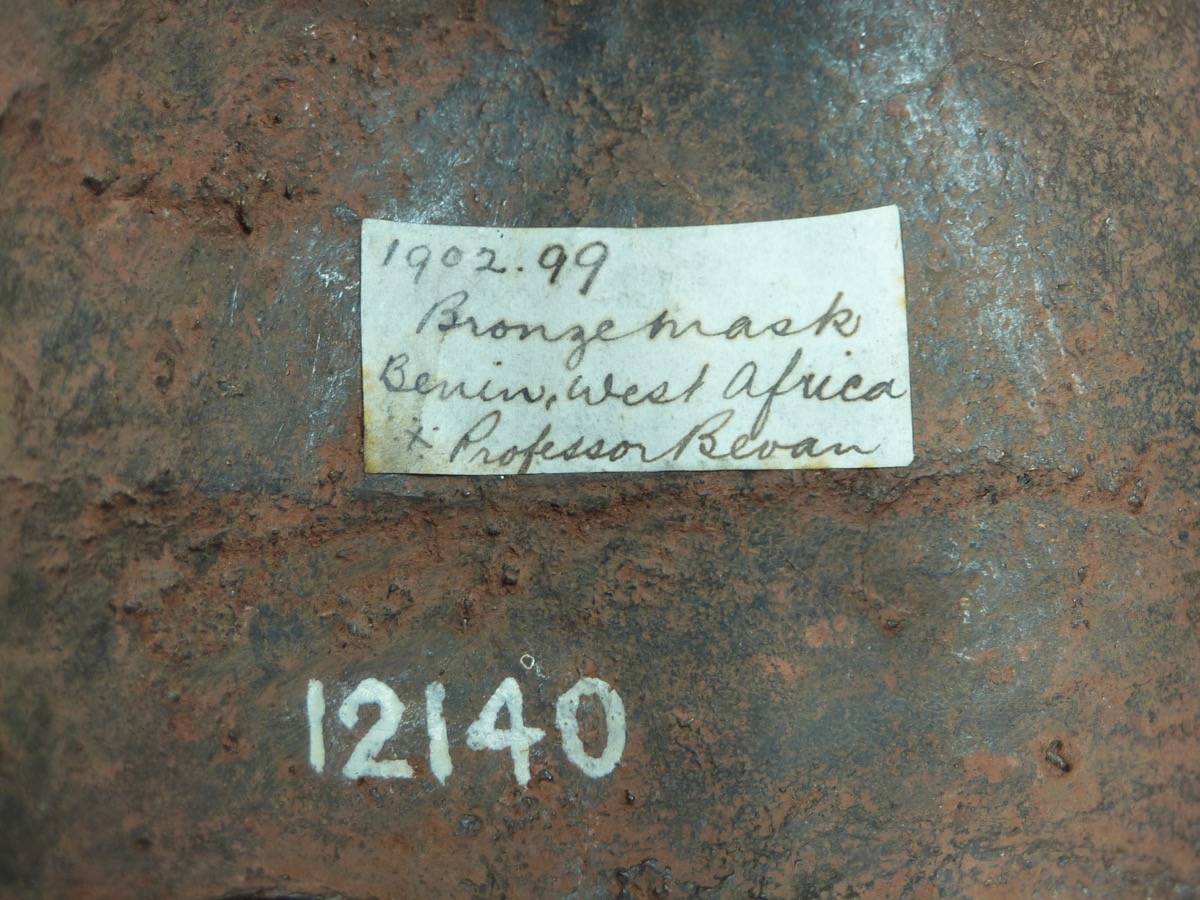
The number '12140' has been written on the rear of the mask, presumably a Stevens stock number
Event Date 28/2/2022
Author: Eleanor Wilkinson
Context (References)
Part of the Digital Benin project website. Available at
Noted as 'Uhunmwu-Ẹkuẹ (pendant masks) is a general term, however each mask has a different name depending on the subject depicted. For example, if an Uhunmwu-Ẹkuẹ depicted Iy’ọba Idia it would be called ‘Uhunmwun-Idia’.
Uhunmwu-Ẹkuẹ are one of the best-known categories of Benin artworks. A range of human and animal heads are depicted, hence the term ‘mask’, although they were not used to cover the face. Sometimes known as ‘hip masks’, they may be worn on the belt or hung at the hip as seen cast on relief plaques and in the carved motifs on altar tusks. Many pendant masks have a series of eyelets around the edge of the lower portion, to which small crotal bells were attached, and as the wearer moved they would have chimed.
The material – ivory or brass – and the iconography depicted were important factors in who was able to wear the masks and why. For example, leopard-head pendant masks may be worn by warriors and those involved in the military, and ivory masks only by the high-ranking Ezomo or Iyase (Blackmun in Plankensteiner, 2007, p.363). Meanwhile, brass crocodile-head pendant masks were the preserve of the Ọba, and he wore them in a set of three along the front of his belt (Blackmun in Plankensteiner, 2007, p.365).
Oftentimes, pendant masks also depict human faces, usually but not always, male. Although scholars do not agree, it has been argued these may depict the Ọba, or perhaps defeated chiefs (Blackmun in Plankensteiner, 2007, pp.358, 362). The faces of Portuguese men are also identifiable by their straight hair and beards, and attest to the importance of relationships between the Benin Kingdom and Portugal in the 16th century. The beautiful Queen Idia pendant masks, carved in ivory and which went on to become emblematic of FESTAC ‘77, are the notable exception to the predominantly male depictions on pendant masks.'
Event Date 14/3/2023
Author: Katrina Dring
Description (Labels & Markings)
Old museum label pasted to rear notes ' 1902.99/ Bronze mask/ Benin/ West Africa/ * Professor Bevan'.
Event Date 14/3/2023
Author: rachel hand
Context (Analysis)
Previous historic analysis indicated by drilled hole in rear at top near loop base, now infilled in yellow/brown. Unknown date or purpose, possibly NAA (neutron activation analysis) or lead isotope analysis
Event Date 14/3/2023
Author: rachel hand
Description (Physical description)
Uhunmwu-Ẹkuẹ. Pendant mask, worn on the hip, made of brass with reticulated headdress, tribal marking over the eyes and coral fronted bands.
Event Date 14/3/2023
Author: Eleanor Wilkinson
Loan (Exhibition)
Fitzwilliam Museum (UCM), 25/7/2023 to 7/1/2024, Enslavement & Resistance: Cambridge & the Black Atlantic
Event Date 25/7/2023
Author: rachel hand
Context (Other)
One of 99 objects on deposit from the National Commission for Museums and Monuments (NCMM), Nigeria (pending a physical return to Nigeria).
Event Date 27/1/2026
Author: Jan-Henrik Hartung
Context (Other owners)
In July 2022, the University of Cambridge agreed to repatriate 116 artefacts, including this object, taken from Benin City by the British military in February 1897. A legal transfer of ownership to the National Commission for Museums and Monuments, Nigeria, took place on 27 January 2026.
The source field has been updated accordingly.
Event Date 27/1/2026
Author: Jan-Henrik Hartung
FM:128046
Images (Click to view full size):