Accession No
1925.73
Description
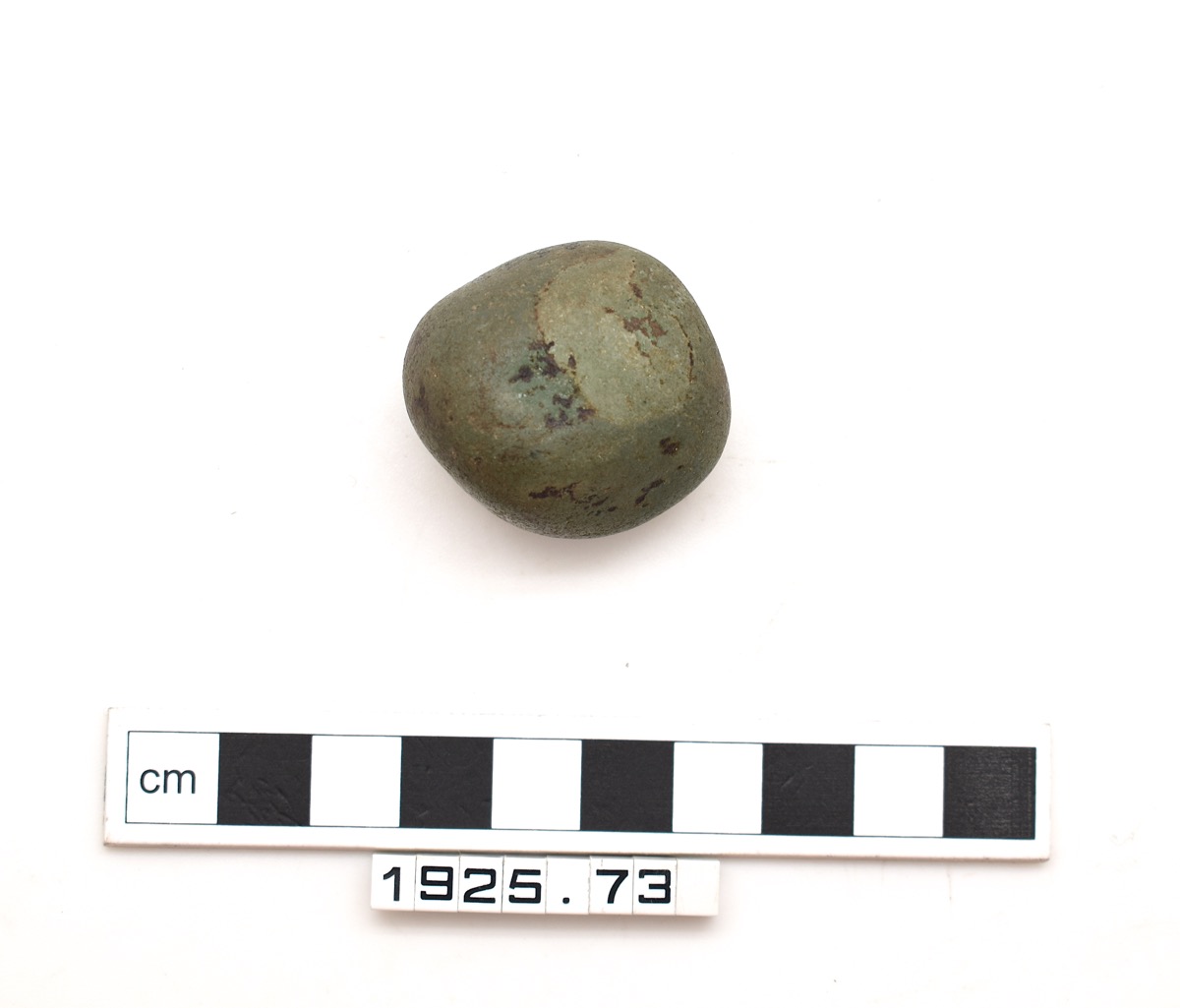
Rain-stone. Green roughly circular pebble, used as a rain stone.
Place
Africa; East Africa; South Sudan; Central Equatoria
Period
Source
Leju lo Lugör [previous owner]; Haddon, Ernest Balfour [collector and donor]
Department
Anth
Reference Numbers
1925.73
Cultural Affliation
Bari
Material
Stone
Local Term
'dikolo [Bari]
Measurements
33mm
Events
Description (Physical description)
Rain-stone (green) obtained from Leju - principal Rainmaker of the Bari (Pitia - ?his son - is now principal man).
Event Date
Author: maa
Context (Acquisition Details)
obtained from Leju - principal Rainmaker of the Bari (Pitia - ?his son - is now principal man).
Event Date
Author: Louise Puckett
Description (Physical description)
Rain-stone. Green roughly circular pebble, used as a rain stone.
Event Date 15/12/2021
Author: Louise Puckett
Context (Amendments / updates)
Between 1898 and 1914, the area on the east bank of the White Nile, south of the 5th parallel was annexed to the Uganda Protectorate. The area north of the 5th parallel was included in Mongalla Province of the Anglo-Egyptian Sudan. In 1914, the boundary between Sudan and Uganda was rectified and the region south of the 5th parallel (including Bari, Lulubo, Lokoya and Otuho cultural groups) was transferred to Sudan. The place field has been updated to ‘South Sudan’. At the time the object was acquired the area was administered by Uganda, but it is now part of South Sudan.
Event Date 15/3/2022
Author: Zoe Cormack
Context (Related Documents)
Haddon, E.B (1911) 'Notes on the Ethnography of the Bari.' M.A. thesis, University of Cambridge, kept in the Haddon Library, Cambridge.
Spire, F (1905) 'Rainmaking in Equatorial Africa.' in Journal of the Royal African Society 5(17): 15-21.
Seligman, C.G and B.Z (1932) 'Pagan Tribes of the Nilotic Sudan'. London: Routledge. pp.281-296.
Simonse, S (2017) 'Kings of Disaster: Dualism, Centralism and the Scapegoat King in Southeastern Sudan. Updated Edition. Kampala: Fountain Press.
The Shindiru shrine (where this rain stone likely originated) has been documented by administrators and anthropologists since the early nineteenth century. For photographs see Spire (1905), Simonse (2017:300) and in MAA collections ‘Rain stone at Shindiru’ (P.13617.ACH2) and ‘Bari rain shrine at Shindiru' (P.13618.ACH2)
Event Date 16/3/2022
Author: Zoe Cormack
Context (Field collection)
Ernest Haddon was an administrator in the Uganda Protectorate based at Gondokoro from 1909 to 1910. He wrote a thesis ‘Notes on the Ethnography of the Bari, Uganda Protectorate’ at Christ’s College in 1911 which was based on his work in Gondokoro. He assembled a collection of objects during this period, some of which are mentioned in his thesis and illustrated in an appendix (Haddon 1911: Appendix iii). This rain stone is illustrated as Fig. 8 in Appendix iii. Haddon has written ‘The stone in my possession is about 1 ¼ inches square. It is of green quartzite bearing some resemblance to the surface quartzite’s of South Africa’ (Haddon 1911:138).
Documentation at MAA records that Haddon acquired this rain stone from ‘Leju – principal rainmaker of the Bari’. Leju lo Lugör was the Rainmaker of Shindiru from 1897-1912. He was the most senior Rainmaker of the Bekat dynasty, the most powerful rain-clan of the Bari. Shindiru was the most important rain shrine to Bari people. It is located about 25 miles south of Juba, near the White Nile and Kit River.
As one of the largest and most influence rain shrines, Shindiru contained over 200 rain stones and other rain making equipment, including iron rods and containers. Spire records that in the early twentieth century, it was enclosed by megaliths, however, these were not present when Simonse visited in 1981. (Spire 1905: 16; Simonse 2017: 300)
It is not clear precisely how Haddon got possession of this rain stone. He met Leju and visited his home in 1909-1910. Haddon describes the Shindiru rain shrine in this thesis: ‘In Leju’s village there was a little enclosure in which the articles were kept…Leju had numerous iron spears, as described by Mr Spire; some double bladed spears were very interesting...’ (Haddon 1911:139)
Although Haddon describes several interactions with Leju, he did not record the circumstances in which the stone was removed from the shrine. It is plausible that Leju gifted the rain stone to Haddon. Leju’s relationship with the government went back several years before his meeting with Haddon, to the time when Spire (a previous administrator) offered him refuge during a drought: ‘Some time ago Ledju publicly announced his inability to make rain and in consequence the population seriously threatened his life and he was obliged to fly to the Government station of protection, where he resided for some time’. (Spire 1905:20) Leju was reported by Haddon to have wavering control over the rain: ‘Leju has, I know, been unfortunate in his control over rain, and I know that Pitia [his brother] now often tries his hand.’ (Haddon 1911:139) It could have been that Leju saw the relationship with the government as a useful contingency, and the gift of a rain stone as a way of consolidating this association. Such a gift may well have been a response from Leju to a request from Haddon for a rain stone. It is also possible that the stone was given to Haddon under duress or a sense of obligation. There are several indications in Haddon’s thesis that he did not hold Leju in high esteem. (Haddon 1911: Appendix vii, 22)
Historical and ethnographic sources note various cultural restrictions and prohibitions over who may see and handle rain stones. If this stone was a gift to Haddon, it is possible that it has been desacralized. However, it is not currently known what the significance of this rain stone might be to the current custodians of the Shindiru shrine. This is a matter for continued investigation.
(with thanks to Simon Simonse for suggestions of sources and interpretation.)
Event Date 16/3/2022
Author: Zoe Cormack
Context (Amendments / updates)
The Pitia who is mentioned in the database as Leju’s son is likely to be his brother, Pitia lo Lungör. He was Chief Rainmaker of Shindiru 1912-1949. In 1981, Pompeio Lado, Pitia lo Lungör’s grandson, was the Chief Rainmaker of Shindiru. (Simonse 2017: 506, 300).
Event Date 16/3/2022
Author: Zoe Cormack
FM:120812
Images (Click to view full size):