Accession No
Z 10040
Description
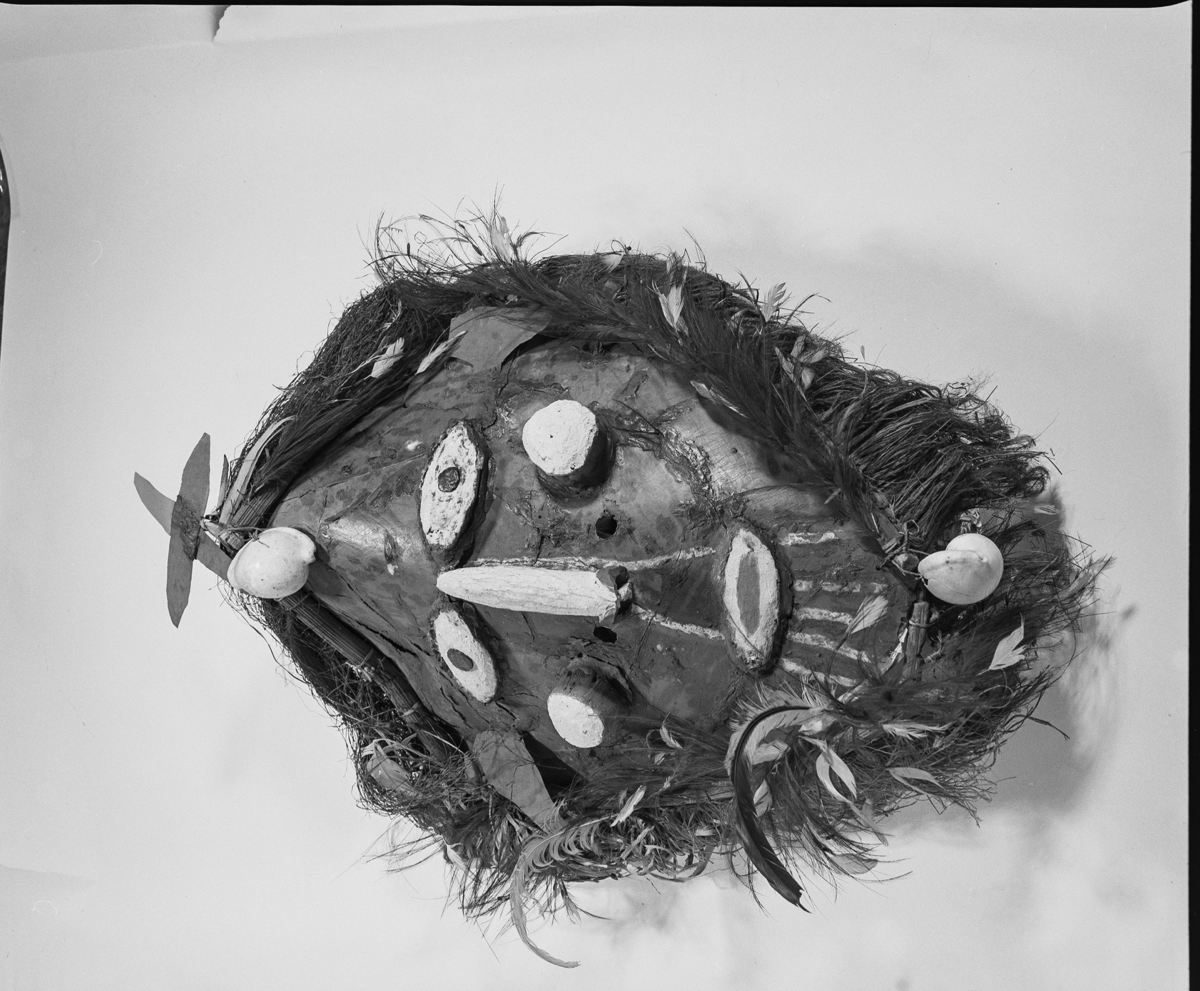
Le op or dogaira wetpur krar. Large mask of the human face made of whole shell of hawksbill turtle, fringed with cassowary and other feathers and vegetable fibres. Attached nose of wood. Nose, eyes, cheeks and mouth painted red and white. Cowries attached at forehead and chin. Crossed bullroarers as crest. Used in dances celebrating a good harvest.
Place
Oceania; Australia; Queensland; Torres Strait; Mer
Period
Source
Bruce, John (Jack) [collector]; Haddon, Alfred Cort (Dr) [donor]
Department
Anth
Reference Numbers
Z 10040; OH 346
Cultural Affliation
Material
Shell; Turtle Shell; Feather; Cassowary Feather; Wood; Plant
Local Term
Le op; dogaira wetpur krar
Measurements
500mm x 760mm
Events
Context (References)
Cf also the Haddon Archive, p.1036 (in the University Library)
Event Date
Author: Rachel Hand
Description (Physical description)
Catalogue card noted" Large mask of the human face made of whole shell of hawksbill turtle, fringed with cassowary and other feathers and vegetable fibres. Attached nose of wood. Nose, eyes, cheeks and mouth painted red and white. Cowries attached at forehead and chin. Crossed bullroarers as crest. Used in dances celebrating a good harvest.
Smaller than original.
Event Date
Author: maa
Context (References)
A.C. Haddon (Reports of the Cambridge anthropological expedition to Torres Straits. Vol. VI. Sociology, magic, and religion of the Eastern Islanders Cambridge: Cambridge University Press, p. 209, Pl. XXII, fig. 7 and which notes:
'An original Dogai mask may exist in some museum, but of this there is no record, so I asked Mr Bruce to have one made for me, and after a great deal of trouble he succeeded in sending a model to the Cambridge Museum (pi. XXII. fig. 7). This specimen is about 755 mm. (nearly 30 in.) in height and 480 mm. (19 in.) in breadth.
It is composed of unpainted turtle-shell; the large nose is white with red alas, the lips are white and the mouth red, the ears are red, the raised eyes are white with a black pupil, below each eye is a low cylinder or wart (au bage bage, “big cheeks,” evidently to indicate high cheek bones) with red sides and white top, 64 mm. in diameter, 37 mm. in height. A red line passes down each side of the nose to the angle of the mouth and one from each ala to the mouth, the space between these is white. Six red and five white lines run vertically below the mouth. A red band runs round the face and expands into a diamond on the forehead. Sticks of pith surround the face, to which are fastened bunches of cassowary and other (mainly white) feathers to represent hair ; shredded bark, grass, etc. form a fringe at the sides of the face and there is a long fringe of sago leaves, bisi, round the head. A white cowry is fastened above and another below and a four-rayed star, dogaira wer, is fixed above the forehead. On each side of the nostril is a hole for the wearer to see through and a loop stretches from side to side at the back of the mask which the wearer gripped in his mouth.'
Event Date 1908
Author: Rachel Hand
Context (References)
cf. cf A. C. Haddon (1935) Reports of the Cambridge Anthropological Expedition to Torres Straits. Volume I. General Ethnography. Cambridge: Cambridge University Press, p. 179-81
Event Date 1935
Author: Rachel Hand
Context (References)
David Moore's book examined all the Haddon material in British and Australian Museums.
Moore, D. (1984) The Torres Strait Collections of A.C. Haddon. London: British Museum Press, p75, No. 365, Pl. XXXII, notes
'Mask, human face, turtle-shell. Dogaira wetpur krar or le op.
Large mask made of whole shell of hawksbill turtle, fringed with cassowary and other feathers and vegetable fibres. Attached nose of wood. Nose, eyes, cheeks and mouth painted red and white. Cowries attached at forehead and chin. Crossed bullroarers as crest. Used in dances celebrating a good harvest. Smaller than original.
J. Bruce, Mer (1905?)'
Event Date 1984
Author: maa
Context (References)
lllustrated in the catalogue Aratjara: Art of the First Australians Kunststammlung, Nordrhein-Westfalen, Dusseldorf and DuMont Buchverlag- Colongne (1993), p. 106, fig. 2
Event Date 1993
Author: Rachel Hand
Context (Display)
Exhibited: On loan to Aratjara: Art of the First Australians. Traditional and contemporary works by Aboriginal and Torres Strait Islander artists, Kunstsammlung Nordrhein-Westfalen, Dusseldorf, 24 April- 4 July 1993.
Event Date 1993
Author: Rachel Hand
Context (Display)
Exhibited: On loan to 'Past Time: Torres Strait Islander Material from the Haddon Collection, 1888-1905' at the National Museum of Australia, Canberra, March 2001-May 2002 and at the Cairns Regional Gallery, June to September 2002. Illustrated in the accompanying catalogue of the same name, p. 41
Event Date 16/1/2015
Author: Rachel Hand
Context (Production / use)
A model commissioned by Jack Bruce, possibly in 1905 for A.C. Haddon. Used in dances celebrating a good harvest. Stated to have been made to order, smaller than original
Event Date 16/12/2024
Author: Rachel Hand
FM:100069
Images (Click to view full size):