Accession No
E 1913.12
Description
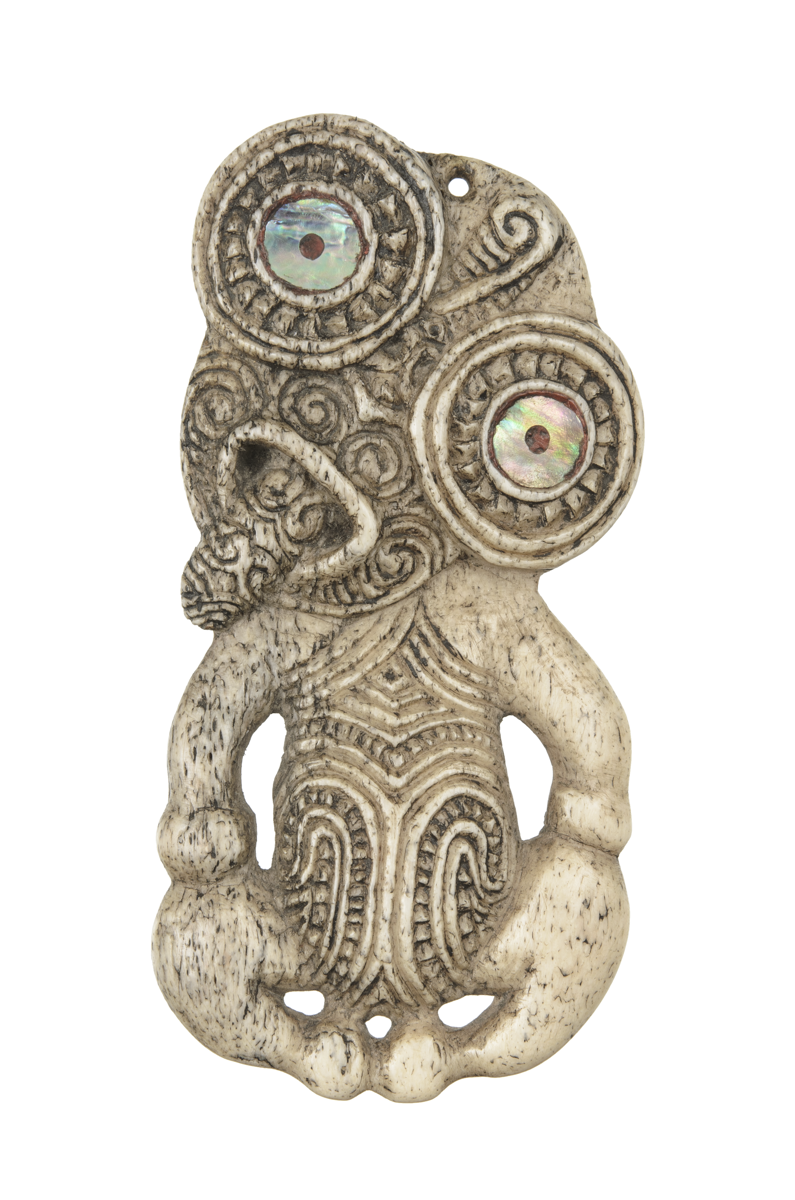
Hei Tiki Parāoa. Whale bone tiki, facing right, with eyes, face, tongue and trunk elaborately carved. Thought to be a fake made by Englishman, James Little
Place
Oceania; Polynesia; Aotearoa New Zealand
Period
Source
von Hügel, Anatole (Baron) [collector]; Bevan, Anthony Ashley (Professor) [monetary donor]
Department
Anth
Reference Numbers
E 1913.12; MAA: Z 6458
Cultural Affliation
Maori
Material
Bone; Whale Bone
Local Term
Tiki
Measurements
45mm x 6mm x 92mm
Events
Context (Acquisition Details)
Register notes that for 1913.4-12 '*Professor Bevan' indicating that it was purchased with money donated to the acquisitions fund by Professor Bevan, and adds '[Hugel Collln]'. This suggests it was purchased from von Hugel's own personal collection, and presumably bought at Webster's sale room, London in 1907.
Event Date 1913
Author: Rachel Hand
Context (References)
H.D. Skinner (1974) Comparatively Speaking', (ed.) Peter Gathercole. Dunedin, p. 180, fig. 12.17,
Event Date 1974
Author: Rachel Hand
Context (Amendments / updates)
Peter Gathercole (1978) suggested this was a fake by James Little and refers to it as carved in a 'trumpet' style.
Event Date 1978
Author: Rachel Hand
Context (References)
P. Gathercole, 1978, ‘Obstacles to the Study of Maori carving: The Collector, the Connoisseur and the Faker' in Art in Society, M. Greenhlagh and V. Megaw (ed.) Duckworth London, pp. 275- 288.
Event Date 1978
Author: Rachel Hand
Context (References)
"Little was a furniture restorer who supplemented his income by dealing in authentic ethnographic artefacts and, eventually, by faking them, specialising in Polynesian, and particularly Maori, objects. He made several similar free-standing figures, one of which, bought in 1910 by a New Zealand collector, W. H. Skinner, is now in the National Museum of New Zealand in Wellington. Little's business, which he operated worldwide by mail order, flourished for nearly twenty years. His activities were first discovered in 1910 by the collector-dealer William Oldman after Little had made and sold a pair of Marquesan stilt steps (Watt 1982). Little's fakes still appear occasionally in sales even today."
The British Museum, WEB, R. J. Watt, 'James Edward Little's Forged Marquesan Stilt Steps', Records of the National Museum of New Zealand 2, no. 7 (1982, pp. 49-63).
Event Date 1982
Author: Rachel Hand
Context (References)
cf. Robin James Watt, ‘Fake Maori Artefacts of James Edward Little and James Frank Robison’, ( PhD thesis, Victoria University, Wellington: 1990, pp. 226-227.
Watt does not ascribe the tiki to Little on the basis that the ’trumpet style tiki is dissimilar to other Little pieces. He also discounts it as one of Robison’s though a similar tiki was sold in Christies in 1974 and was described as probably by Robison, but gave no evidence. Watt also notes that E 1913.12 may have been exhibited in Ta Aroa L’Univers Polynesian in Brussels in 1982, as the catalogue image (illustrated by him on Pl. 92) seems to show this tiki, (see De Dekker, Credit Communal de Belgique, 1982)
Event Date 1990
Author: Rachel Hand
Description (CMS Description)
Whale bone charm, tiki, facing right, with eyes, face, tongue and trunk elaborately carved. Age unknown,
Event Date 2/7/1993
Author: maa
Context (Related Documents)
Used on the publicity poster for the MAA exhibition Pasifika Styles, 2006. Curator Amiria Salmond noted that that was ' one of the reasons we (or at least I) thought he was a great ambassador for our project, which sought to confound people's expectations of what counts as "Maori" (or "Pacific") art, and to demonstrate its global influence' 15.12.2008, email correspondence from Amiria Henare [Nee Salmond) to Steve Hooper
Event Date 2006
Author: maa
Context (Amendments / updates)
Ngarino Ellis, University of Auckland, notes that the authenticity of this piece is questionable and that the ethnicity of the maker should be investigated, 16/10/2014
Event Date 16/10/2014
Author: Rachel Hand
Context (Amendments / updates)
Steven Hooper, (email to Amiria Henare 15.12.2008) suggested this could be by James Edward Little, and noted that "it is almost certainly the work of the famous English faker James Edward Little. It includes diagnostic features such as the double ring around the eyes, the single spiral with crescents below on the forehead and the rather poor carving on the body, which are typical of Little's whalebone work. His wood fakes were more precise, though sometimes in idiosyncratic style and sometimes copies of things he had stolen from museums.
As far as I know, whalebone was not used for tiki until the end of the 19th century when fakers and souvenir-makers started using it. The acquisition date by MAA of 1913 in a saleroom fits well with Little's activities. There is an article about Little and Robieson (another faker) in the book of essays by H.D. Skinner edited by Peter Gathercole, 'Comparatively Speaking', Dunedin 1974. On page 180, fig. 12.17, you will see a bone flute by Little in a similar style, now in Pitt Rivers and previously Wellcome collection, which was full of fakes.
The history of 'Maori' fakes and their relationship to replicas, commercial souvenirs and art in new materials, where boundaries are blurred and the whole issue of authenticity is problematised, is really interesting. There were certainly German and Dunedin-based lapidaries in the early 20th century making nephrite mere and tiki, partly as fakes to deceive and partly to restock Maori communities whose older ones had been sold, stolen or given away."
Hooper continued (in a later email, 15.12.2008) ‘W.D. Webster was a dealer operating at that time in London, who could have been 'fed' things by Little. It looks as though the baron was buying things for himself, and then perhaps Bevan put up money to buy them for the museum subsequentl'y.
Hooper later noted [in an email to R. Hand 15.12.2016] 'Little remains the most likely maker. The fact that it came from WD Webster in 1907 suggests he could have got it from a UK source. Webster had sold up most of his stock in 1904, but continued to operate as a dealer until his death in 1913 (see Hermione Waterfield's Provenance book, 2006). It doesn't have the look of a Robieson piece, as he was experimenting with whacky designs and forms in a Maori style. There may have been other unnamed pakeha making things like this at the period. My gut feeling is that it was not a Maori who made it, even an apprentice Rotorua-type carver supplying tourists.'
Event Date 14/12/2016
Author: Rachel Hand
Description (Labels & Markings)
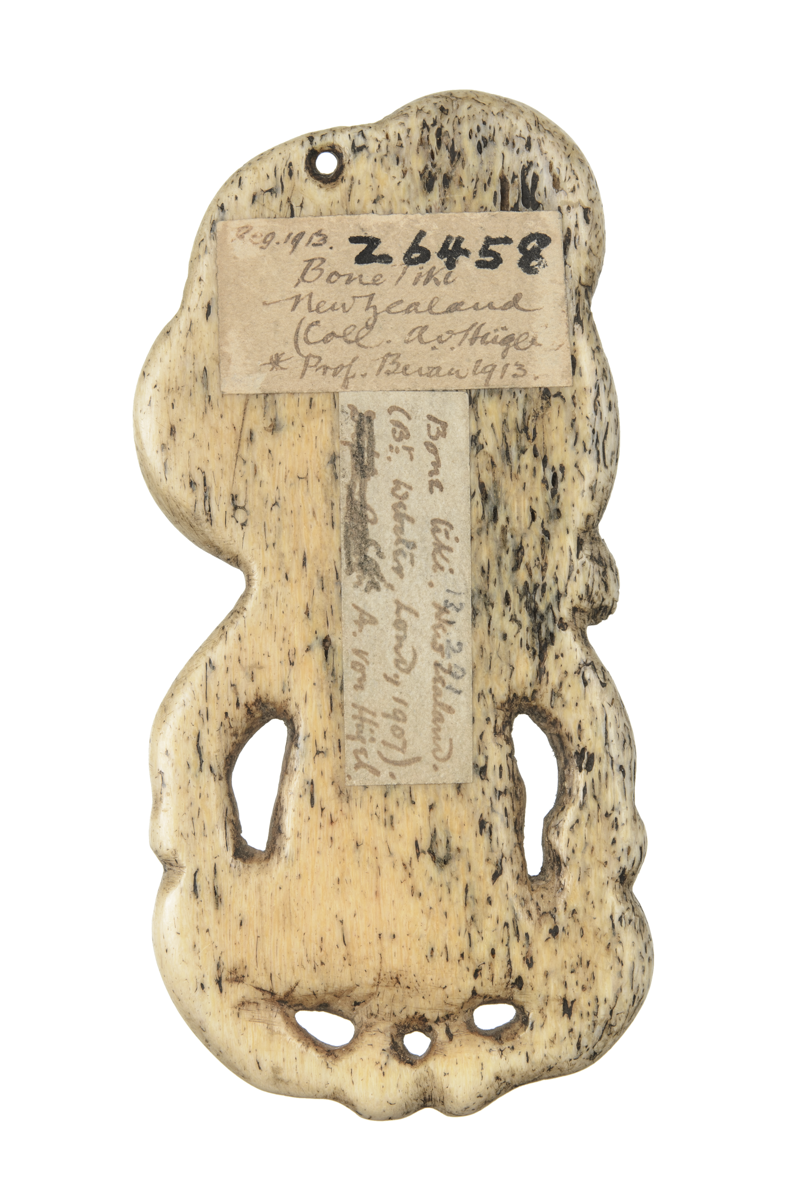
Object Label (1) affixed to rear of the hei tiki parāoa notes: '(Bt. Webster, Lond., 1907). A. von Hugel.'
Label (2) affixed to rear of tiki notes: 'Coll. A. von Hugel. Prof Bevan 1913.'
Event Date 26/7/2024
Author: Rachel Hand
FM:98521
Images (Click to view full size):