Accession No
1951.995
Description
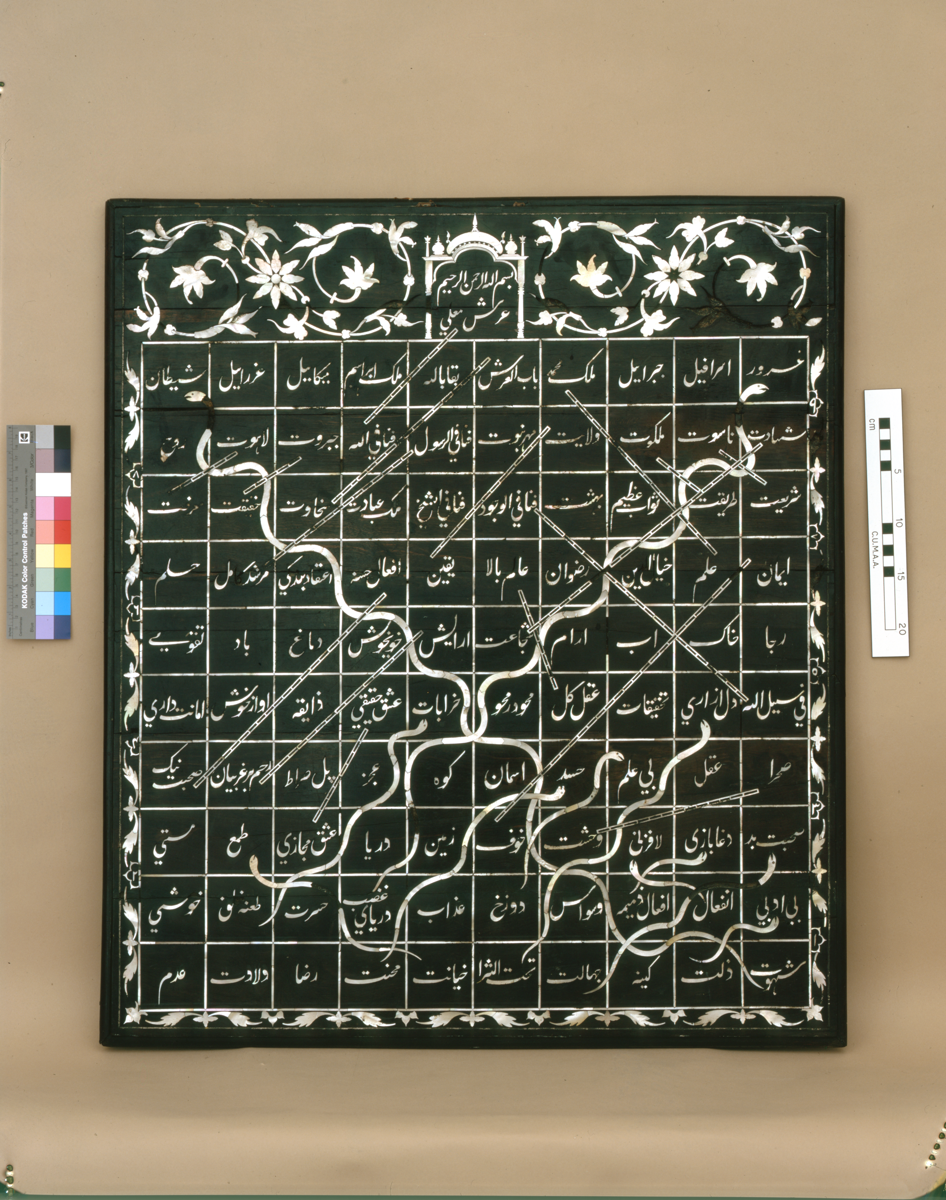
Shatranj-i ‘urafā. Snakes and Ladders game board made of wood inlaid with mother of pearl. 100 squares, each with a virtue or vice in Arabic script. Players must attempt to reach the top of the board, hoping to land on virtues from which ladders take lead to higher squares and avoiding the vices from which snakes lead downward.
Place
Asia; South Asia; India; ?Delhi
Period
19th century
Source
Lawrence, Richard Charles (Sir) [collector]; Lawrence, Henry Rundle [Lieutenant-Colonel] [donor];
Department
Anth
Reference Numbers
1951.995
Cultural Affliation
Material
Wood; Shell; Mother of Pearl
Local Term
gyan chapar
Measurements
695mm x 80mm x 798mm Weight 22.0kg
Events
Context (Other owners)
Letter from Henry Lawrence to MAA, 11 December 1938:
‘Sir. I am not out after money – when I had the privilege of the friendship of Baron Anatole von Hügel, I put in a few objects that he thought worthy of the Varsity Museum. I have now two things that I thought you might be interested in. One would rather see them go to our Varsity than into a junk shop.
‘Item A “Snake & Ladder” board which my Grandfather, General Richard Charles Lawrence, brought back from India in 1857, when he “acquired” it after the Mutiny under the impression that it was then an antique. It is of mother of pearl inlaid in a heavy black wood which may be ebony, but which I believe to be shisham, or Tali.
‘My small stepgrandson, who knows all about snakes and ladders, inspected it thoughtfully and asked what the name in the top left hand corner was. No chance of getting out of that. Shaitan. What does that mean? The devil. Oh well. Of course. Then you have to go back to the beginning. The arch angels etc. are interesting. Clearly some Hindu or other unbeliever has got at the Lord Mahomed, and picked out the mother of pearl. Is it any use to you? A permanent loan till I pan out – Then for my executor – beneficiaries there will be none. Personal, and poor, snap shots enclosed.’
Event Date 11/12/1938
Author: Mark Elliott
Description (Physical description)
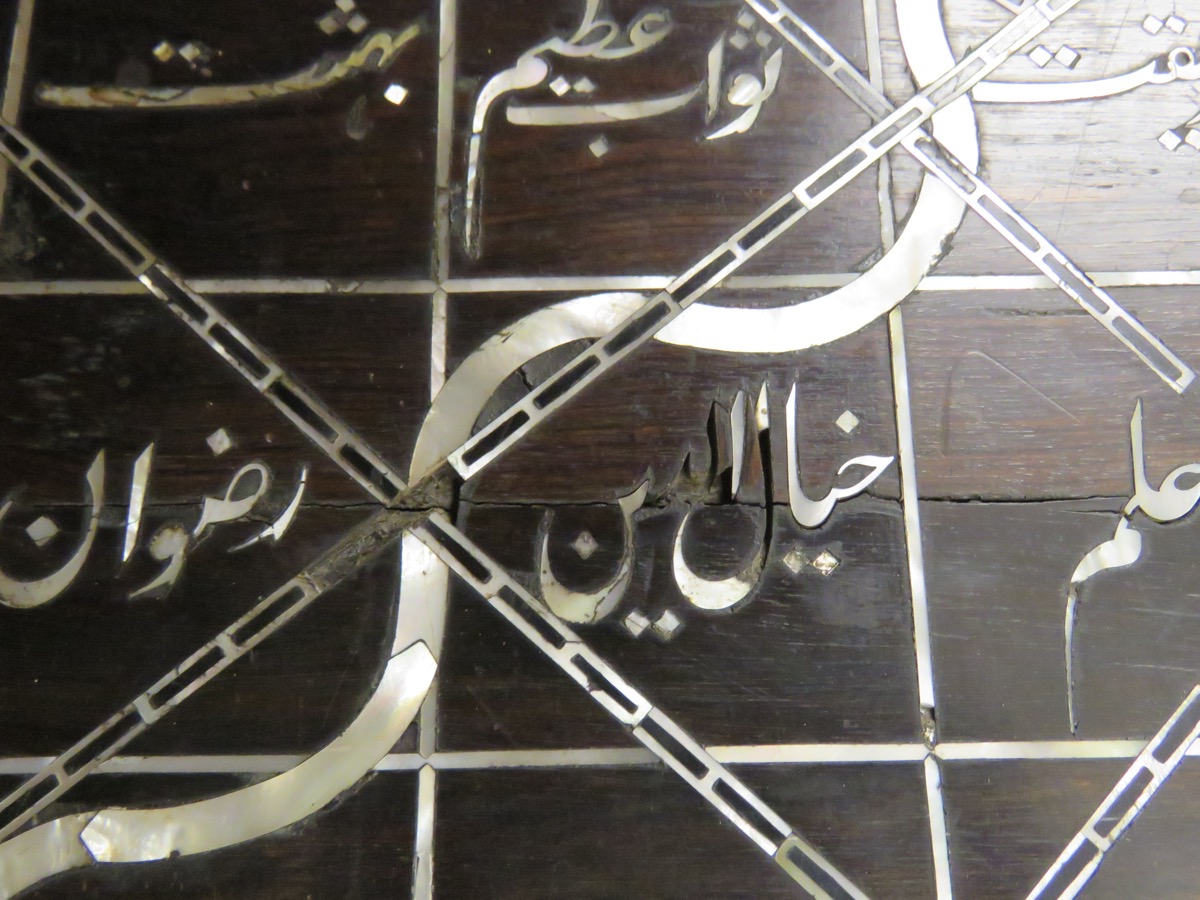
" Snakes and ladders" board based on " Jagar Table" , made of heavy, black wood (possibly ebony, shisham or Tali), and inlaid with mother of pearl. There is a floral design and the representation of a mosque at the top, while the squares of the board bear an inscription in Persian characters.
Event Date 29/8/1995
Author: maa
Context (CMS Context)
Translation: This is long - a name or expression being contained in each square. At the top is Diswilah, the Throne of God. The top line reads: " Satan; Azrael; Michael; Father Abraham; Bukabala; the Gate of the Citadal; Mohammed; Gabriel; the Angel of Death; Pride. The last line reads (left to right): " Want; birth; consent; labour; dishonesty; Tahtalhara; folly; hatred; insult; desire." For full translation see contents of large envelope attached to correspondence in Dr Bushnell' s file, 1949, under " L" .; Collected by: Lawrence.R.C in 1857
Event Date 29/8/1995
Author: maa
Context (Amendments / updates)
Piece of glass specially cut to fit over this object under the frame now disposed of.
Event Date 18/2/2013
Author: Rachel Hand
Exhibition (Other)
Exhibited: "Gifts and Discoveries" Li Ka Shing Gallery, MAA, 25 May 2012 - 17 February 2013.
Curated by Nicholas Thomas and Mark Elliott. Exhibition text:
"Snakes and Ladders
"The game we know as snakes and ladders comes from India. It goes back eight centuries or more, and there have been Hindu, Jain and Buddhist versions, as well as one inspired by Sufi Islam.
"This early nineteenth-century wooden board is unique. Only three Sufi boards are known to have survived, all of them on paper or parchment. This one, inlaid with mother of pearl, was obviously very valuable and made for a wealthy patron.
"It was collected in North India by the British soldier and colonial administrator General Richard Charles Lawrence, probably around the time of the Indian Rebellion in 1857. It may have been a made on commission, a gift, or a purchase; it may also have been obtained as loot."
Event Date 18/2/2013
Author: Rachel Hand
Context (Display)
Loaned Out: National Maritime Museum, from 24/09/1999, for exhibition (01/12/1999 - 24/09/2000), 'Story of Time'; returned approx. 29/09/2000.
Event Date 18/2/2013
Author: Rachel Hand
Loan (Other)
Exhibited: On loan to 2 Temple Place, London, 30 January - 27 April 2014, and the Fitzwilliam Museum, Cambridge, 26 May- 27 July 2014, as part of the UCM exhibition, Discoveries: Art, Science and Imagination. Returned 4 August 2014.
Event Date 6/8/2014
Author: Remke van der Velden
Context (Related Documents)
Accession Register No.12 (1950-1955), p.65:
1951.995 - Ebony inlaid mother of pearl snakes and ladders board. Asia. d. the late Lt. Col. Henry R. Lawrence. India, probably of Persian origin.
Event Date 25/10/2016
Author: Mark Elliott
Context (References)
Published: Topsfield, Andrew. 2006. ‘Snakes and Ladders in India: Some Further Discoveries’ Artibus Asiae vol. 66, No. 1 (2006), pp. 143-179 http://www.jstor.org/stable/25261845
p.154
“17. Museum of Archaeology and Anthropology, Cambridge (fig. 9). Attractively inlaid in mother-of-pearl in a heavy dark wood, possibly shisham or ebony, this board is probably from the Delhi-Agra region or Lahore and datable to the second quarter of the nineteenth century. It was collected in the 1850s by General R.C. Lawrence (1818-1896), who spent much of his career in the Punjab. The 10x10 playing area is framed in a small cartouche representing a late Mughal mosque (RAS has a more expansive mosque design). The squares are unnumbered as in RAS, and the majority of the one hundred Persian square-names are also the same: about a quarter differ in varying degrees or have been transposed. Where RAS has ’aql (reason, 3) Cambridge has riza (contentment); where RAS has gham (grief, 17), Cambridge has darya-ye ghazab (sea of wrath); where RAS has atish (fire, 58) Cambridge has damagh (pride, drunkenness).
“The patterns of snakes and ladder connections are largely similar, though Cambridge has only eleven snakes and sixteen ladders to RAS’s thirteen and seventeen. As in RAS, the snakes are clustered in the lover half of the board, apart from the two disastrous upper-corner snakes, which plunge from Shaitan (Satan, 100) to shahwat (lust, 10) and from ghurur (pride, 91) to darya-ye ghazab (17). The ladders correspondingly increase in the upper rows; two of the more advantageous ones hare are absent in RAS: from khauf (fear, 26) to iman (faith, 70) and from shuja’at (fortitude, 55) to shahadat (bearing witness, 90). As in RAS, the 84th square fana fi Allah (extinction of the soul in God) leads directly to the Throne of God and the end of the game.”
Event Date 25/10/2016
Author: Mark Elliott
Context (CMS Context)
Published: Lippincott, Kristen. 1999. The Story of Time. London: National Maritime Museum, Merrel Holberton, p.239
“261 Indian (probably Sufic)
Snakes and Ladders
Blackwood and mother of pearl, 19th century
Cambridge, University Museum of Archaeology and Anthropology [1951.995]
“The game of Snakes and Ladders is derived from a much older type of game that originated in India, Nepal and Tibet. The Nepalese version is called nagapasha, or 'to fall into the trap of the serpent.' Based on Hindu influences, the aim of the nagapasha is to move through degrees of progressive consciousness - from the level of human existence through the realm of fantasy, the realm of karma, the realm of balance, the realm of human consciousness, of knowledge, of reality and, finally, to the realm of the gods. The board is decorated with red snakes and black snakes, the former are benevolent and lead upwards towards enlightenment and the latter are malevolent, leading downwards towards bestiality. in Tibet, the game was called 'the game of liberation' and it tends to frame enlightenment in more Buddhist terms, with the ultimate goal being nirvana. In India, the game was called jnana cahupar and its board was marked with snakes and arrows. This Snakes and Ladders game preserves an Islamic variant of the nagapasha idea. Each square is filled with a Persian inscription describing one of a hundred different states of man. Along the bottom, representing the lowest estate of man, one finds such words as: Want, Birth, Consent, Labour, Dishonesty, Folly, Hatred, Insult and Desire. At the top of the game, the squares read Satan, Azrael, Michael, Father Abraham, Bukabala, the Gate of the Citadel, Mohammed, Gabrial, the Angel of Death and Pride - showing that, even once one has risen through the ranks, there are still sufficient dangers to send you sliding back downwards again. At the very top of the game there is Diswilah, 'the Throne of God'.”
Event Date 25/10/2016
Author: Mark Elliott
Context (Other owners)
Letter from Henry Rundle Lawrence 11 December 1938:
‘Sir. I am not out after money – when I had the privilege of the friendship of Baron Anatole von Hügel, I put in a few objects that he thought worthy of the Varsity Museum. I have now two things that I thought you might be interested in. One would rather see them go to our Varsity than into a junk shop.
‘Item A “Snake & Ladder” board which my Grandfather, General Richard Charles Lawrence, brought back from India in 1857, when he “acquired” it after the Mutiny under the impression that it was then an antique. It is of mother of pearl inlaid in a heavy black wood which may be ebony, but which I believe to be shisham, or Tali.
‘My small stepgrandson, who knows all about snakes and ladders, inspected it thoughtfully and asked what the name in the top left hand corner was. No chance of getting out of that. Shaitan. What does that mean? The devil. Oh well. Of course. Then you have to go back to the beginning. The arch angels etc. are interesting. Clearly some Hindu or other unbeliever has got at the Lord Mahomed, and picked out the mother of pearl. Is it any use to you? A permanent loan till I pan out – Then for my executor – beneficiaries there will be none. Personal, and poor, snap shots enclosed.’
Event Date 25/10/2016
Author: Mark Elliott
Context (Related Documents)
Catalogue Card:
‘“Snakes and Ladders” board or “Jagar table” made of heavy black wood - possibly ebony, or shish or Tali - and inlaid with mother of pearl. There is a floral design and the representation of a mosque at the top while the squares of the board bear an inscription in Persian characters. This board was presented to General Richard Charles Lawrence, grandfather of the donor, one time Resident at Nepal and brought back by him after the Indian Mutiny in 1857.’
‘Dimensions = 2ft 3 1/4 ins x 2ft 7 1/2 ins
‘Presented to the Museum by the late Lt Col Henry R Lawrence C.I.E.’ (Pembroke College 1896-1900) through Mrs Lawrence 1949.
---
‘Translation = This is long – a name or expression being contained in each square. At the top is Diswillah, the Throne of God. The top line reads: Satan; Azrael; Michael; Father Abraham; Bukabala; the Gate of the Citadel; Mohammed; Gabriel; The Angel of Death; Pride.
‘The last line reads (left to right):-
‘Want; Birth; Consent; Labour; Dishonesty; Tahtalhara; Folly; Hatred; Insult; Desire.
“For full translation see contents of large envelope attached to correspondence in file mentioned below.
“See Correspondence in Dr Bushnell’s File 1949 under “L”.”
Event Date 25/10/2016
Author: Mark Elliott
Context (Related Documents)
Annual Report:
Annual Report of the Faculty Board of Archaeology and Anthropology on the Museum of Archaeology and Ethnology, 1951-52, p.4:
“Lawrence, Mrs H.R.: Inlaid ebony snakes and ladders board, Nepal (51.995).
Event Date 25/10/2016
Author: Mark Elliott
Conservation ()
CON.2013.157 |
Event Date 1/3/2016
Author: maa
Loan (Exhibition)
Wardown House Museum & Art Gallery, Old Bedford Road, Luton, 18/09/2017 to 19/10/2017, Title TBC- Part of Luton's Celebration of Indian and Pakistan's independance
Event Date 18/9/2017
Author: Rachel Hand
Description (Physical description)
Gyan Chapar. Snakes and Ladders game board made of wood inlaid with mother of pearl. 100 squares, each with a virtue or vice in Arabic script. Players must attempt to reach the top of the board, hoping to land on virtues from which ladders take lead to higher squares and avoiding the vices from which snakes lead downward.
Event Date 1/12/2022
Author: Mark Elliott
FM:95332
Images (Click to view full size):