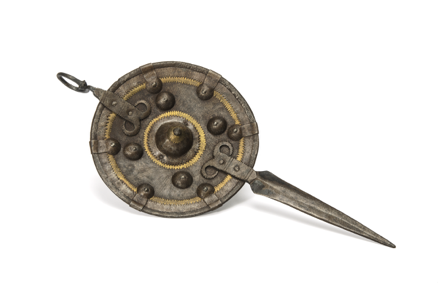
Accession No
E 1916.148.54
Description
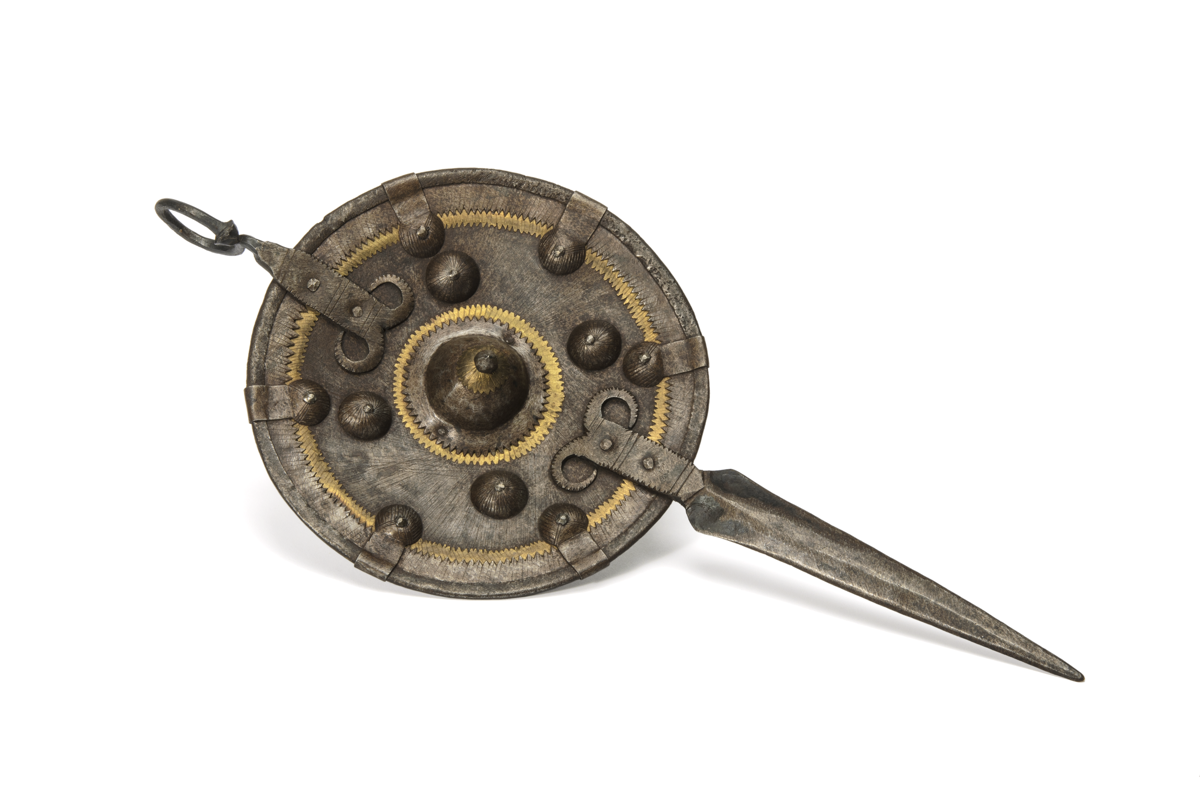
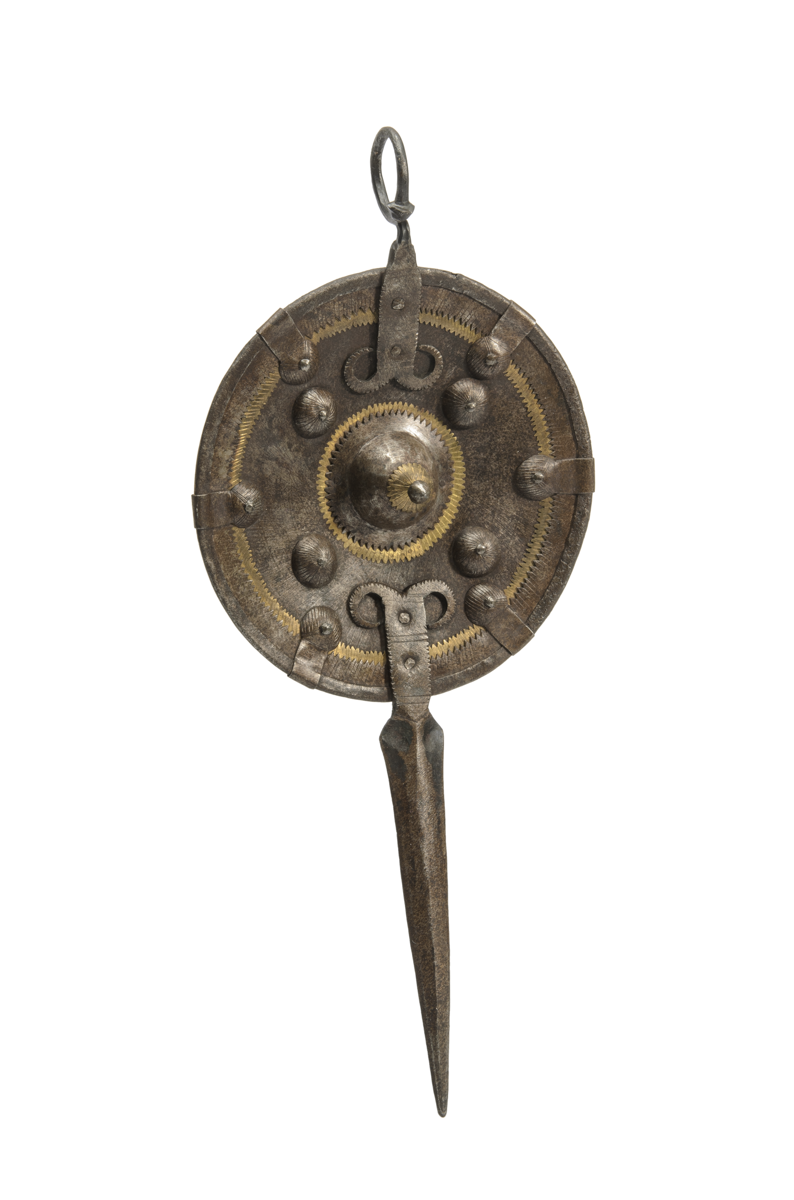
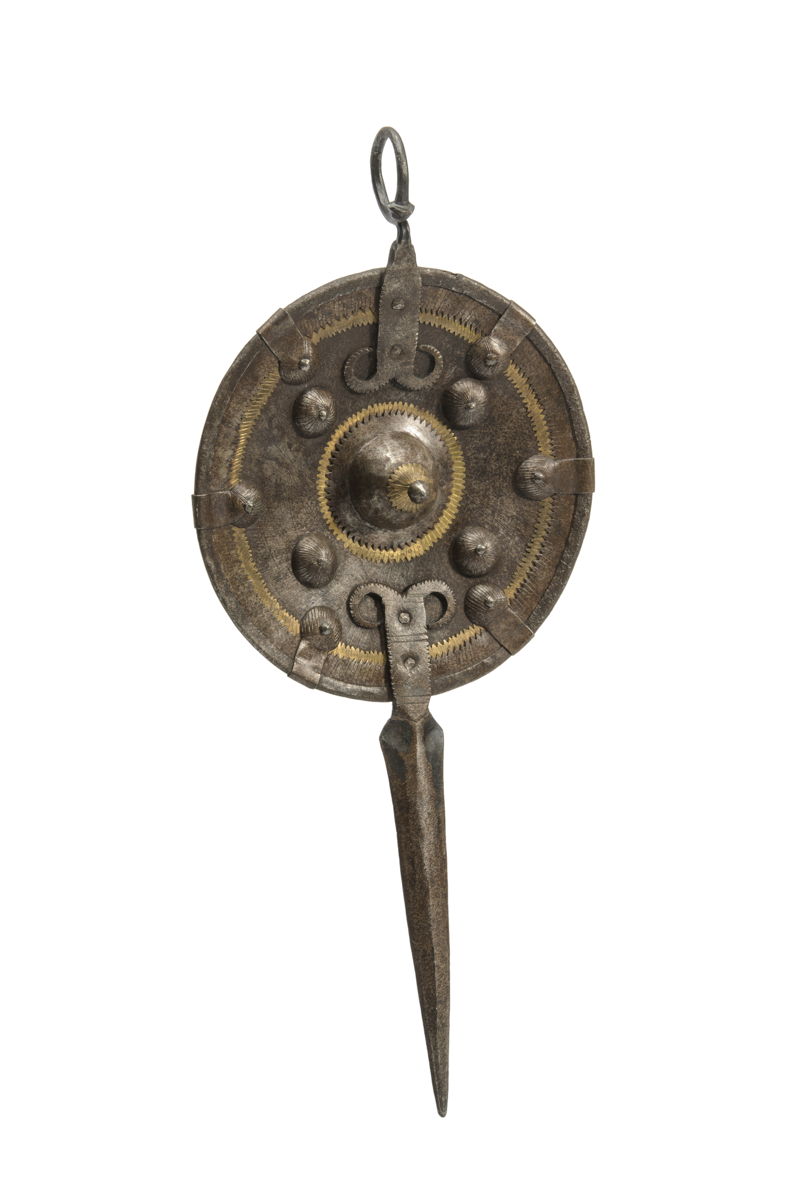
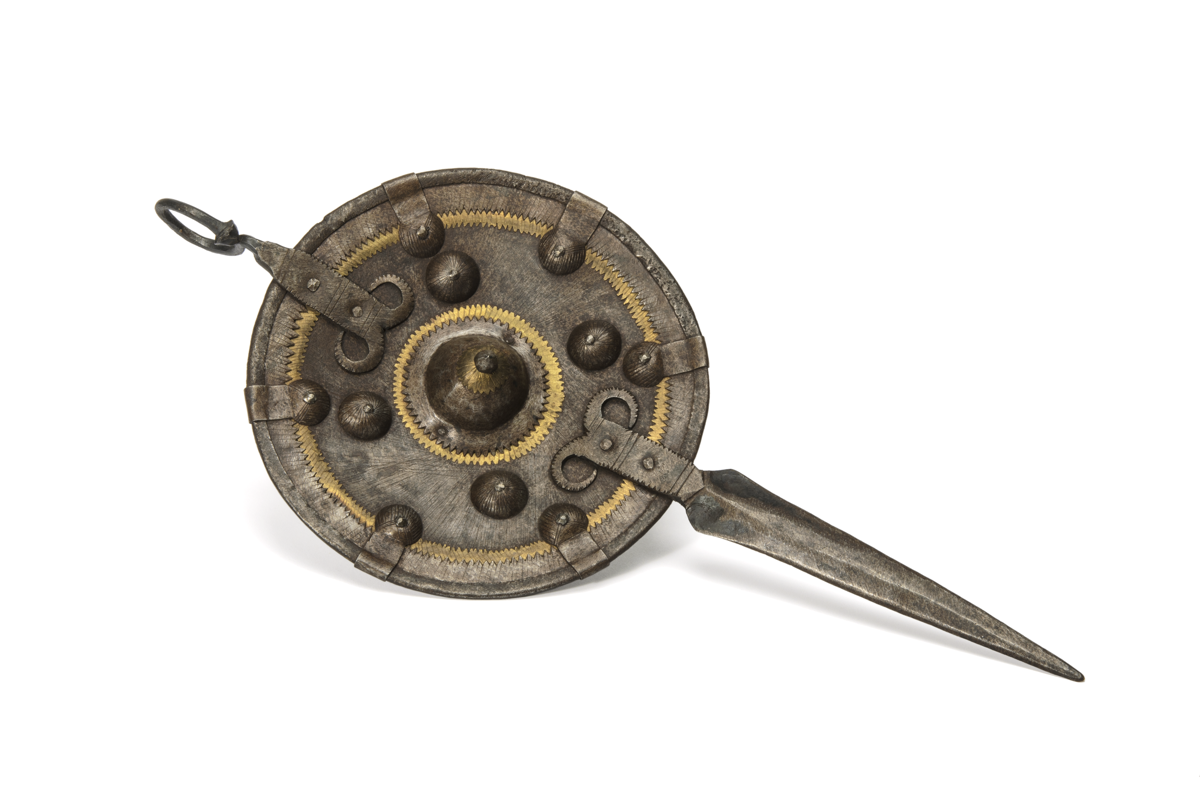
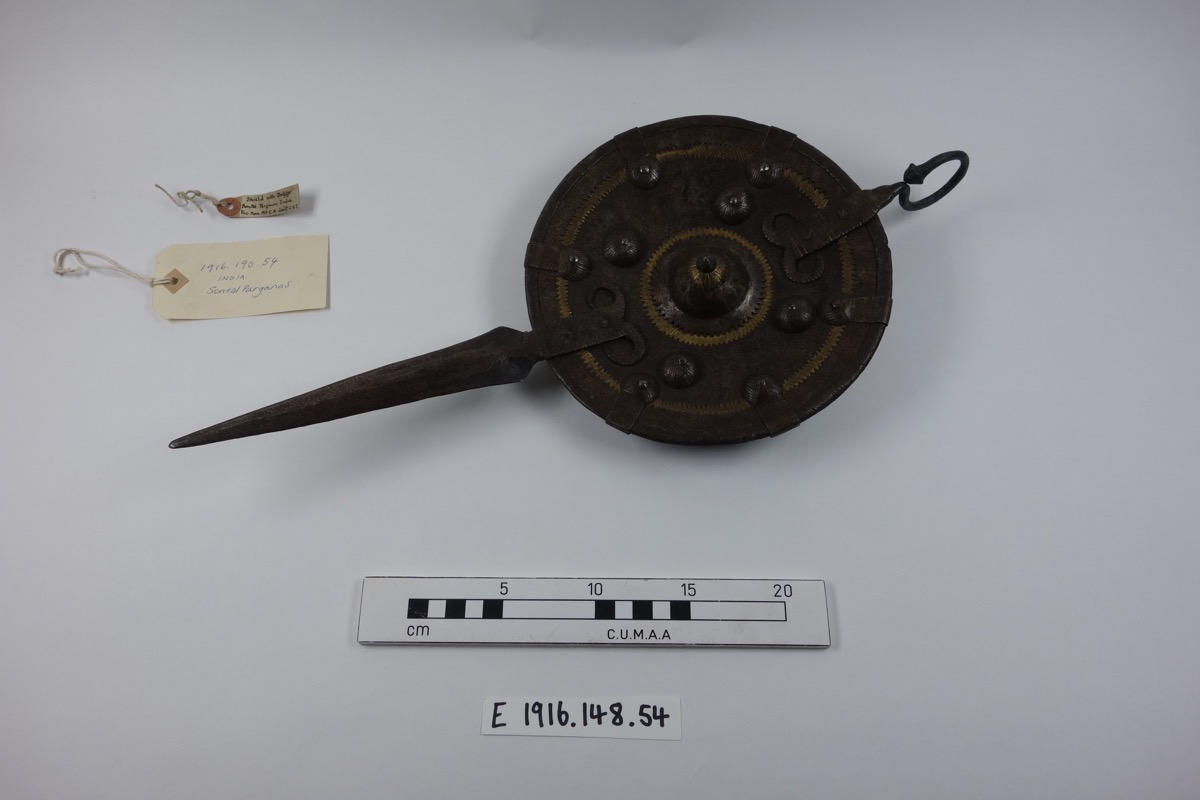
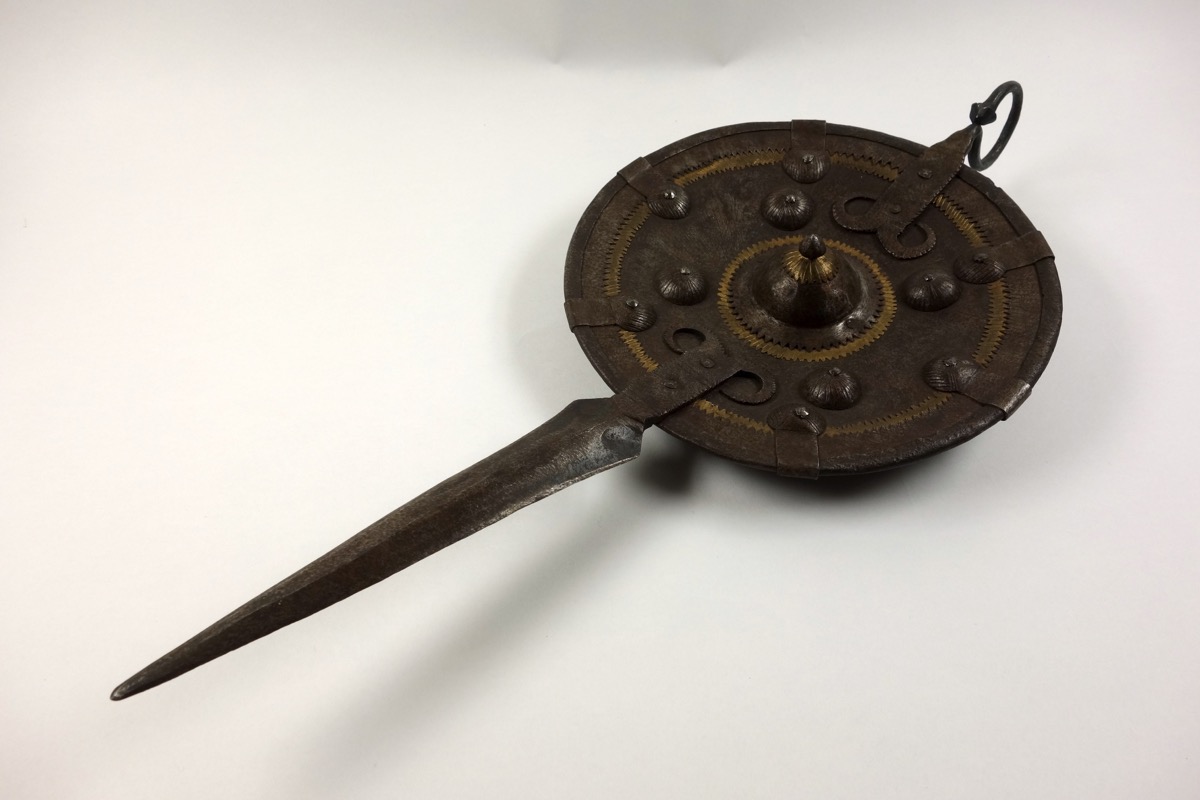
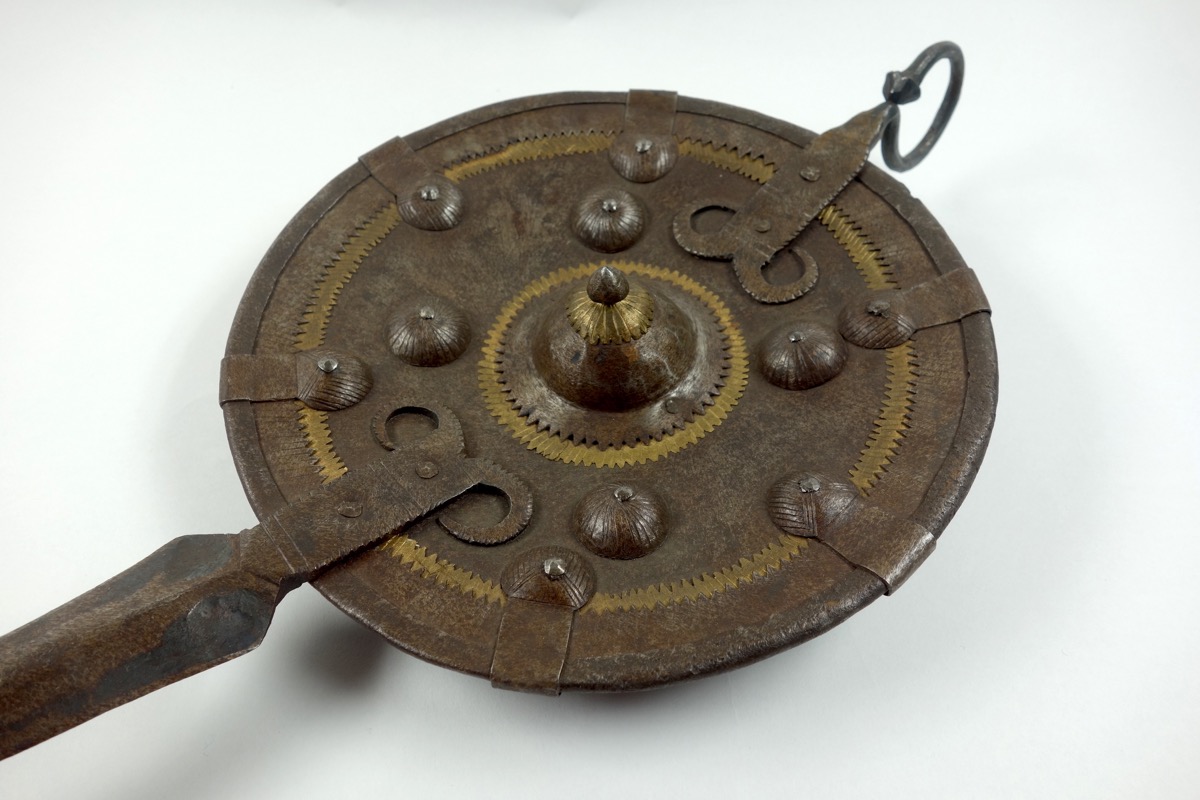
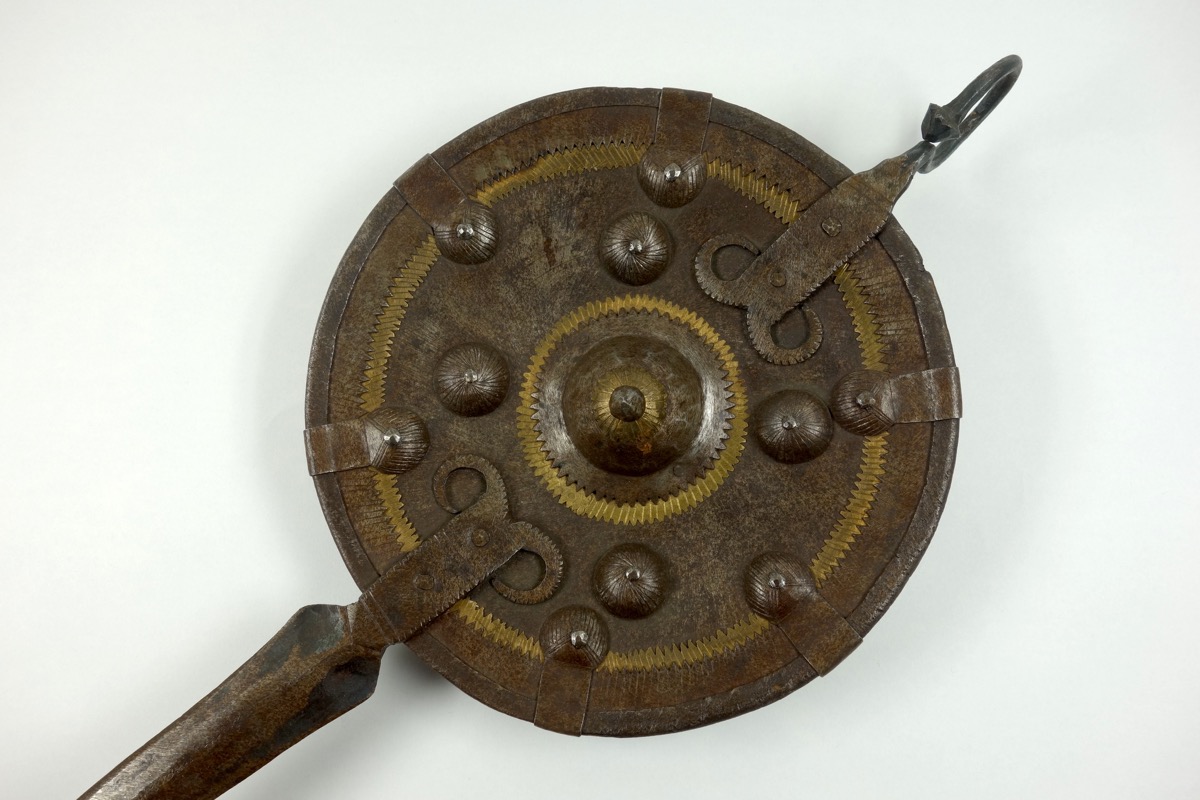
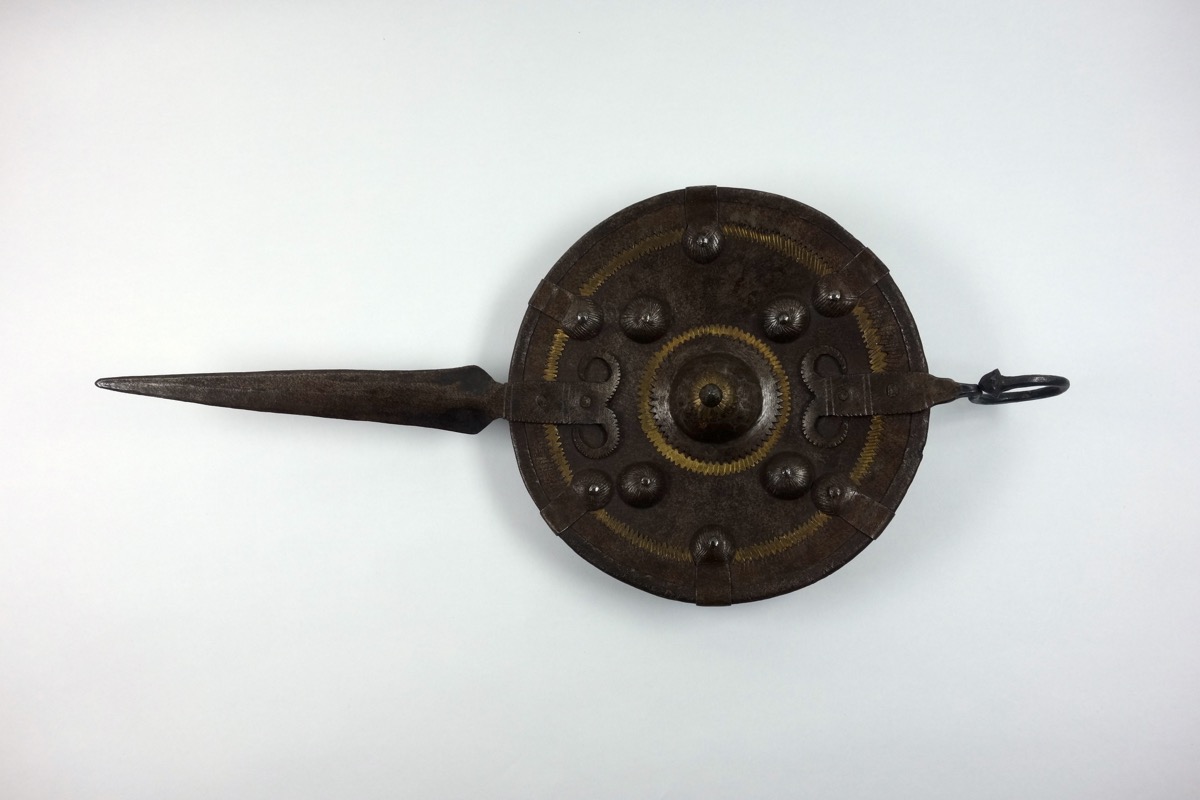
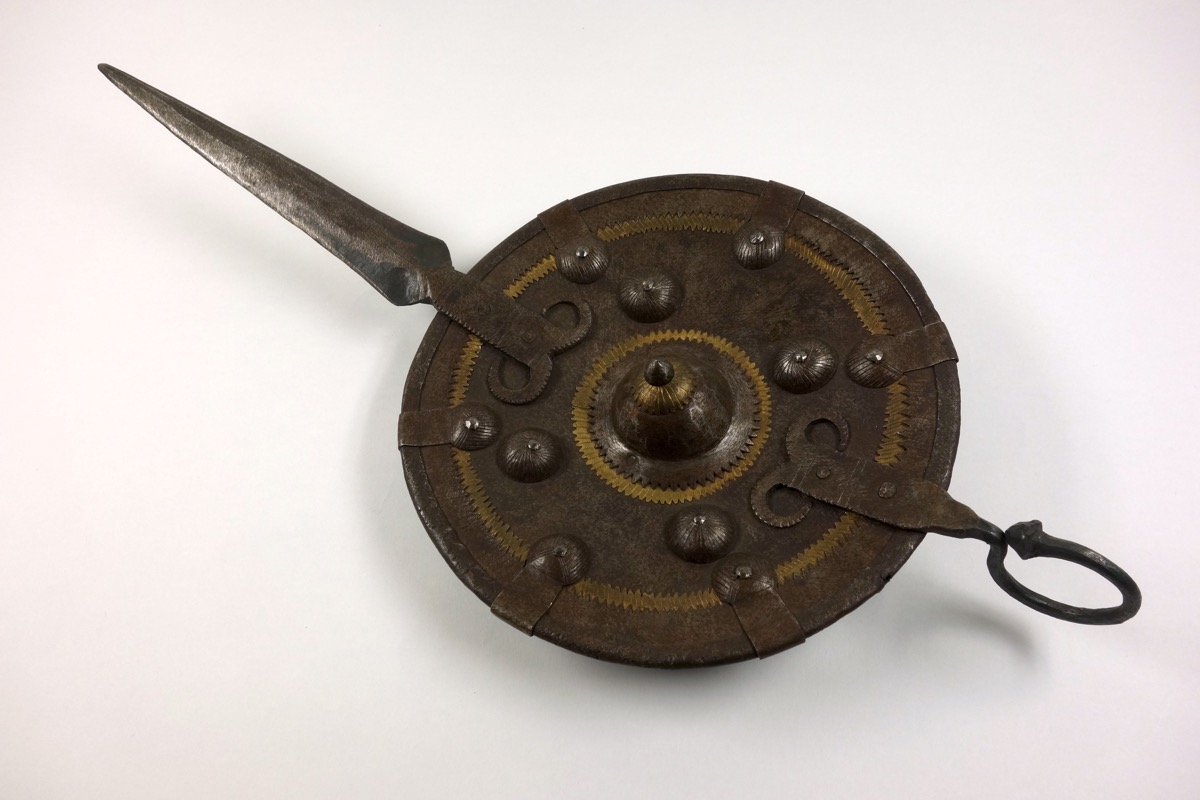
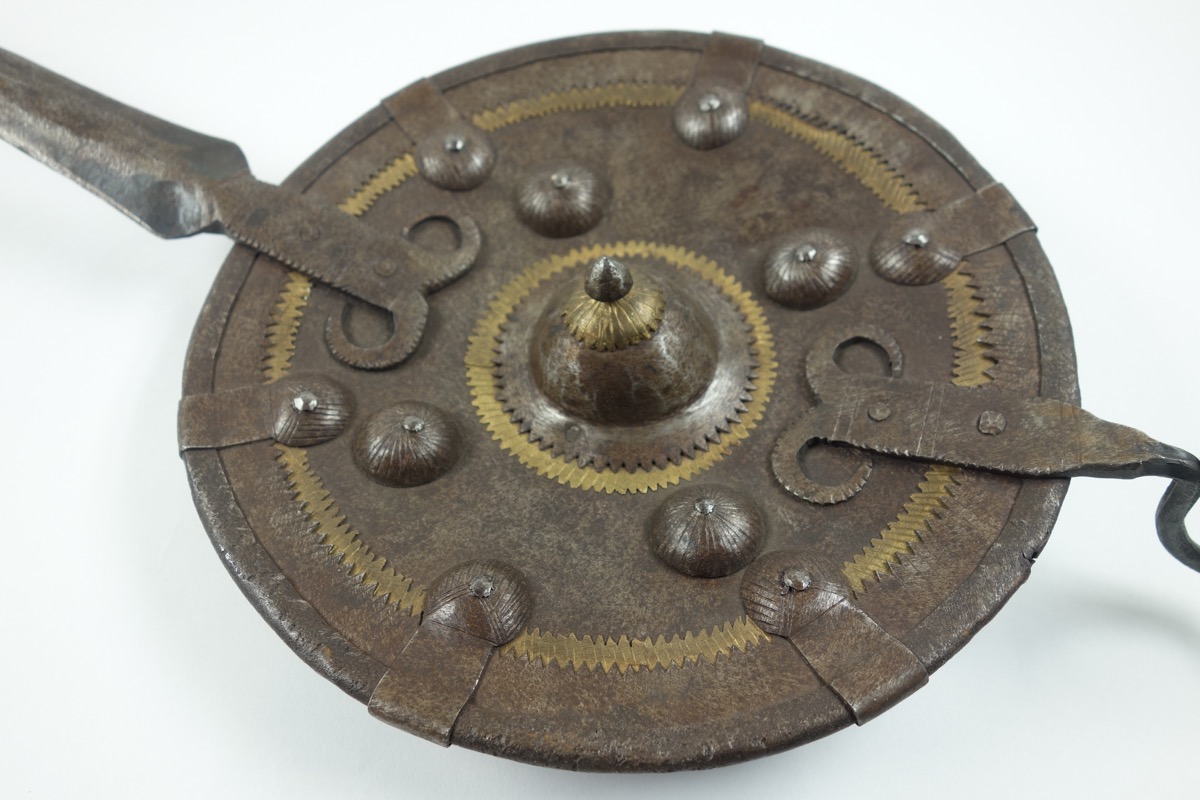
Phiri. Parrying shield. Small, circular shield, comprising a studded concave bronze disc with a spike mounted in the centre, and concentric brass rings on its surface. There is a thin bronze dagger projecting from one side, mounted on the edge of the shield. on the opposite side to the dagger is mounted an ?iron suspension loop. A textile bundle is fixed to the back of the shield with plant fibre string.
Place
Asia; South Asia; India; Chota Nagpur; Jharkhand; Santhal Pargana
Period
Source
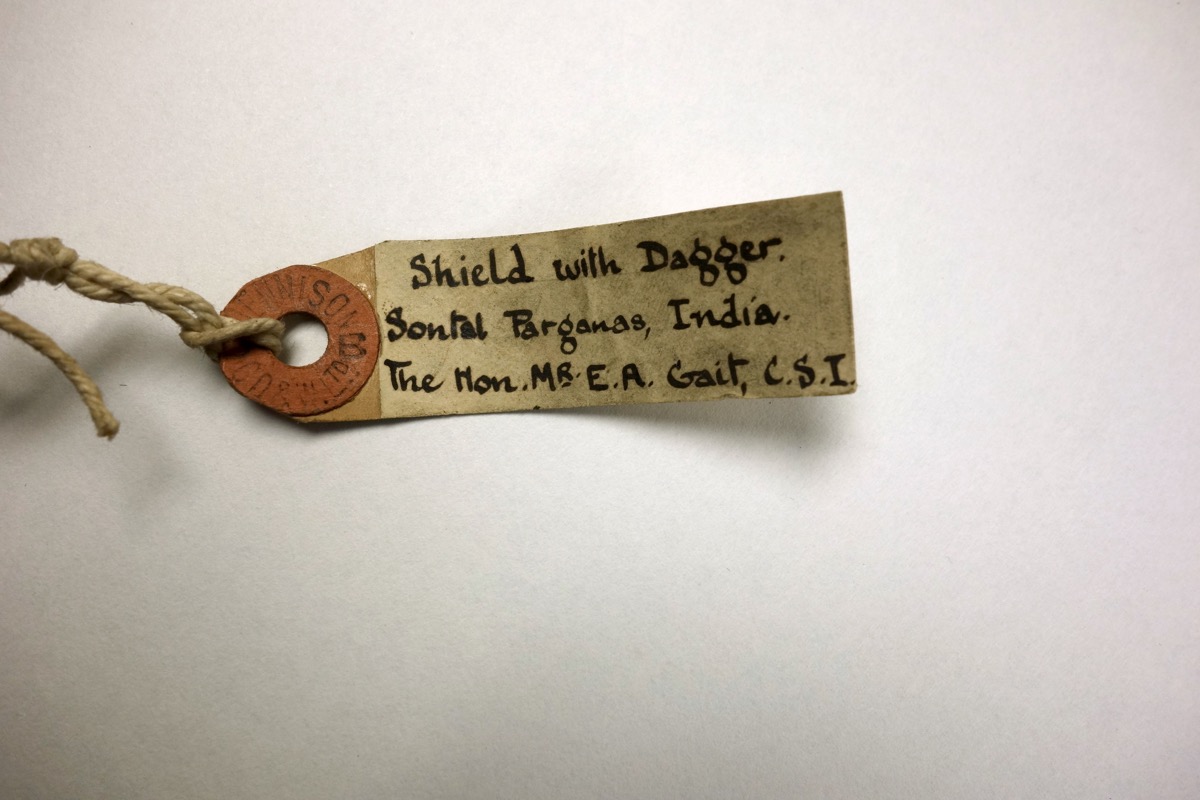
Roy, Sarat Chandra [field collector]; Gait, Edward Albert (Sir) [donor]
Department
Anth
Reference Numbers
E 1916.148.54; MAA: AR 1916.190.54
Cultural Affliation
Santal [Santhal]
Material
Metal; Copper Alloy; Brass; Bronze; ?Iron; Textile
Local Term
Measurements
213mm x 62mm x 480mm
Events
Context (Acquisition Details)
Part of a collection of Indian material donated by Gait, numbered E 1916.148.1-87 (from the entry in the accessions register). These items were also numbered as AR 1916.190.1-87 (from the entry in the Annual Report). Some items have since been known only by their Annual Report number and so, for the sake of consistency, the whole collection has been entered on computer as AR 1916.190.1-87. Original accessions numbers are entered in the CRN field. (Alison McKeating, April 1995)
Event Date 22/3/1995
Author: maa
Description (Physical description)
Small, circular shield, with concave face decorated with studs and brass dagger mounted on side
Event Date 22/3/1995
Author: maa
Description (Physical description)
Shield
Event Date 7/12/2016
Author: maa
Conservation (Surface Clean)
CON.2016.3527 | Surface Clean
Event Date 30/8/2016
Author: Rachel Howie
Context (Display)
'Another India: Explorations and Expressions of Indigenous South Asia' 07/03/2017 - 22/04/2018 MAA exhibition label text reads:
The ‘Santhal Trophy’
In February 1856 the Illustrated London News carried an account of the suppression of the Santal rebellion in Chota Nagpur, which Santals today commemorate as the Hul. One of the illustrations provided by the author, Captain Walter Sherwill, was this extraordinary assemblage entitled simply Santhal Trophy.
The Trophy presented hunting tools such as bows, arrows and axes as well as drums as war loot - weapons that were evidence of Santal resistance and savagery. Most of these ‘weapons’ would have had peaceful use outside of the Hul, when sticks and hoes were also taken up in the struggle against landlords and the government.
This reconstruction of Sherwill’s Trophy from the collections at MAA questions the perception of these ‘weapons’, then and now. These objects have been transformed under different gazes at different times. They tell stories of historical struggle, and become symbols of Santal identity and Adivasi resistance today.
1. Phiri (parrying shield)
The phiri was not a common object, possessed only by people with power and strength. Used as a weapon, it served as
a shield, a sword and a hook for catching the opponent’s blade. But it was more than simply a weapon in the conventional sense, having an alternative meaning and use as a shield from ‘bad thoughts’. Some Santal homes will still have a phiri on the wall.
Santal. Chota Nagpur, Jharkhand Collected by Sarat Chandra Roy Donated by Sir Edward A. Gait
E 1916.148.54
Event Date 22/3/2017
Author: Remke Velden
Exhibition (Li Ka Shing Gallery)
EXH.2017.2 | Another India: Explorations and Expressions of Indigenous South Asia
Event Date 8/3/2017
Author: Remke Velden
Description (Physical description)
Small, circular shield, comprising a studded concave bronze disc with a spike mounted in the centre, and concentric brass rings on its surface. There is a thin bronze dagger projecting from one side, mounted on the edge of the shield. on the opposite side to the dagger is mounted an ?iron suspension loop. A textile bundle is fixed to the back of the shield with plant fibre string.
Event Date 27/2/2023
Author: Flo Sutton
FM:94334
Images (Click to view full size):