Accession No
E 1916.148.29 A-B
Description
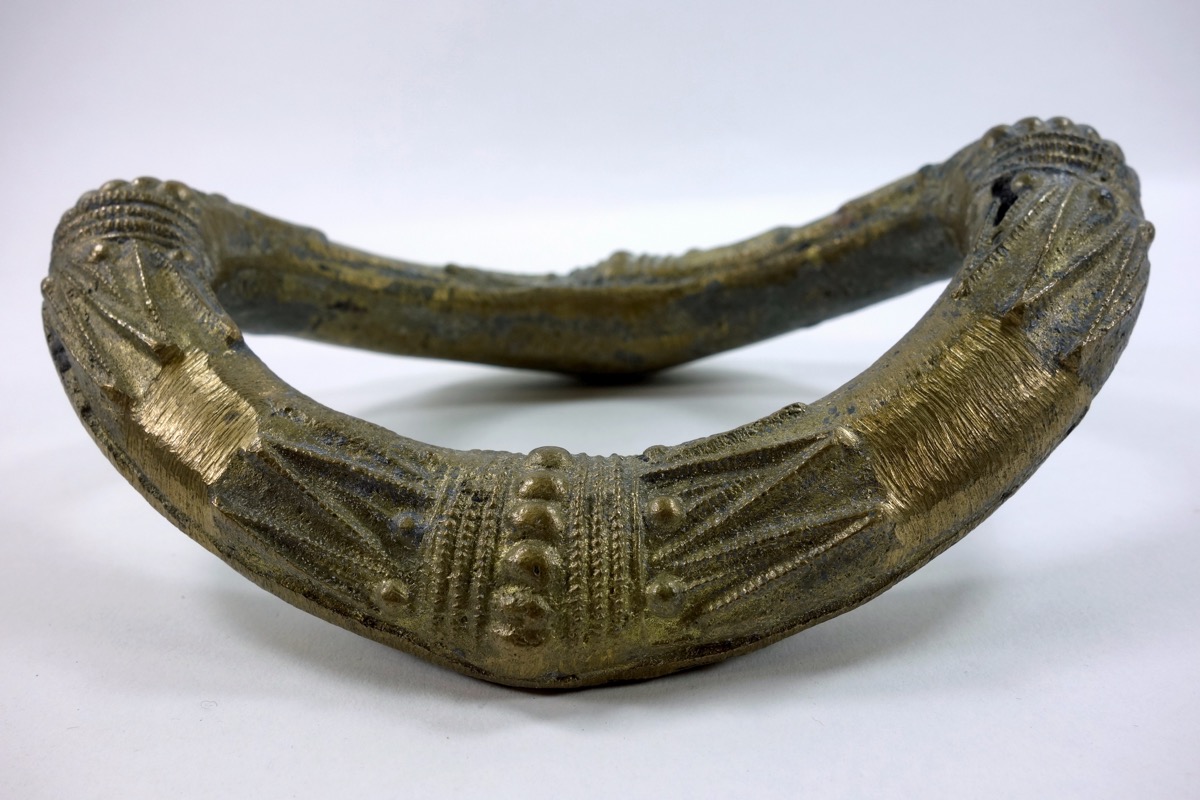
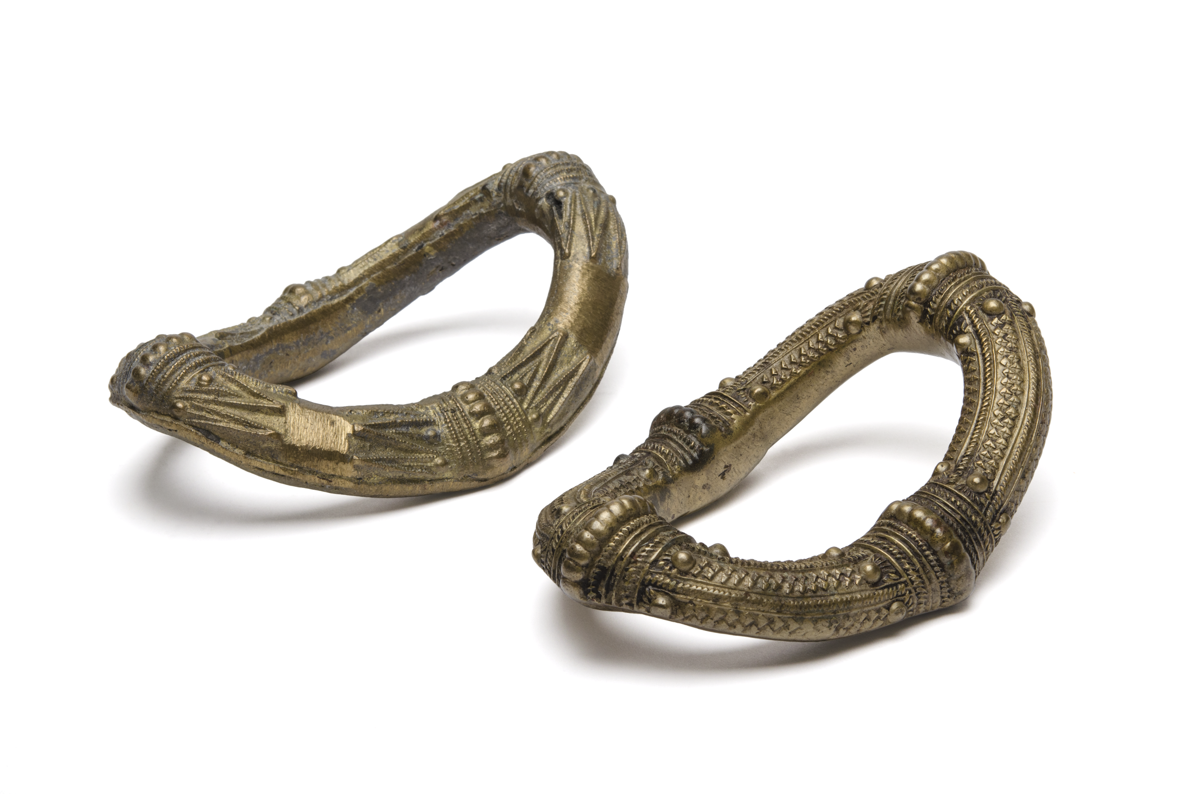
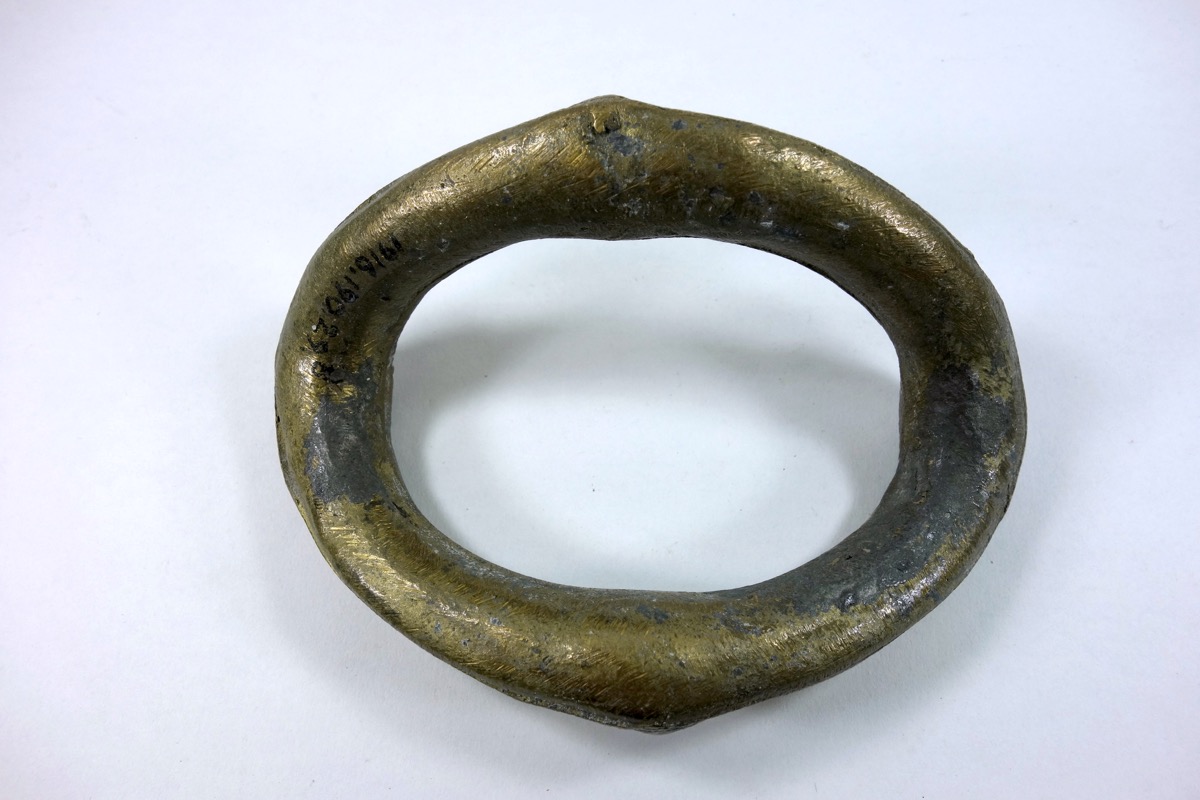
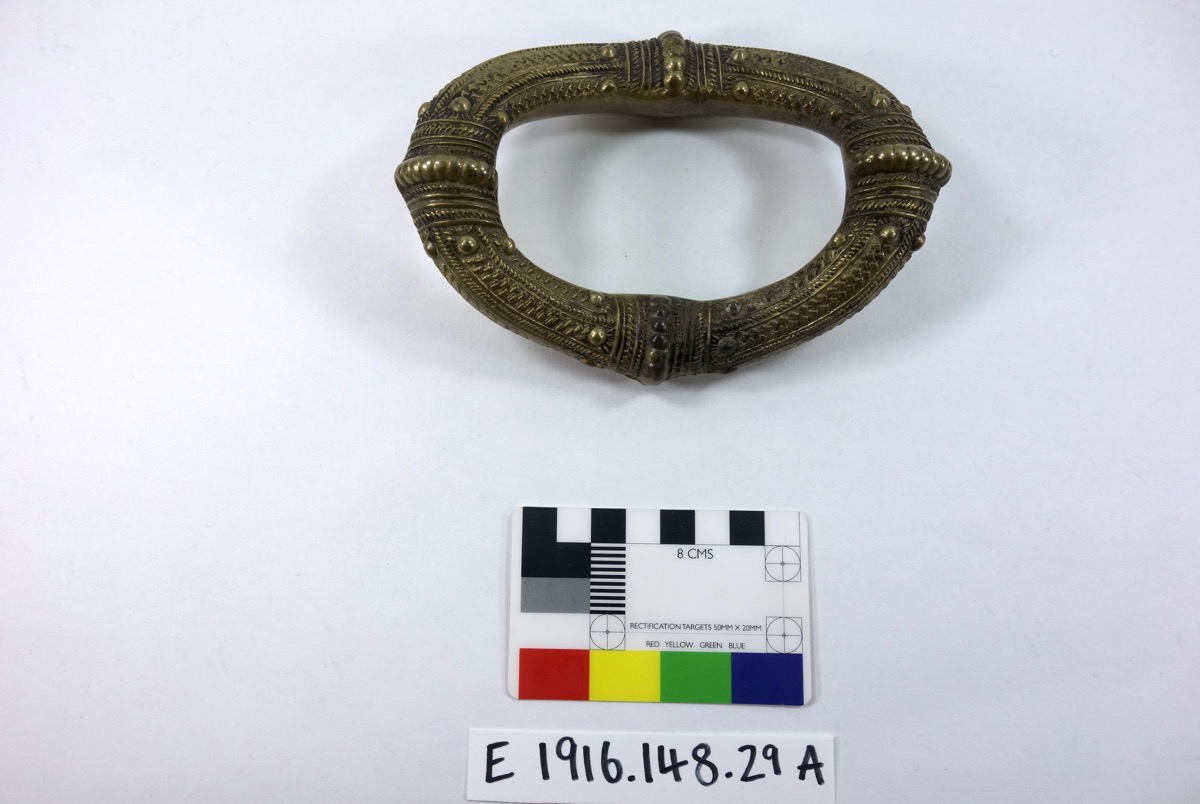
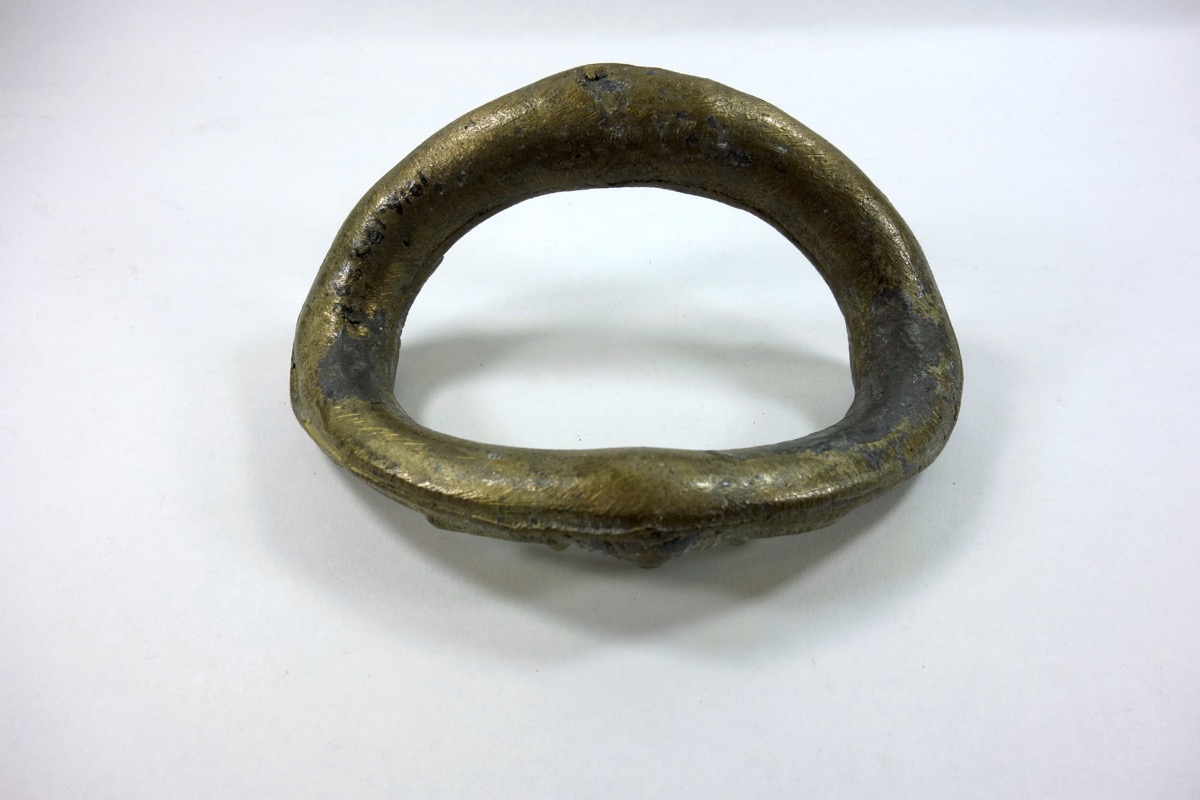
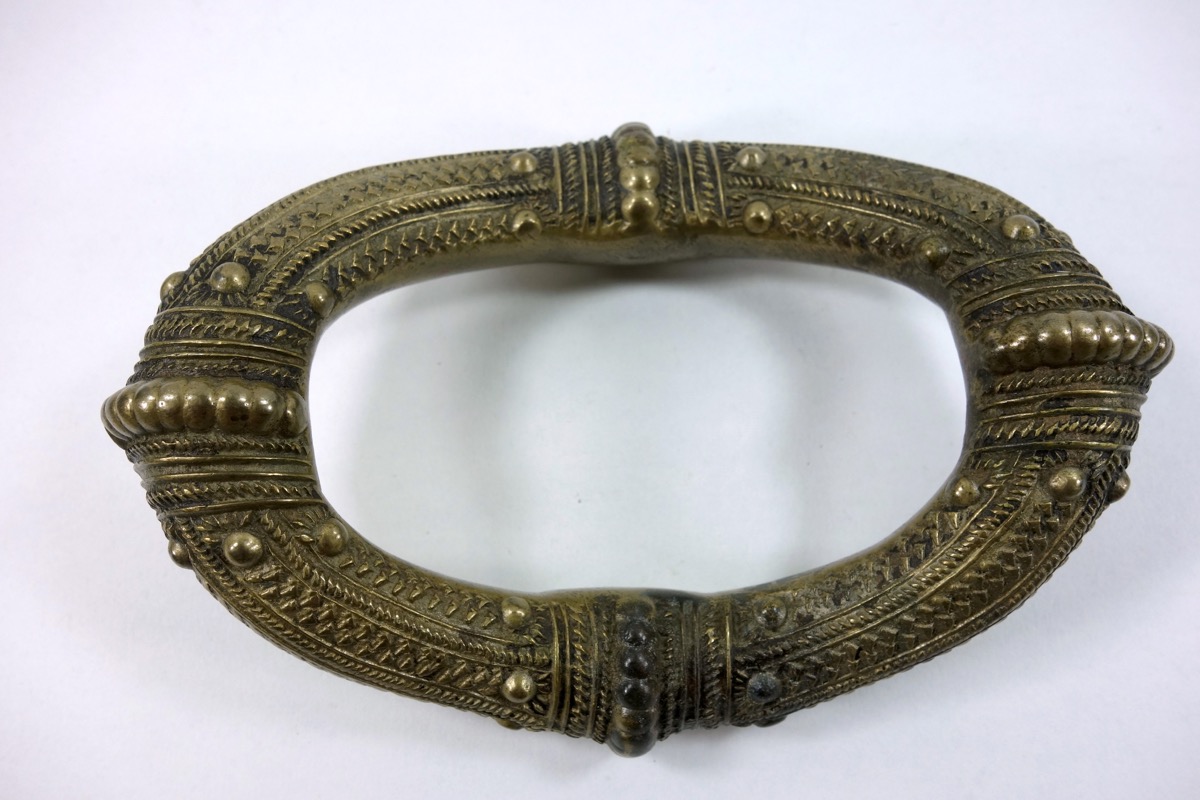
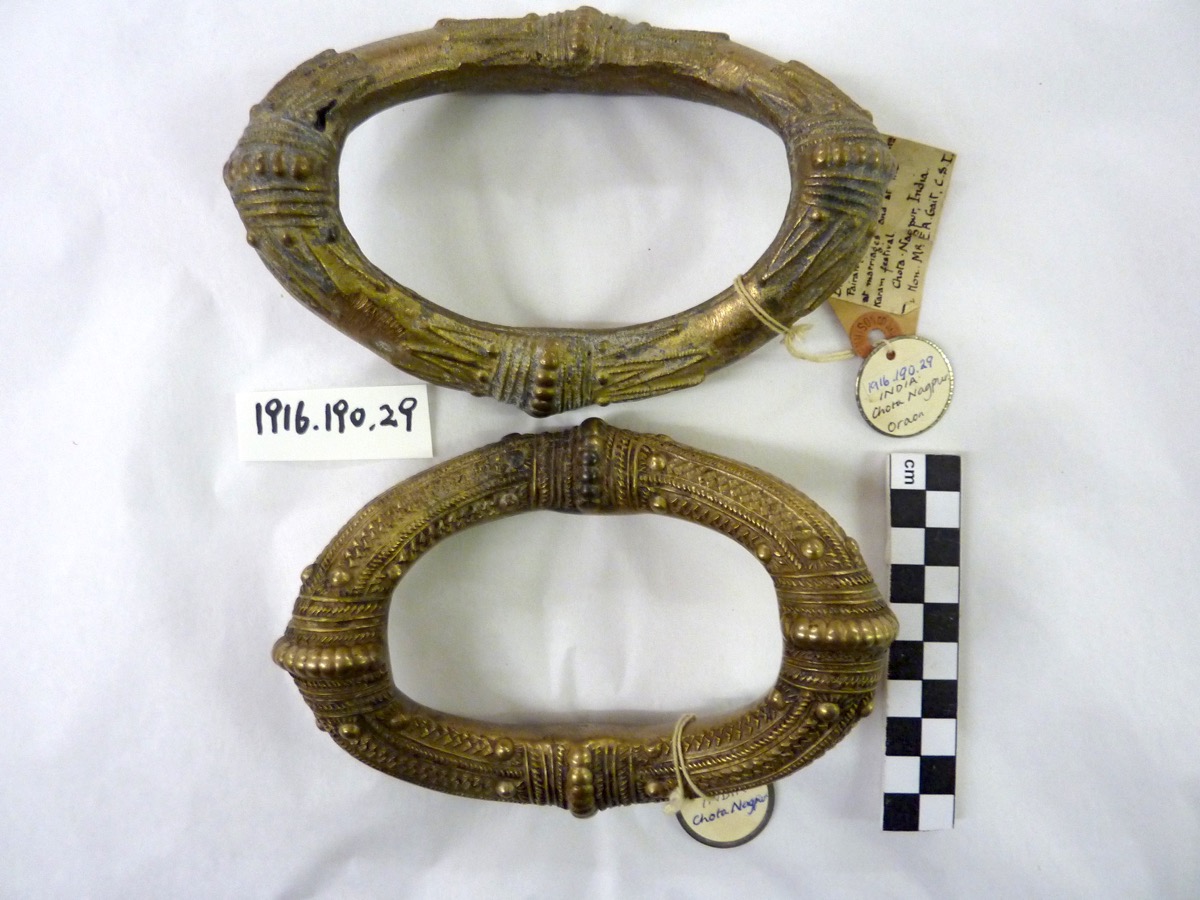
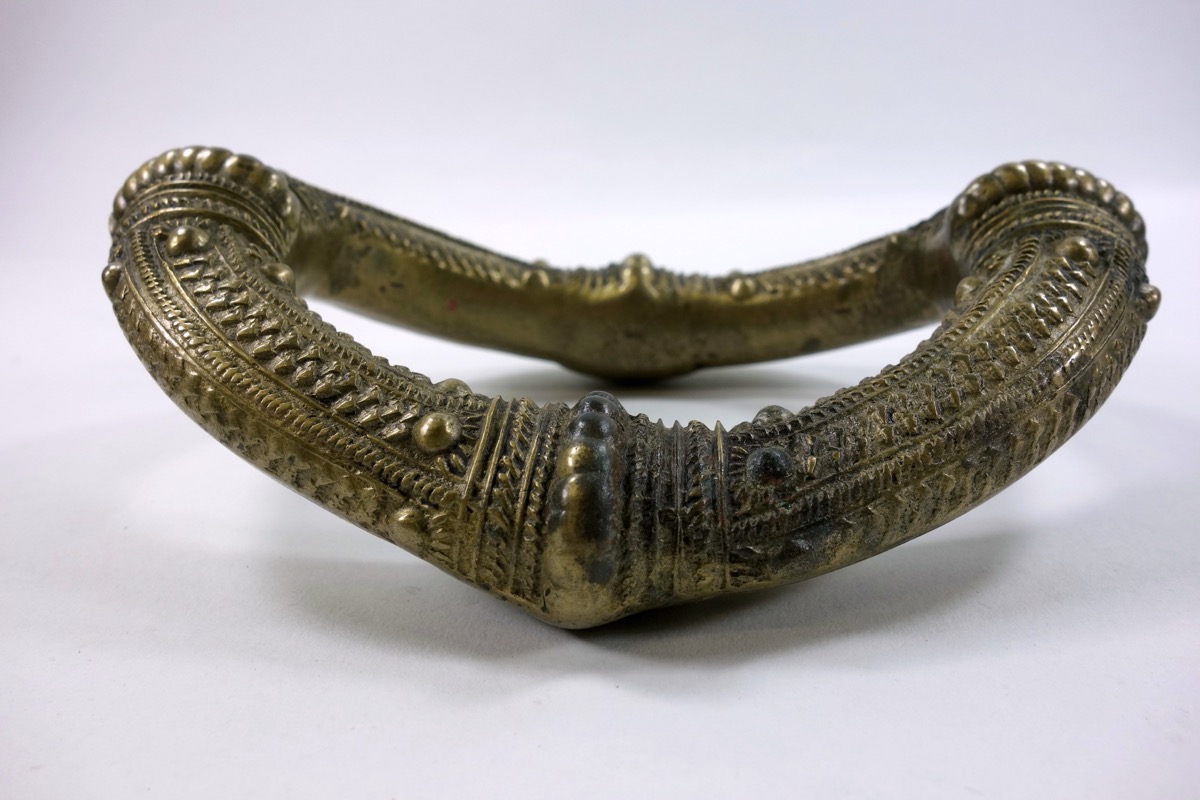
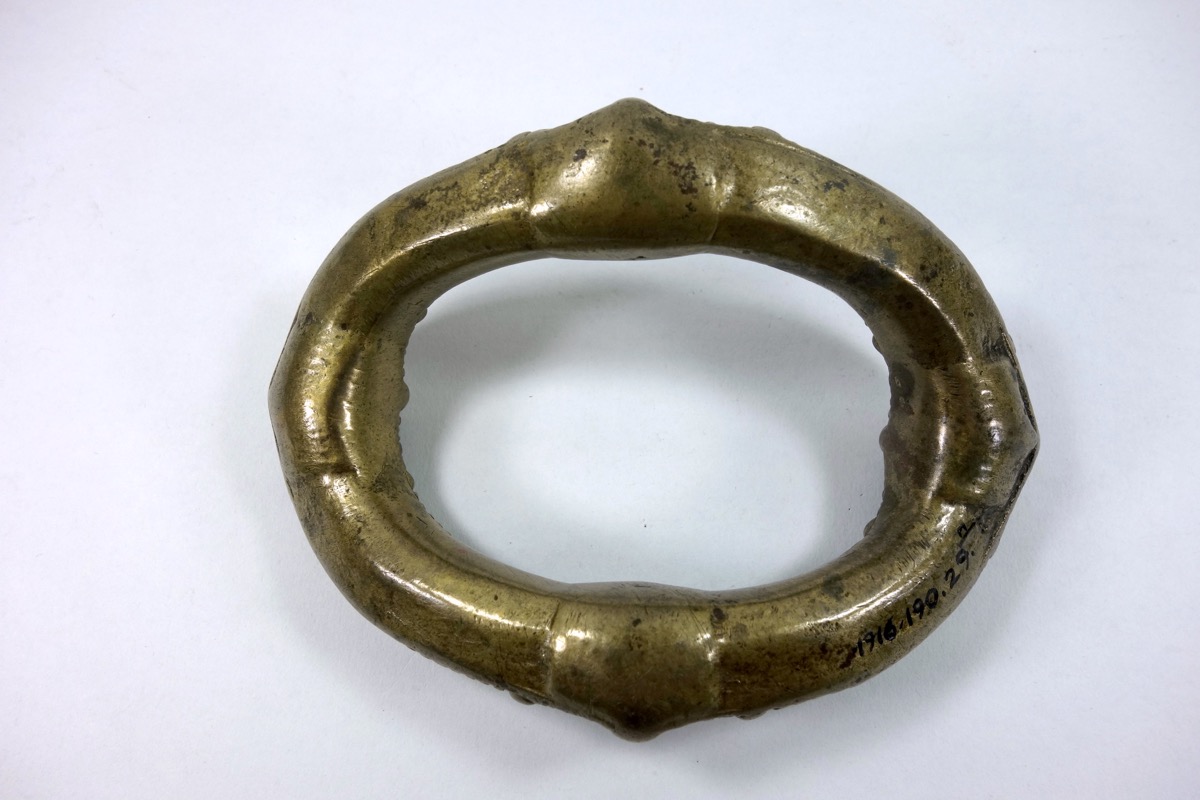
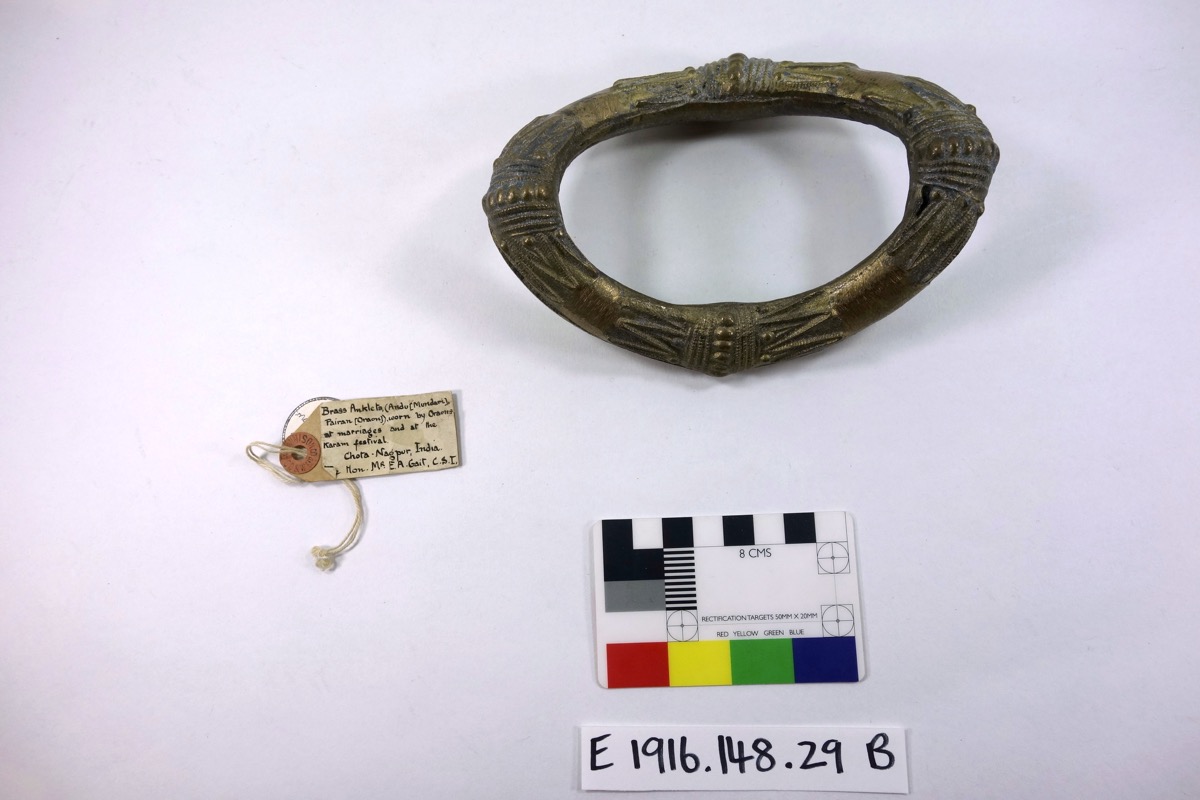
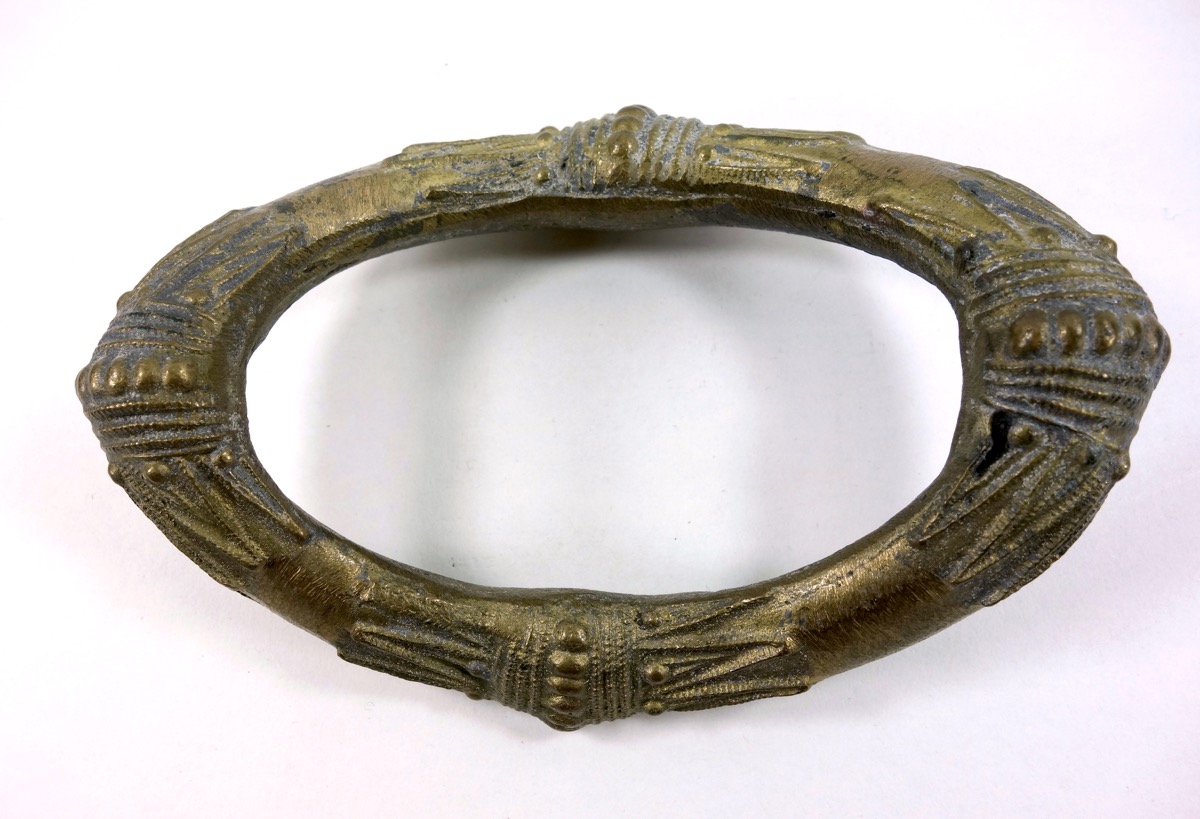
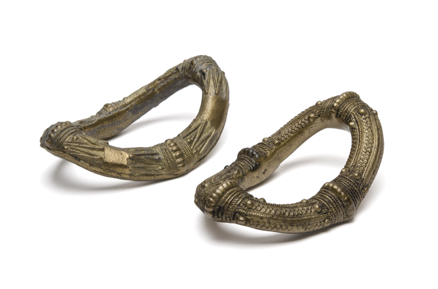
Andu; Pairan. Pair of large brass anklets, each comprising a loop of brass which is curved upwards at each end. The top surfaces of the anklets are moulded with intricate geometric designs, while the bottom surfaces are plain and smooth.
Place
Asia; South Asia; India; [Chota Nagpur]; ?Jharkhand; ?West Bengal; ?Orissa; ?Chhattisgarh
Period
Source
Roy, Sarat Chandra [collector]; Gait, Edward Albert (Sir) [donor]
Department
Anth
Reference Numbers
E 1916.148.29 A-B; MAA: AR 1916.190.29 A-B
Cultural Affliation
Munda; Kurukh [Oraon]
Material
Metal; Copper Alloy; Brass
Local Term
Andu [Munderi]; pairan [Mundari]; ?painra
Measurements
110mm x 5mm x 155mm
Events
Description (Physical description)
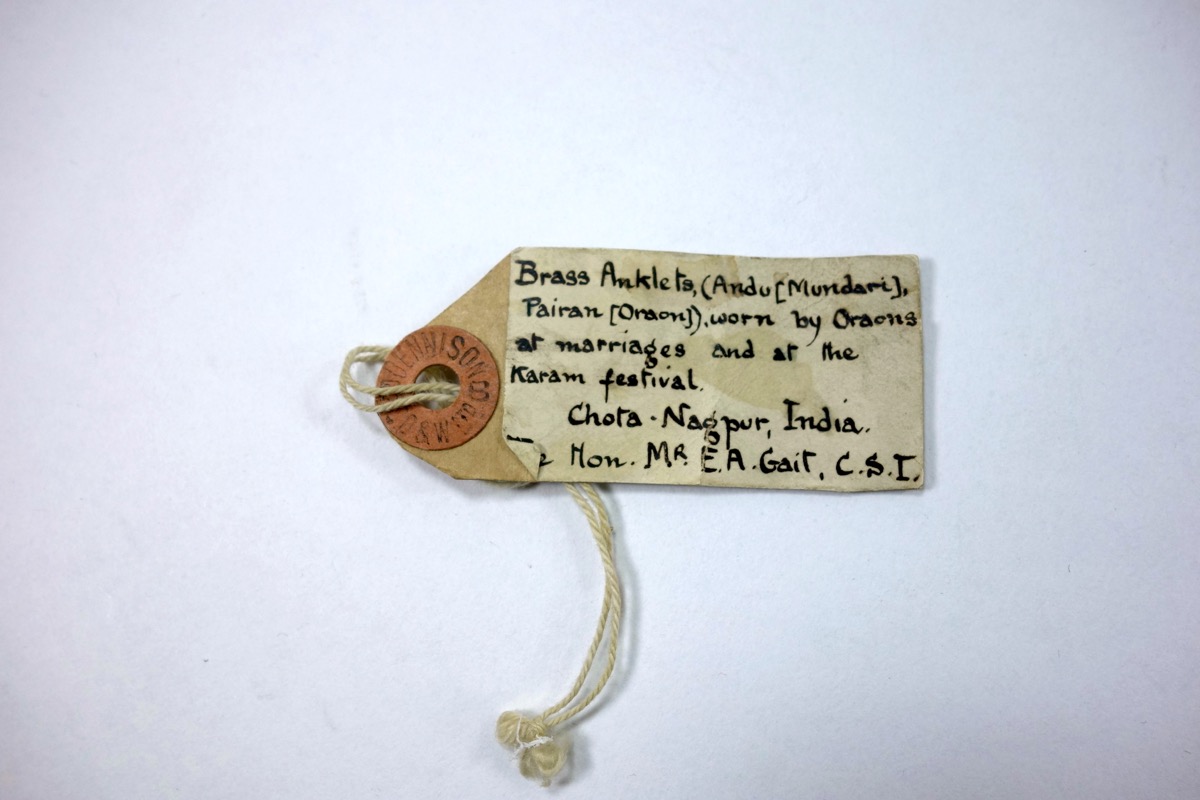
Pair of large brass anklets (known as " andu" by Munderi, and as " pairan" by Mundari). Worn by Oraons at marriages and at the Karam festival
Event Date 22/3/1995
Author: maa
Context (Field collection)
Part of a collection of Indian material donated by Gait, numbered E 1916.148.1-87 (from the entry in the accessions register). These items were also numbered as AR 1916.190.1-87 (from the entry in the Annual Report). Some items have since been known only by their Annual Report number and so, for the sake of consistency, the whole collection has been entered on computer as AR 1916.190.1-87. Original accessions numbers are entered in the CRN field. (Alison McKeating, April 1995); Exhibited: Displayed at " The Raj: India and the British 1600-1947" at the National Portrait Gallery, October 1990 to March 1991
Event Date 22/3/1995
Author: maa
Context (References)
Published: C. A. Bayly (ed.) 1990 The Raj: India and the British 1600-1947 National Portrait Gallery Publications. p. 299-300
[Section III, Photography in Nineteenth-Century India (by John Falconer), Anthropology and the Colonial Image]
‘386 Oraon objects collected by E.A. Gait
[...]
ii) Brass anklets
c. 1916
Diameter 15 (6)
Attached label: Brass anklets (Andu [Mundari] Pairan [Oraon]) worn by Oraons at marriages and at the Karam festival. Chota-Nagpur, India. Hon. Mr E. A. Gait. CSI
Cambridge University of Archaeology and Anthropology (1916.190.29.A/B)
[...]
E. A. Gait (1863-1950), Commissioner of Chota Nagpur, wrote the introduction to Roy’s first book, The Mūndās and Their Country (1912). He first met Roy when he was supervising the settlement of the Munda country and Roy had appeared as ‘the sturdy champion of the Mundas’ in almost all the cases involving Mundas and caste-Hindu landlords and moneylenders (Roy 1912, p.i).
Similar objects to these, together with about fifty other Oraon objects, were photographed in a display and reproduced as a plate in Roy’s The Oraons of Chota Nagpur (1915). [...] The anklets, Roy stresses, were worn by Oraon brides at their weddings only (p.98), though the label on this item (presumably information supplied by Gait) suggests that they were also worn for the Karam ‘festival’. This is a series of dances, described by Roy, in which young Oraons dance in lines, singing in unison:
The drummers move backwards and for-
wards, but more backwards than
forwards. The boys who dance slowly
move in a circle so as to make a circuit of
the ākhṛā [public dancing ground] in due
time; but now and again they quickly
advance and recede, waving their
‘chewers’ and ‘sailōs’ [fans made of wild
date-palm] in the air now upwards and
downwards and again forwards and back-
wards and at times fanning the earth as if
coaxing her to bear abundantly (Roy 1915, p.295). C.P.
Provenance: Donated to present owners by E. A. Gait, 1916.
Literature: Roy 1912 (see also Gait, introduction to above, pp. i-x); Roy 1915, ill. fpp. 177, 216.’
Event Date 13/5/2016
Author: Olivia Maguire
Context (Display)
'Another India: Explorations and Expressions of Indigenous South Asia' 07/03/2017 - 22/04/2018 MAA exhibition label text reads:
Adorned bodies in Chota Nagpur
In 1916 the governor of Bihar and Orissa donated almost one hundred artefacts from the province to this Museum. Half of these, from the Chota Nagpur area, are thought to have been collected by Sarat Chandra Roy, a lawyer who had long worked with and on behalf of Adivasis in the region.
These ornaments, which Roy had described in his book The Oraons of Chota Nagpur the previous year, point to Adivasis’ connections with peoples nearby and across India. Presented here, removed from the bodies that gave them movement and sound, they call our attention to absent bodies.
2. Anklets (painra)
These heavy anklets were worn by an Oraon or Munda woman but probably made by outsiders: purchased or commissioned from jewellers. They were valuable heirlooms, said to be a pair, although of different designs.
Oraon or Munda. Chota Nagpur Collected by Sarat Chandra Roy Donated by Sir Edward A Gait, 1916 E 1916.148.29 A-B
Event Date 22/3/2017
Author: Remke Velden
Exhibition (Li Ka Shing Gallery)
EXH.2017.2 | Another India: Explorations and Expressions of Indigenous South Asia
Event Date 8/3/2017
Author: Remke Velden
Description (Physical description)
Andu; Pairan. Pair of large brass anklets, each comprising a loop of brass which is curved upwards at each end. The top surfaces of the anklets are moulded with intricate geometric designs, while the bottom surfaces are plain and smooth.
Event Date 28/2/2023
Author: Flo Sutton
Context (Amendments / updates)
'Asia; South Asia; India; [Chota Nagpur]; ?Jharkhand; ?West Bengal; ?Orissa; ?Chhattisgarh' has been entered as the place, as these are all contemporary regions corresponding to the historic region of Chota Nagpur.
Event Date 28/2/2023
Author: Flo Sutton
FM:94309
Images (Click to view full size):