Accession No
1922.979
Description
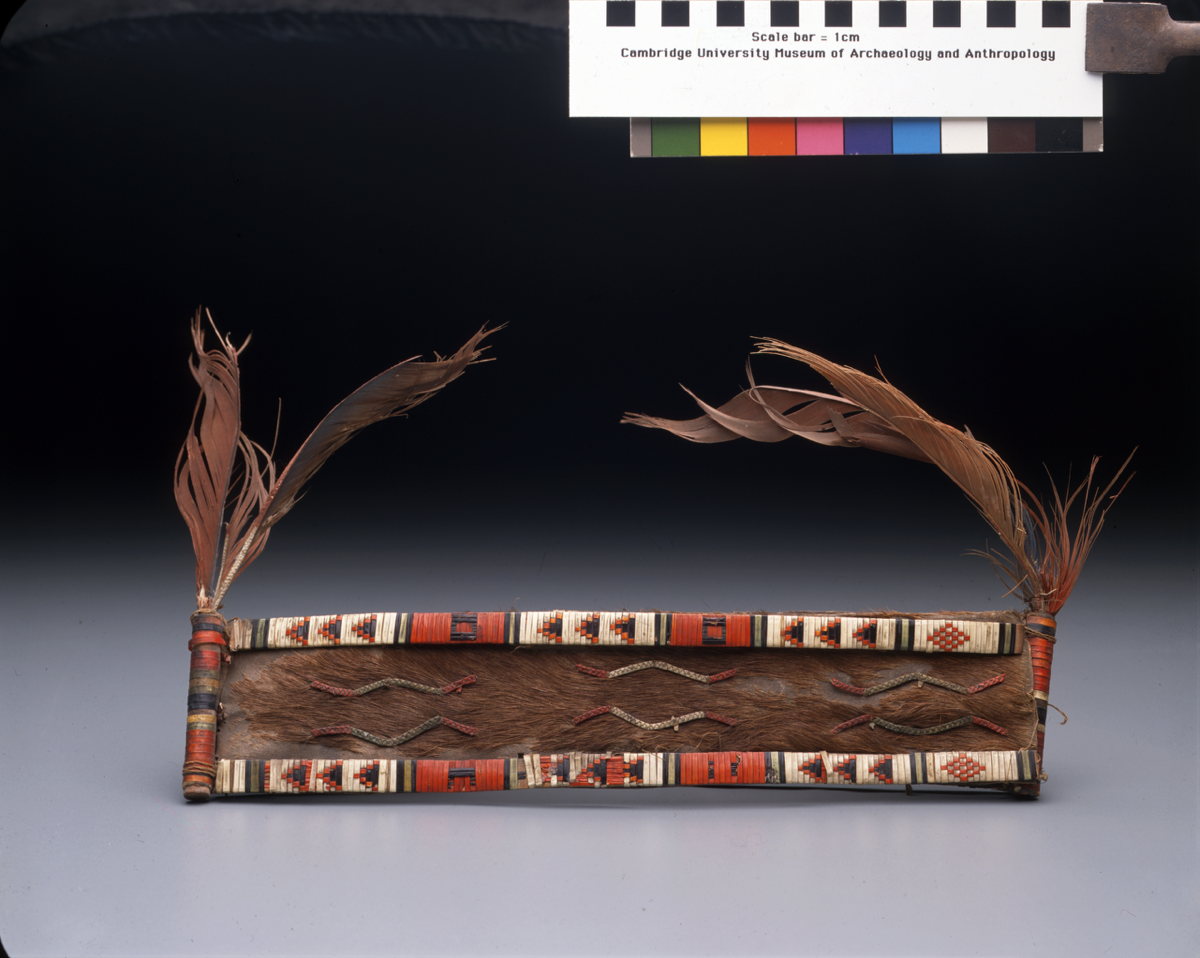
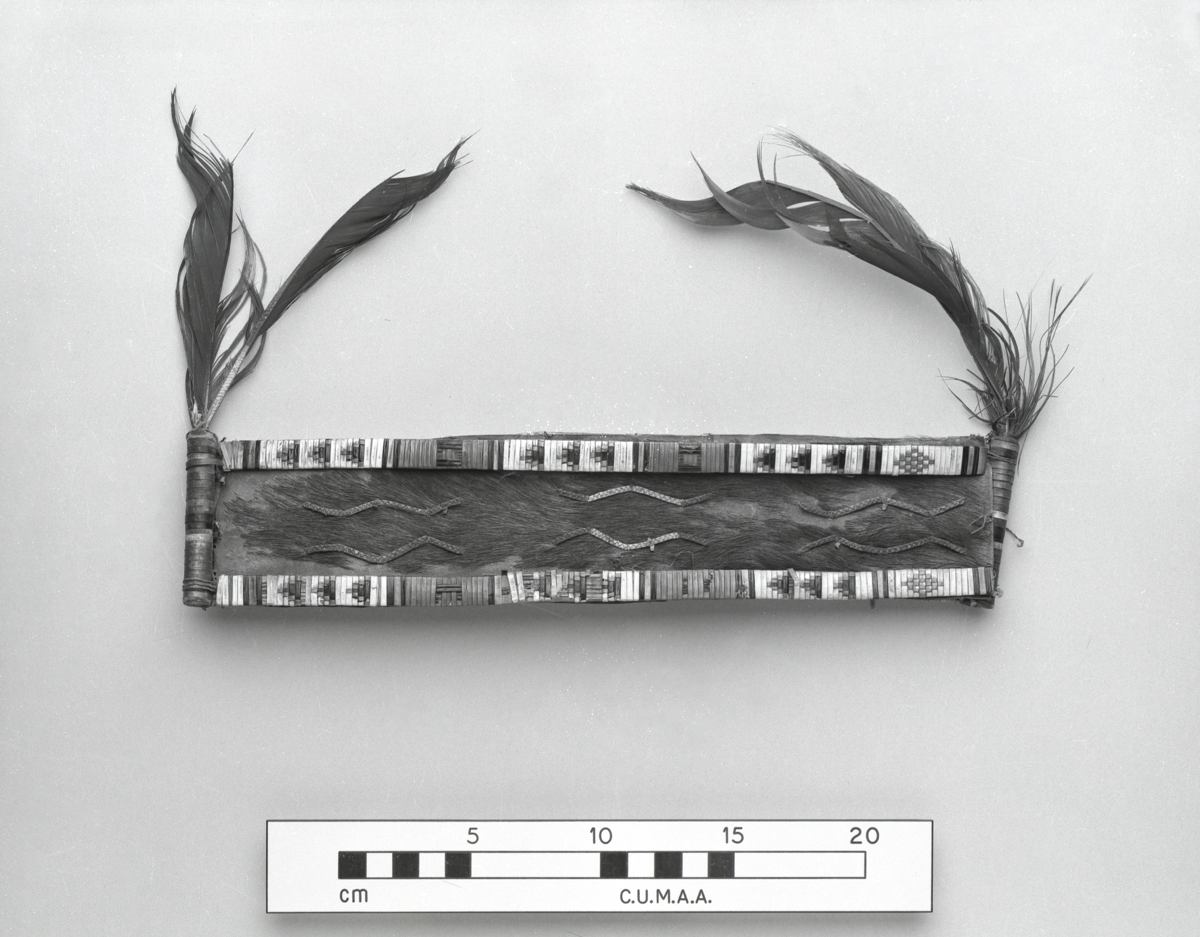
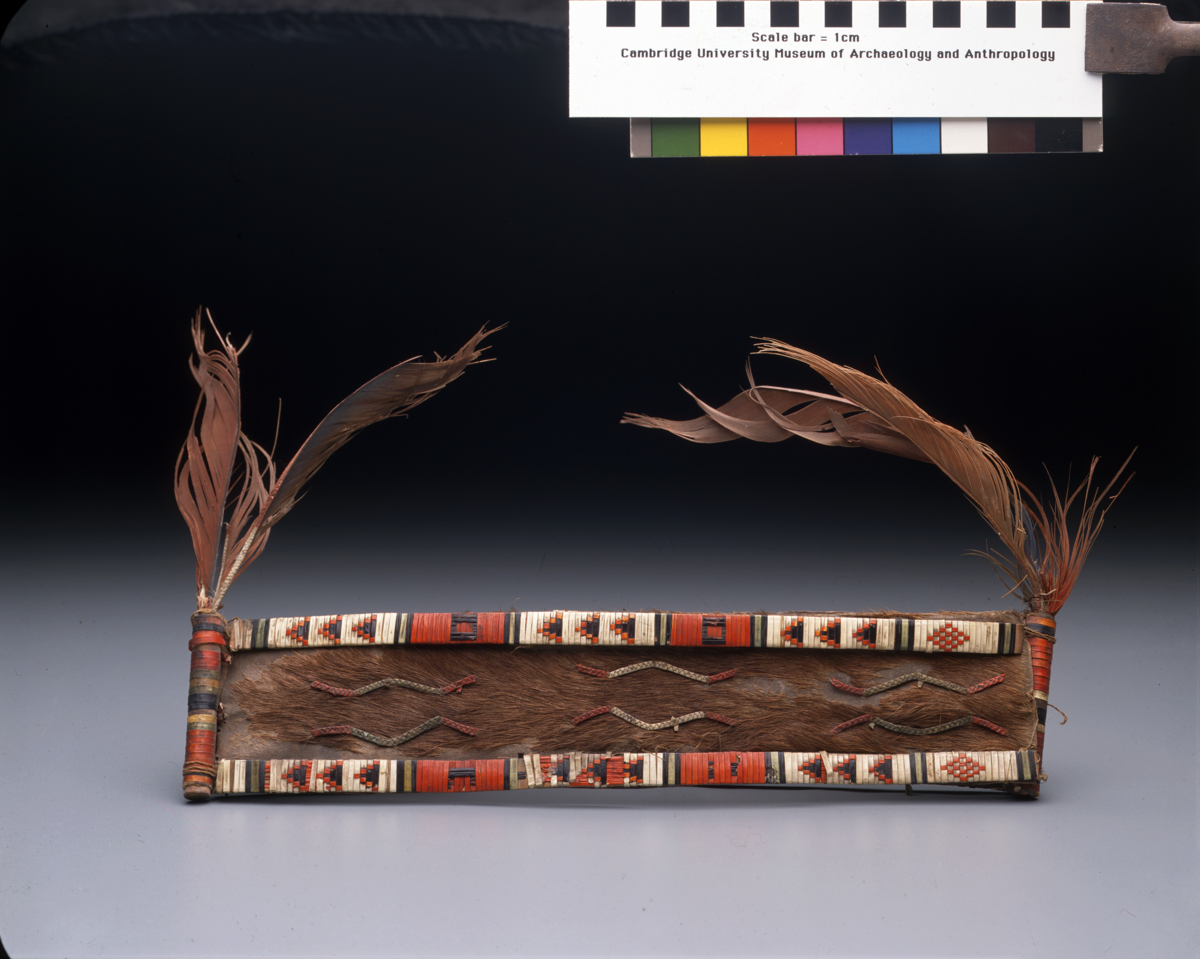
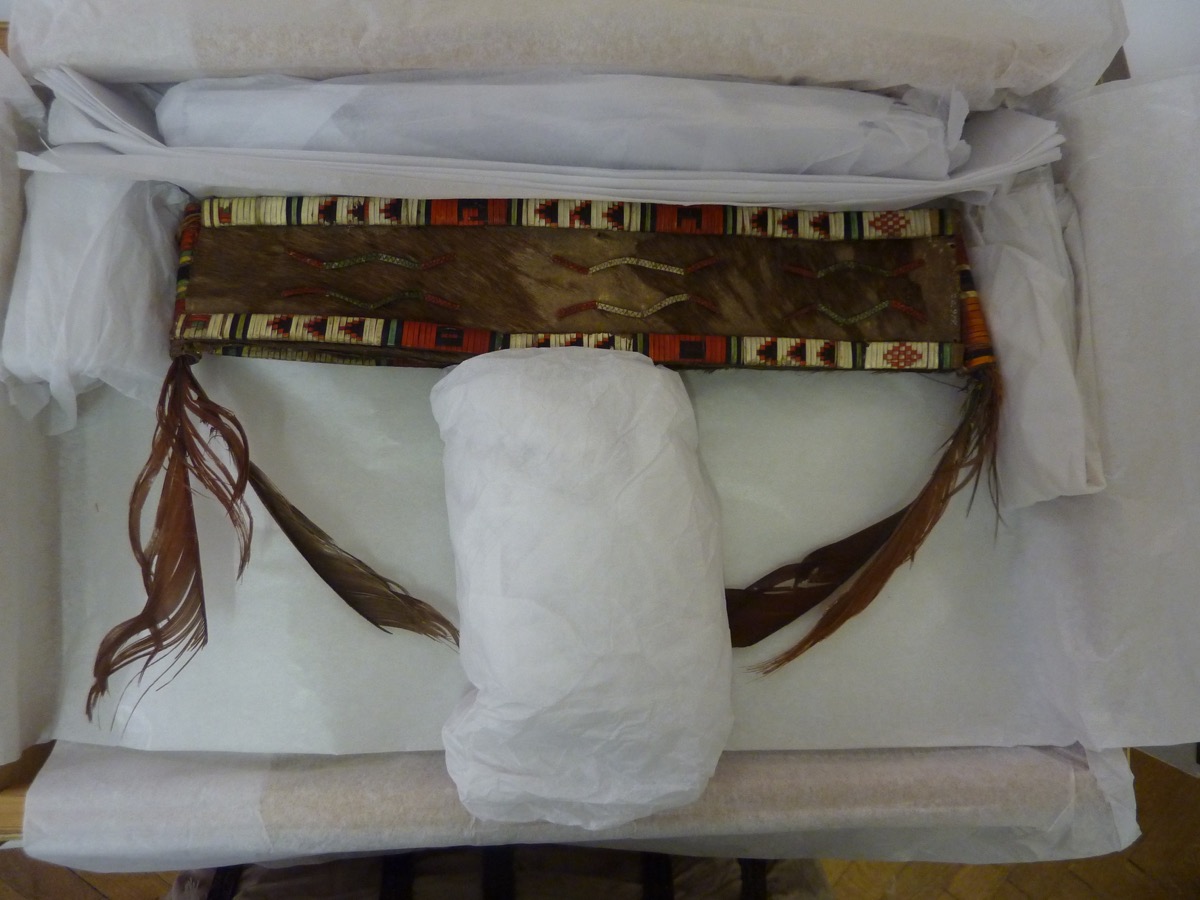
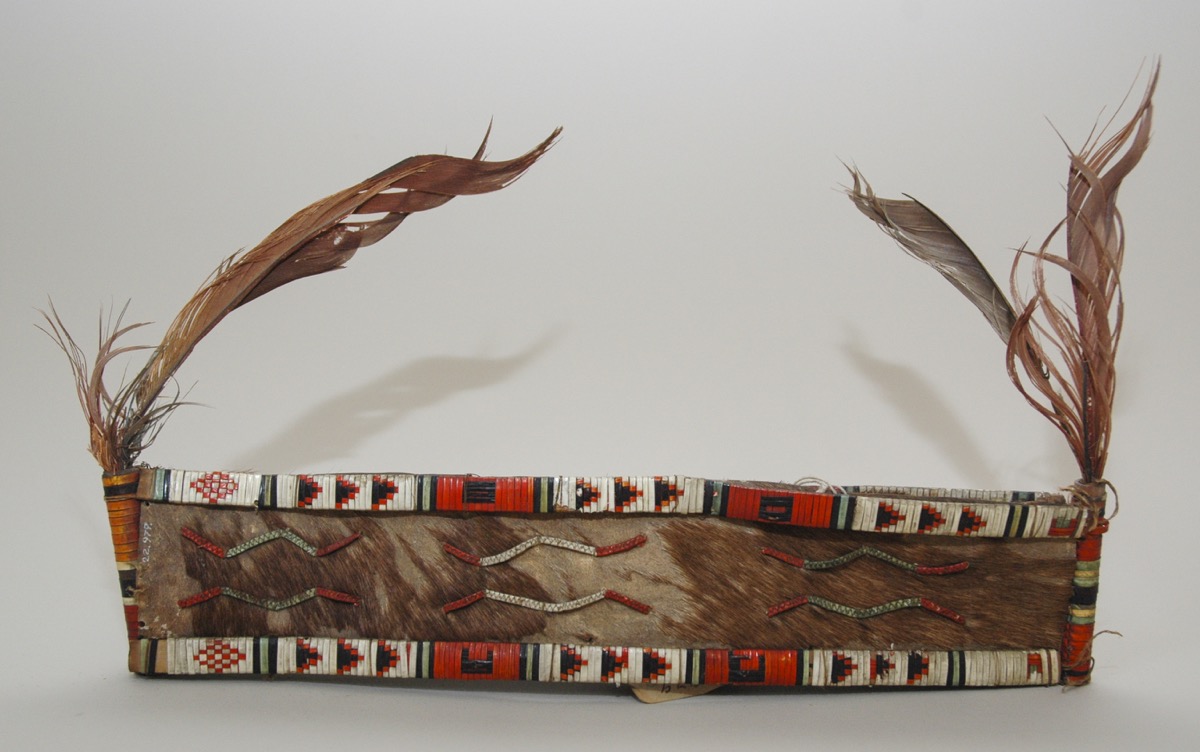
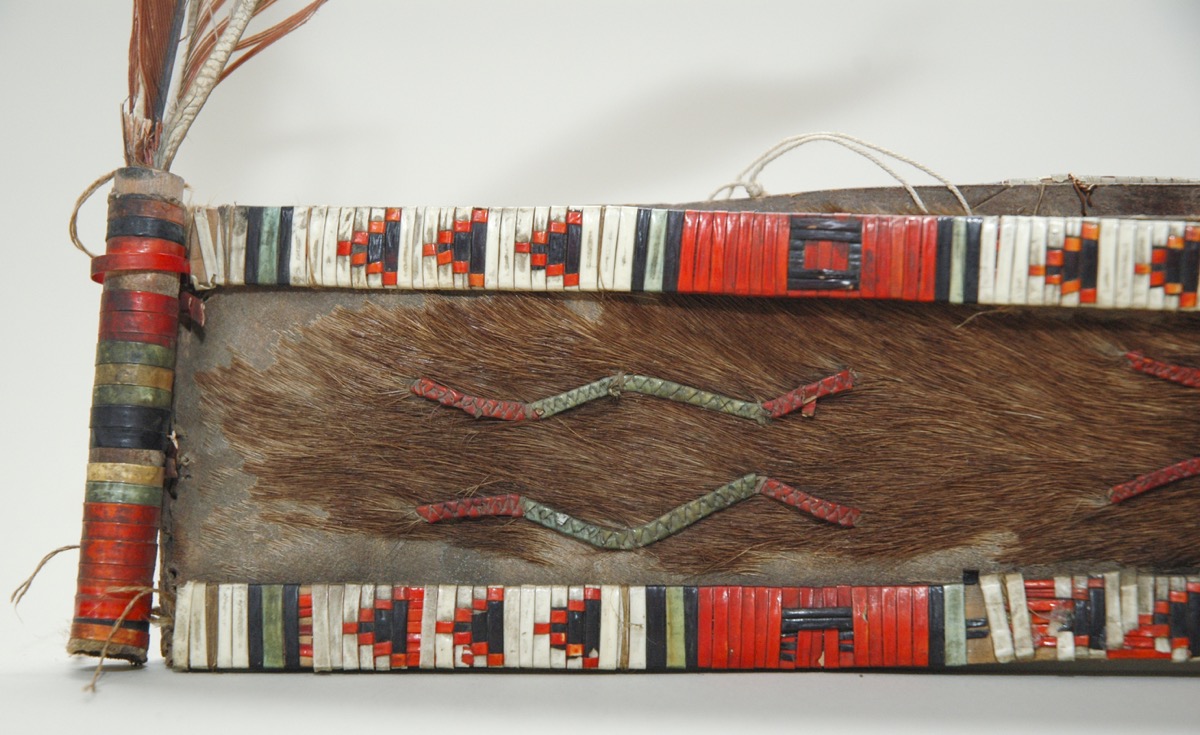
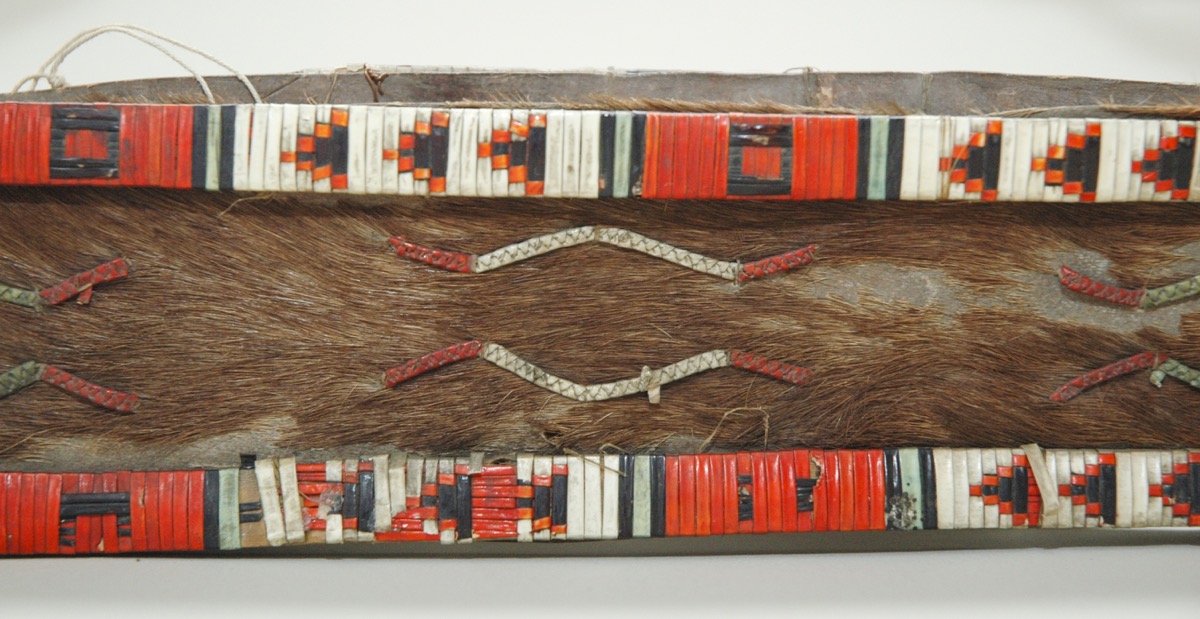
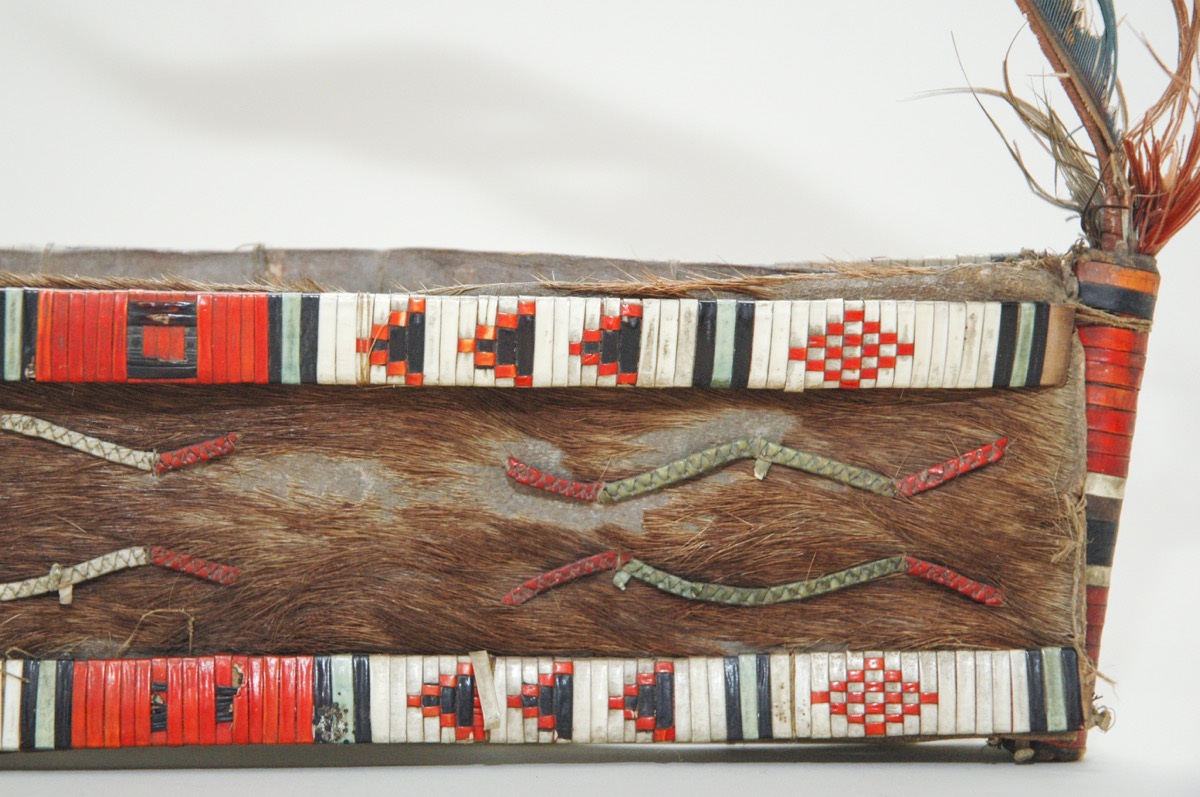
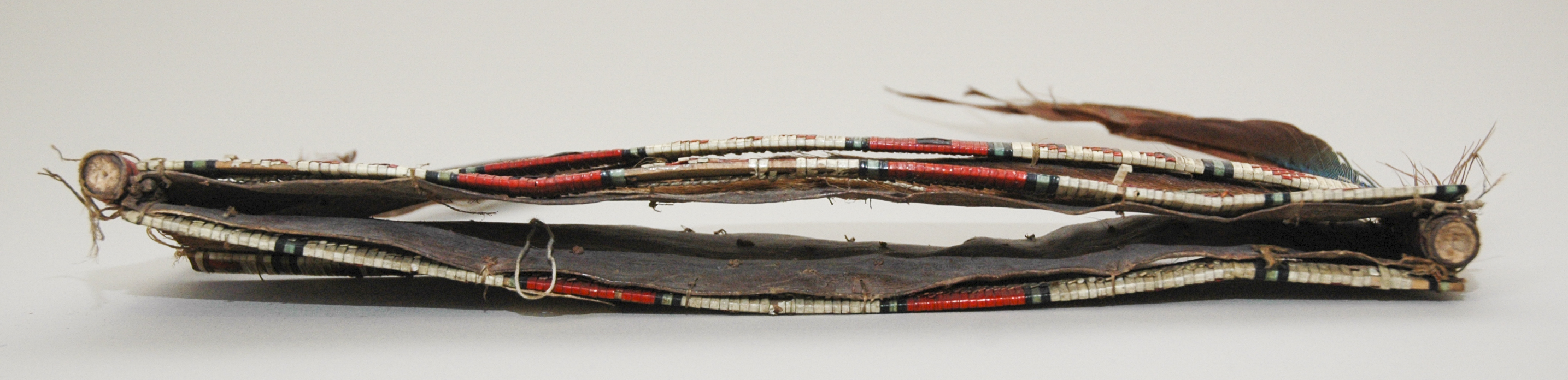
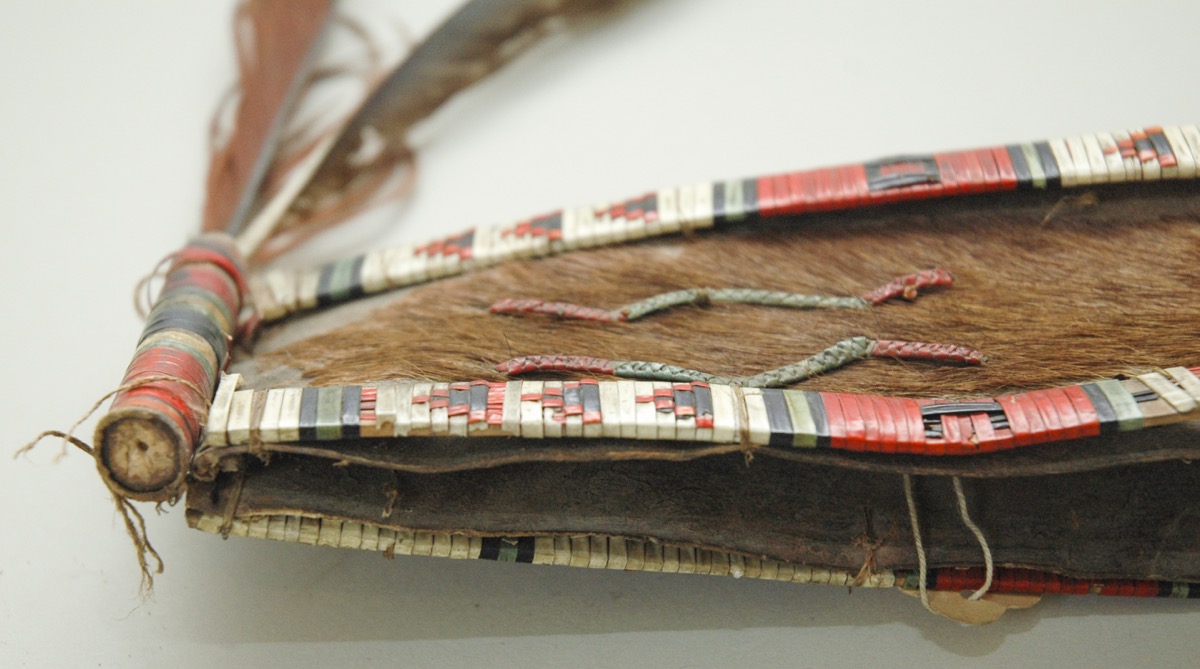
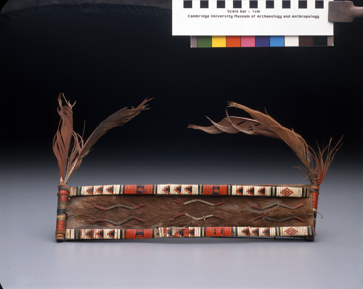
Headdress made of two narrow strips of animal skin attached together, with a cylindrical tube at each end. The tubes are decorated with quillwork and have feathers inserted into them. The animal skin is decorated along the top and bottom edges with quillwork in white, green, black and orange. There is also a central field of animal skin decorated with six zigzags of quillwork in three pairs
Place
Americas; North America; ?USA
Period
18th century
Source
Clarke, Louis Colville Gray (Dr)[donor] Leverian Museum; Widdicombe House
Department
Anth
Reference Numbers
1922.979; MAA: 1913.3; 6624
Cultural Affliation
Woodlands; Delaware; Eastern Great Lakes; Anishinaabe [Ojibwe/Ojibwa, Odawa/Ottawa, Chippewa, Potawatomi, ?Cree]
Material
Hide; Quill; Feather; Bark
Local Term
Measurements
200mm x 320mm
Events
Context (Auction / Sale)
Collected by: Widdicombe House Collection. This headdress was illustrated by Sarah Stone and was in the collection of Sir Ashton Lever. See J.C.H. King, "Woodlands Art as Depicted by Sarah Stone in the Collection of Sir Ashton Lever" in American Indian Art Vol. 18 Number 2 Spring 1993 (J.Tanner, July 1998).
The Leverian Museum: The museum was established by Sir Ashton Lever (1729-1788), a private collector of substantial means. In 1771 he opened a museum at his home at Alkrington Hall in Lancashire. As the museum grew in size and reputation, it was moved to Leicester House, London in 1775 and was one of the first commercial museums in London. However, by the 1780s Lever had fallen into financial difficulties and the collection was disposed of by lottery to a Mr Parkinson, who later sold it at auction in 1806. The sale lasted 65 days from May 5th to July 19th, with over 7800 lots.
A Mr Rowe, a parson from Bristol, bought several lots of items and subsequently some of these passed to his relative Arthur Holdsworth of Widdicombe House, Kingsbridge, Devon. UCMAA' s curator, Louis Clarke, later acquired pieces from this collection, including this item. However, it is not known exactly how Lever acquired the object.
Much of the Leverian collections were acquired during the 1770s period of the American Revolution, when many items were collected by soldiers. Lever was known to have had military connections, so it may be possible that he requested items via such links. This is not unlikely given the documentary evidence that by 1770 Lever had extended his quest to foreign lands and leaflets were printed listing those items he wished to obtain. Copies of this leaflet, followed by a more detailed one in 1773, were sent by Lever' s friends to their associates in different parts of the world. (J. Tanner; 1999).
Event Date 20/11/1992
Author: maa
Description (Physical description)
Headdress of skin, decorated with quillwork and feathers.
Event Date 20/11/1992
Author: maa
Description (Physical description)
Additional description: Two narrow strips of hide attached together, with a cylindrical tube at each end. Tubes covered with decorative quillwork and have feathers inserted into them. Hide decorated along top and bottom edges with quillwork in white, green, black and orange. Central field of hide strips decorated with six zigzags of quillwork in three pairs [J.Tanner]
Event Date 7/1998
Author: Katrina Dring
Context (Amendments / updates)
Eastern Great Lakes area, similar to headdresses collected from the Anishinaabe (the term now used to refer to the Ojibwe (Ojibwa), Odawa (Ottawa), Chippewa and Potawatomi and also possibly some Cree people), but is unlikely to have been collected from the Delaware as noted on the database).
Dates to second half of 18th century, and is similar to other headdresses collected by British military officers who fought in the Seven years War and the American Revolution, see others in the Blair Castle (Scotland) and Caldwell Collections (Canadian Museum of Civilisation).
[Notes added by GRASAC Project Team, (Ruth Phillips, Trudy Nicks, Laura Peers, Stacey Lower)]
Event Date 5/5/2009
Author: Rachel Hand
Context (Amendments / updates)
Noted on old paper/card label in pencil "aeg [unclear] 1913" and added in pen '3'- may refer to a 1913.3 accession
Event Date 5/5/2009
Author: Rachel Hand
Description (Physical description)
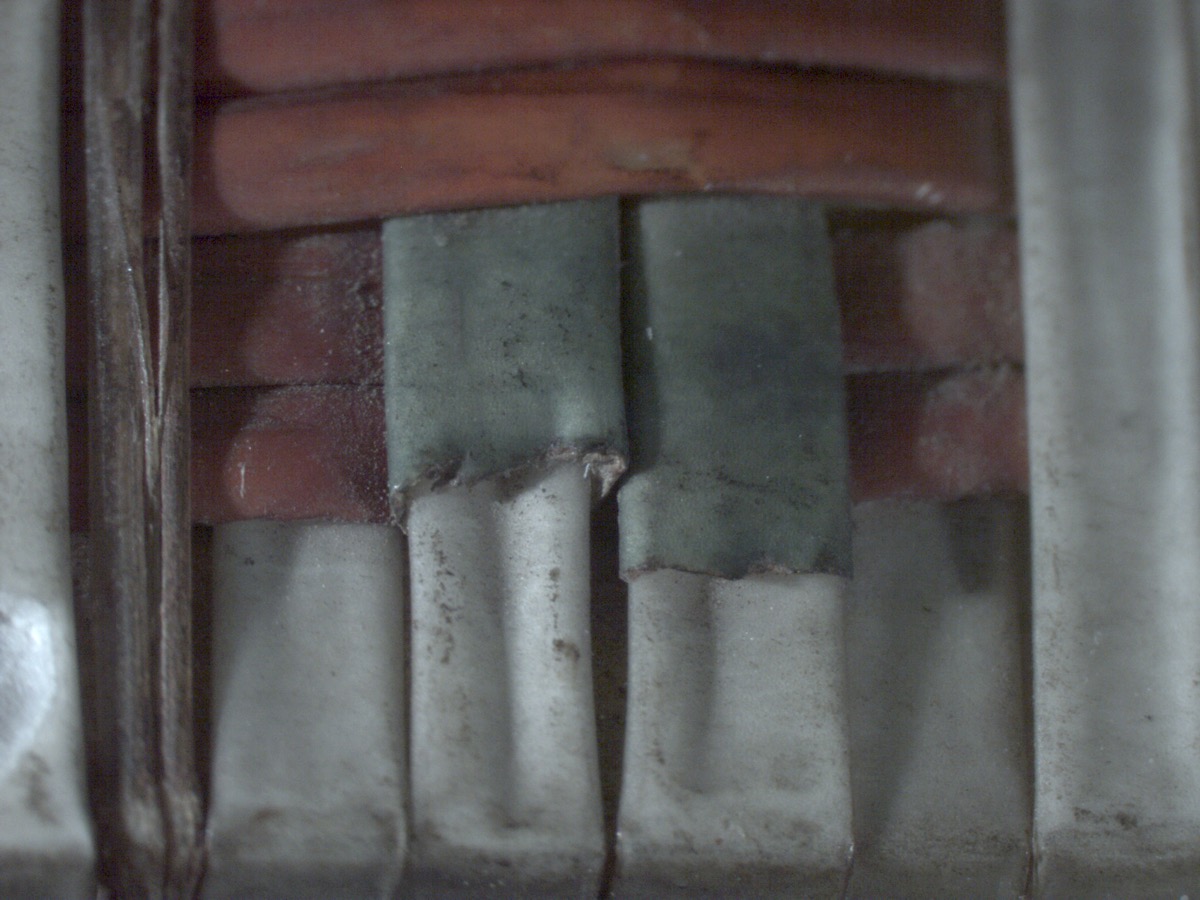
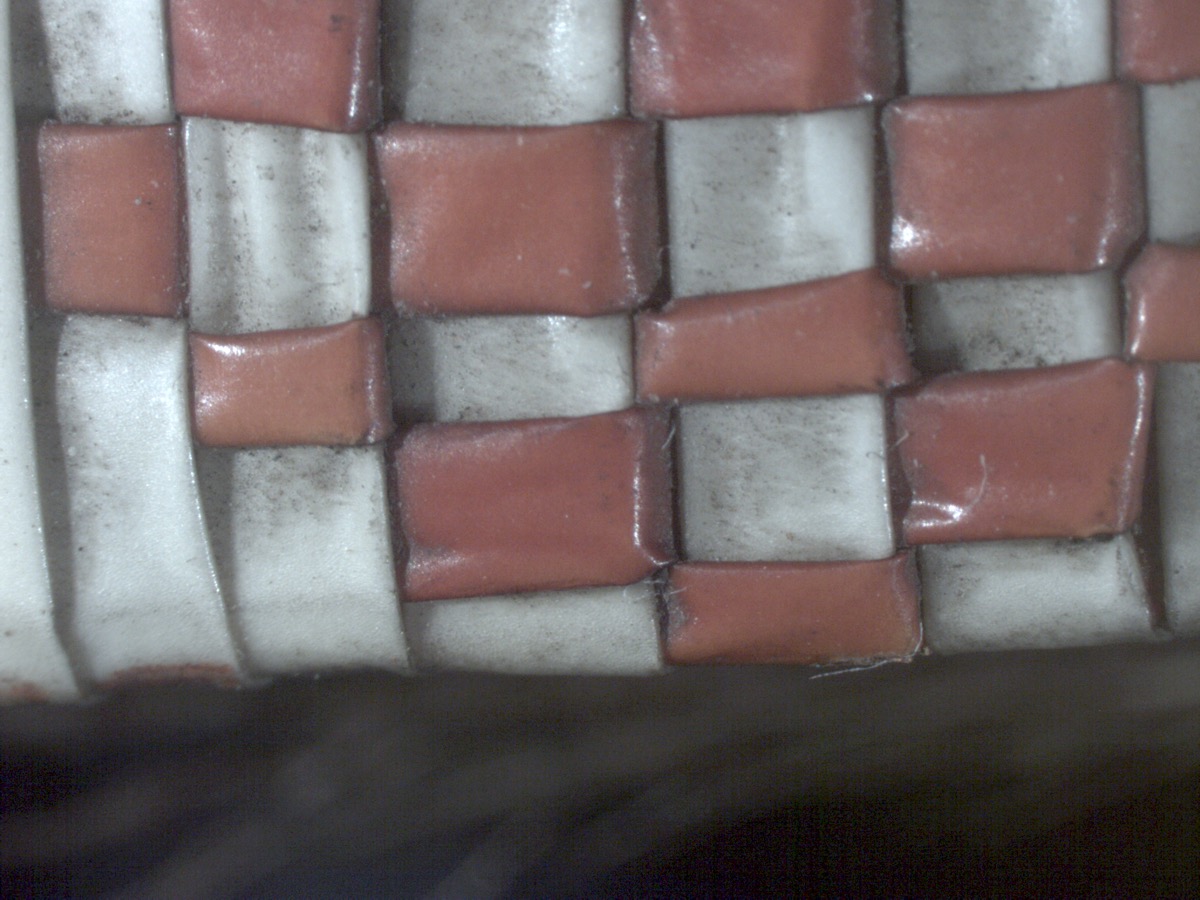
Deerhide band, backed with birch bark, sewn together and bound along outer edges with twine (linen or vegetable fibre). Decorated with a horizontal band of quill wrapped splints of birch bark. The quill design which wrap the splints is woven in chequer-work, stepped and other patterns. In between the splints are 6 paired horizontal zigzag braided quills- the short zigzags may represent serpents. There are four vertically halved feathers, (the blue ones may be kingfisher) and are dyed, probably with ochre. feathers inserted into cylinders at base, ?wood, which are wrapped with quills. No trade goods present.
[Description added by GRASAC Project Team, (Ruth Phillips, Trudy Nicks, Laura Peers, Stacey Lower)]
Event Date 5/5/2009
Author: maa
Context (Production / use)
Nikolaus Stolle suggests that the hide is not deer, but may be pig or cowskin.
Event Date 21/4/2011
Author: maa
Description (Physical description)
The headdress is made of two narrow strips of animal skin attached together, with a cylindrical tube at each end. The tubes are decorated with quillwork and have feathers inserted into them. The animal skin is decorated along the top and bottom edges with quillwork in white, green, black and orange. There is also a central field of animal skin decorated with six zigzags of quillwork in three pairs
Event Date 30/7/2014
Author: maa
Context (Related Documents)
Catalogue card reads [handwritten in black ball point:] "22.979. N. AMERICA"; [later addition handwritten in blue ball point:] "WOODLANDS DELAWARE"; [continues:] "Headdress of skin decorated with Quillwork + feathers. L.G.C. [sic] CLARKE [underlined] from Widdicombe House." [Red circular sticker top right of card.]
Probably part of donation listed in Annual Report for the year 1922, in Museum Annual Reports 1910-1981 (no page number), Appendix I, Donations: "Clarke, Mr. L.C.G. ... ; fifty-one specimens of weapons, ornaments, &c., from N. America, Brazil, New Caledonia, New Hebrides, Niue, E. Pacific, Australia, Celebes, Borneo ; a Tridacna carving from skull-house W. Ysabel, Solomon Islands (22.955-1001)".
Accession register entry (Accessions 11 page 87) reads [handwritten in black ink:] "979 Headdress of skin decorated with quill work & feathers[.] ' ' ' [North America] ' [Louis .C.G. Clarke] ' ' [From Widdicombe House. Kingsbridge. S. Devon.]".
Event Date 12/1/2015
Author: Heather Donoghue
Context (References)
Kaeppler "Holophusicon: The Leverian Museum" (2011:227): "6624 [Leverian lot no.] "Head-dress of a North American chief; ornamented stick of ditto, and sundry others" [Leverian description] (Fig. 6.146, 6.147, 6.148 [Page 227])
Headdress depicted by Stone, Sketchbook IV: 19
(1) Headdress of hide, quill, and feathers, 22.979.
(2) Ball-headed club (with scalp attached) of wood, bone, quill, hide, yarn, tin, and hair, 22.975.
(3) A bundle of tassels, 22.978, probably came from this lot.
(4) Dance stick, 22.976."
Reference compiled by Amiria Salmond during research for the ESRC funded project "Artefacts of Encounter".
Event Date 12/1/2015
Author: Heather Donoghue
Context (Display)
Exhibited: On loan to the exhibition, 'On the Trails of the Iroquois', at the Art and Exhibition Hall of the Federal Republic of Germany, Bonn, 22 March- 4 August 2013, and 18 October 2013 to 6 January 2014 at Martin Gropius Bau museum, Berlin. Returned January 2014.
Illustrated in the accompanying catalogue, On the Trails of the Iroquois, by Sylvia S. Kasprycki, Kunst- und Ausstellungshalle der Bundesrepublik Deutschland, 2013, p168, fig. 249, ‘Headdress/ Iroquois (attributed) second half of 18th century/ Buckskin with fur, porcupine quills birch/bark, feathers, 18 x 31cm/ Museum of Archeology & Anthropology, Cambridge University, cat. no. 1922.979/ (Widdicombe House coll. formerly in the Leverian Museum.)/
Headdresses made of a circular band whose edges are reinforced by quill-wrapped strips and with attached feathers are found e.g., on Romney’s portrait of Joseph Brant (cat. no. 230) and on Benjamin West’s William Penn’s Treaty with the Indians (1771). The present example was displayed in 1784 in the Leverian Museum in London where it was drawn by Sarah Stone (Einhorn and Abler 1996: 44- 45; King 1993: 39; cp. also Feest 2007a:51) C. F’ [by Christian Feest]’
Event Date 11/5/2015
Author: Rachel Hand
Context (Other owners)
The Holdsworths of Widdicombe House, Stokenham, Devon, were a wealthy merchant family. Collections from Widdicombe House were acquired by MAA between 1921 and 1922 probably at the instigation of curator Baron Anatole von Hügel, whose wife, Eliza, was related to the Holdsworth family through her mother.
Eliza donated several items to the museum in 1921 that she had probably purchased when parts of the estate were being sold off. The majority of the Widdicombe House material appears to have been purchased by von Hügel’s successor, Louis Colville Gray Clarke, and accessioned by the museum (along with a Baroness von Hügel acquisition) shortly after Clarke’s appointment in June 1922. A further item was accessioned in 1925, another six objects in 1927, 16 during the 1903s, with a final one in 2013. Scattered notes in accession registers, on catalogue cards and surviving labels record a first, second and third Widdicombe House Collection, deposited in 1922 by Baron von Hügel, which suggests that there may have been three separate groups of material that came to MAA, possibly deposited by von Hügel, but eventually paid for by Louis Clarke.
Research by Adrienne Kaeppler has revealed that the Holdsworth family acquired objects from the sale of the collections of the Holophusicon or Leverian Museum in 1806. The Leverian is known to have contained a large number of Cook voyage pieces, in particular third voyage pieces from the Pacific and Northwest Coast of America, as well as material from the First Fleet. Using a series of drawings commissioned by Lever from the artist Sarah Stone in the 1780s, Kaeppler was able to identify a number of artefacts and match them with items in the Leverian sale catalogue. Other Leverian Museum material was bought at J.C. Stevens Auction Rooms, (Stevens), in 1905 by von Hügel and later deposited/donated and may also be the source of other von Hügel pieces.
Kaeppler identified John Rowe, (a clergyman from Bristol), as the purchaser of 77 lots, made on behalf of his brother-in-law Richard Hall Clarke, of Bridwell House, Uffculme, Devon and Clarke’s son-in-law, Arthur Howe Holdsworth of Widdicombe House. According to Kaeppler, at least sixty artefacts in MAAs collections are most likely to be Cook voyage pieces and can reasonably be associated with Rowe’s purchases for Widdicombe House.
The MAA Widdicombe House collection encompasses 168 objects and includes items from North American Woodlands, Asia and Africa, that do not match any of the Leverian lots purchased by Rowe and which must have been acquired by the Holdsworths through other means.
For many years, the Holdsworth family were unaware of the Cook connection to their collections and believed them to have been acquired by a distant relative called ‘Admiral Gordon’. Consequently, MAA assigned Gordon as the collector for much of the Widdicombe House material and this is reflected in registers and catalogue cards. Despite extensive research, no Admiral Gordon has ever been found and is now believed to have played no part in the history of these objects.
For further information see: Adrienne Kaeppler, 2011. ‘Holophusicon: The Leverian Museum: An Eighteenth Century English Institution of Science, Curiosity and Art.’ Amiria J.M. Salmond, (publication pending). ‘Artefacts of Encounter: the Cook-Voyage Collections in Cambridge’ (Museum Ethnographers Group). Also see Bio entry for Widdicombe House.
(Rachel Hand, 12.01.2015)
Event Date 12/71/2015
Author: Heather Donoghue
Conservation ()
CON.2013.12 |
Event Date 1/3/2016
Author: maa
Context (Amendments / updates)
Language- Algonquian speakers
Language group affiliations were previously recorded in the cultural group field but this has now been removed.
Event Date 12/8/2020
Author: Katrina Dring
Context (Amendments / updates)
Source field edited to retain references to the Leverian Museum and Widdicombe House collections, but Rowe is only noted in the contxct below for clarity.
Event Date 12/8/2020
Author: Katrina Dring
FM:83574
Images (Click to view full size):