Accession No
1993.76
Description
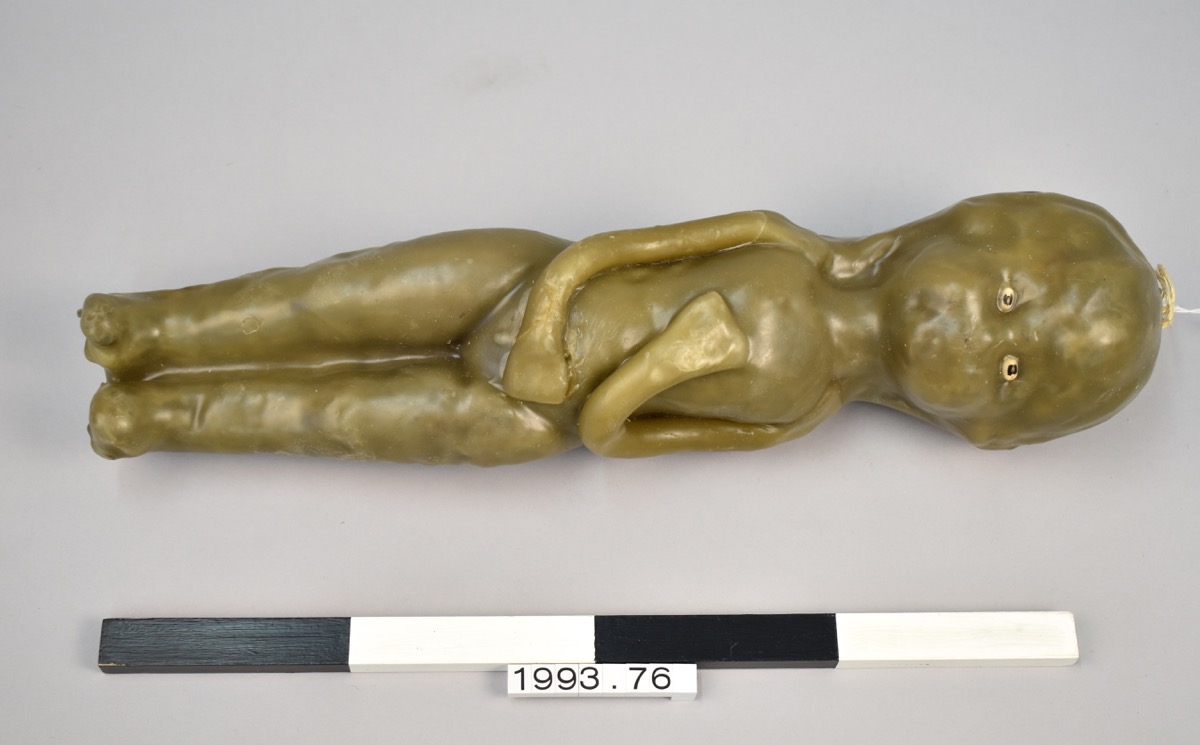
Tamata. Votive offering. Stylised representation of a standing child, hand modelled in olive green wax. Its right hand rests on its left hip and its left hand is placed on its abdomen. A loop of string protrudes from the top of its head suggesting a point of suspension. The eyes are black-eyed beans pushed into the wax. The right forearm is damaged, wax has cracked and fallen away.
Place
Europe; Southern Europe; Cyprus
Period
Source
Papadakis, Ioannis [field collector]; Crowther-Beynon Fund [monetary donor]
Department
Anth
Reference Numbers
1993.76; MAA: 1993.30 [conservation lab no.]
Cultural Affliation
Greek Cypriot; Greek Orthodox
Material
Wax; Seed; Fibre
Local Term
Tamata
Measurements
440mm
Events
Context (Field collection)
Collected by Ioannis Papadakis in 1990/1991.
Event Date 1990
Author: Lucie Carreau
Context (Production / use)
'These votive offerings have been collected in the Republic of Cyprus (i.e. the southern side of the divided island where the internationally recognised government resides) during my fieldwork(Oct. 1990 - Dec. 1991). These votive offerings are predominantly used by the (Greek Orthodox) Greek Cypriots though in the past the (Sunni Muslim) Turkish Cypriots might sometimes place offerings in Greek Orthodox churches. With the advent of nationalism which eradicated most syncretistic practices this came to an almost complete halt, even though today votive offerings may be placed by Turkish Cypriots at the monastery of Apostle Andreas (in the north), who has an island-wide reputation as a particularly powerful saint and shrine. Even though one could offer anything at all as votive offerings (tamata), these often take the form of ready-made wax or silver offerings. As soon as a wish or request is made to a saint (mostly in private prayer) an offering may be placed at a shrine with the expectation that the saint will produce the desired effect. Especially for health problems, related to say the eyes, feet, child-bearing or the health of a child, an offering in the shape of the ill body part or baby/child will be made. In the past, people might place offerings for the curing of a sick animal and these would be in the shape of an animal. In one instance, I saw an offering in the shape of a book which could be related to some educational problem. Ready-made votive offerings come in two kinds, wax and silver, the former being bulkier but cheaper and the latter much smaller but more expensive. The ones of silver may be pinned on the cloth covers of an icon, while the wax ones may be placed at the feet of the icon or at some place specially designed for this purpose within the church. The ones made of silver may sometimes be collected and placed in a wooden box with a glass front mounted on the wall.' (Ioannis Papadakis)
Event Date 1/7/1993
Author: maa
Description (Physical description)
Votive offering. Stylised representation of a standing child, hand modelled in olive green wax. Its arms are elongated. Triangular slab shapes represent the hands. Its right hand rests on its left hip and its left hand is placed on its abdomen. A loop of string protrudes from the top of its head suggesting a point of suspension. The eyes are represented by black-eyed beans pushed into the wax. The right forearm is damaged, wax has cracked and fallen away; Good
Event Date 1/7/1993
Author: maa
Context (Display)
Loaned to the Sainsbury's Centre, Norwich, 23.4.1997. Now returned to shorts 19/10/2000
Event Date 23/4/1997
Author: Lily Stancliffe
Description (Physical description)
Tamata. Votive offering. Stylised representation of a standing child, hand modelled in olive green wax. Its right hand rests on its left hip and its left hand is placed on its abdomen. A loop of string protrudes from the top of its head suggesting a point of suspension. The eyes are black-eyed beans pushed into the wax. The right forearm is damaged, wax has cracked and fallen away
Event Date 17/4/2023
Author: Lily Stancliffe
FM:82151
Images (Click to view full size):