Accession No
1988.180
Description
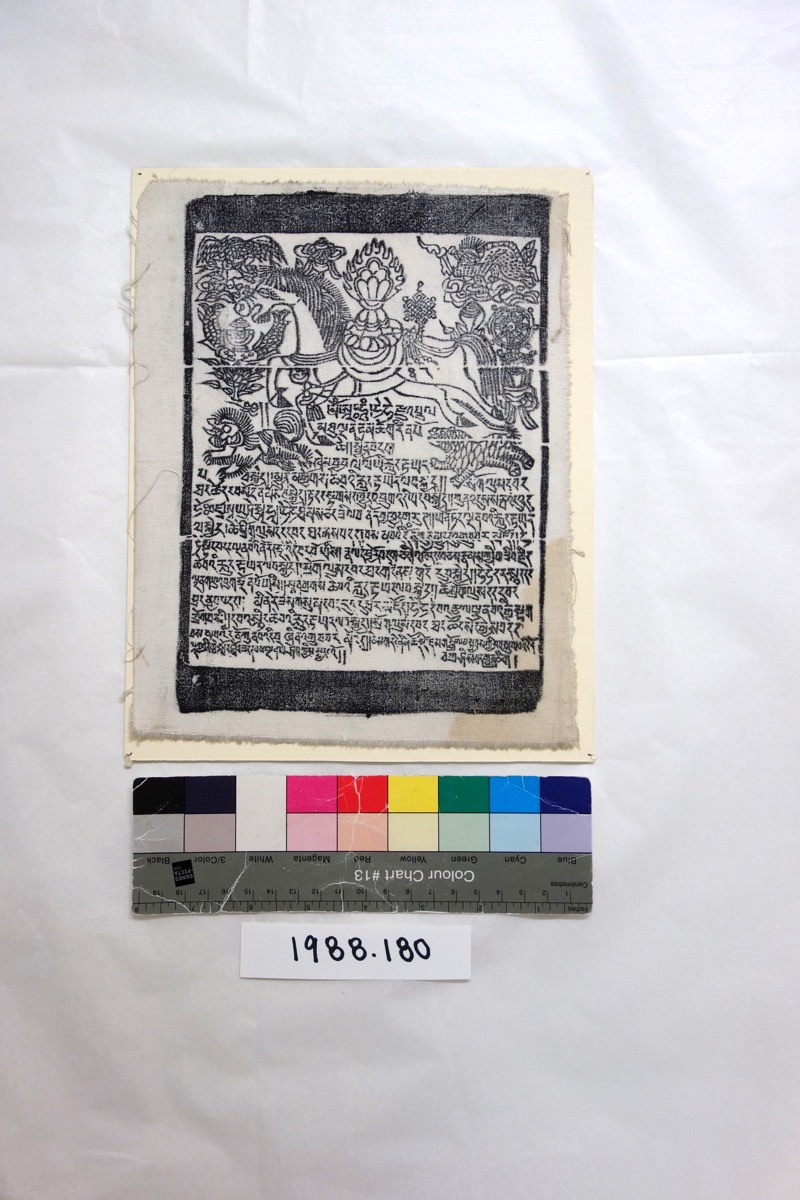
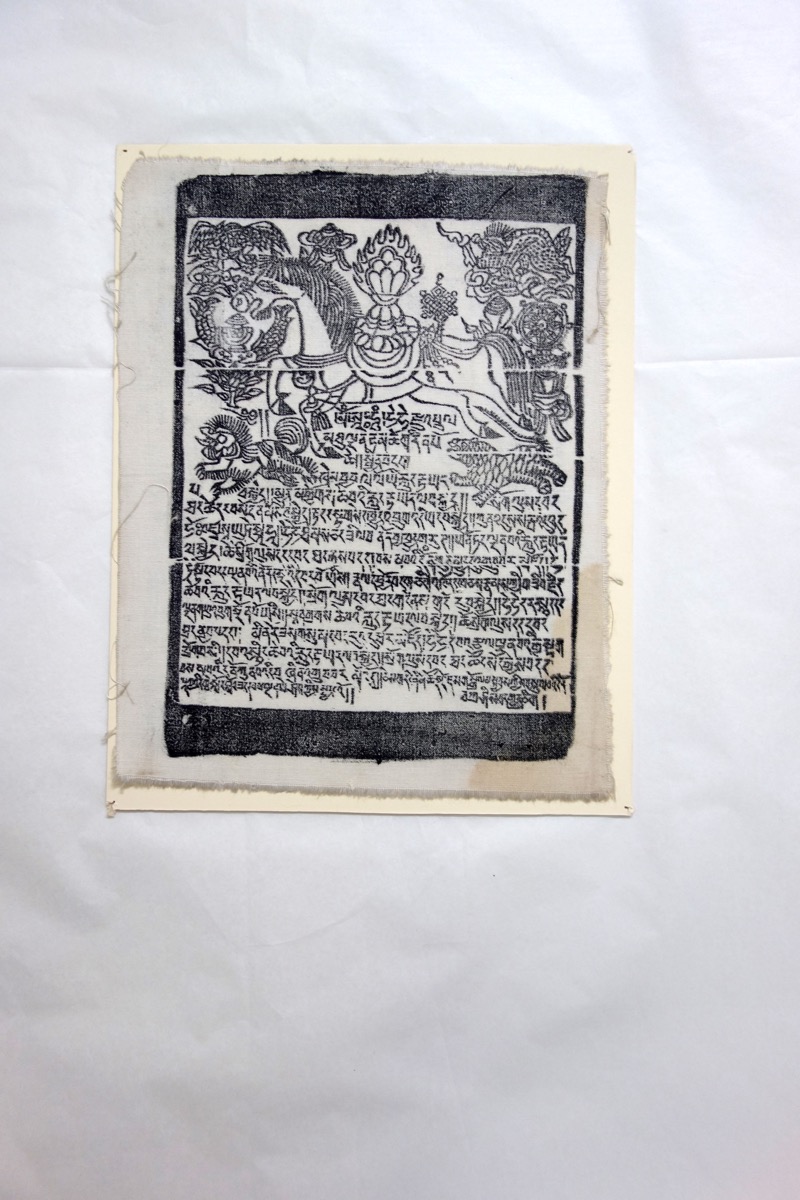
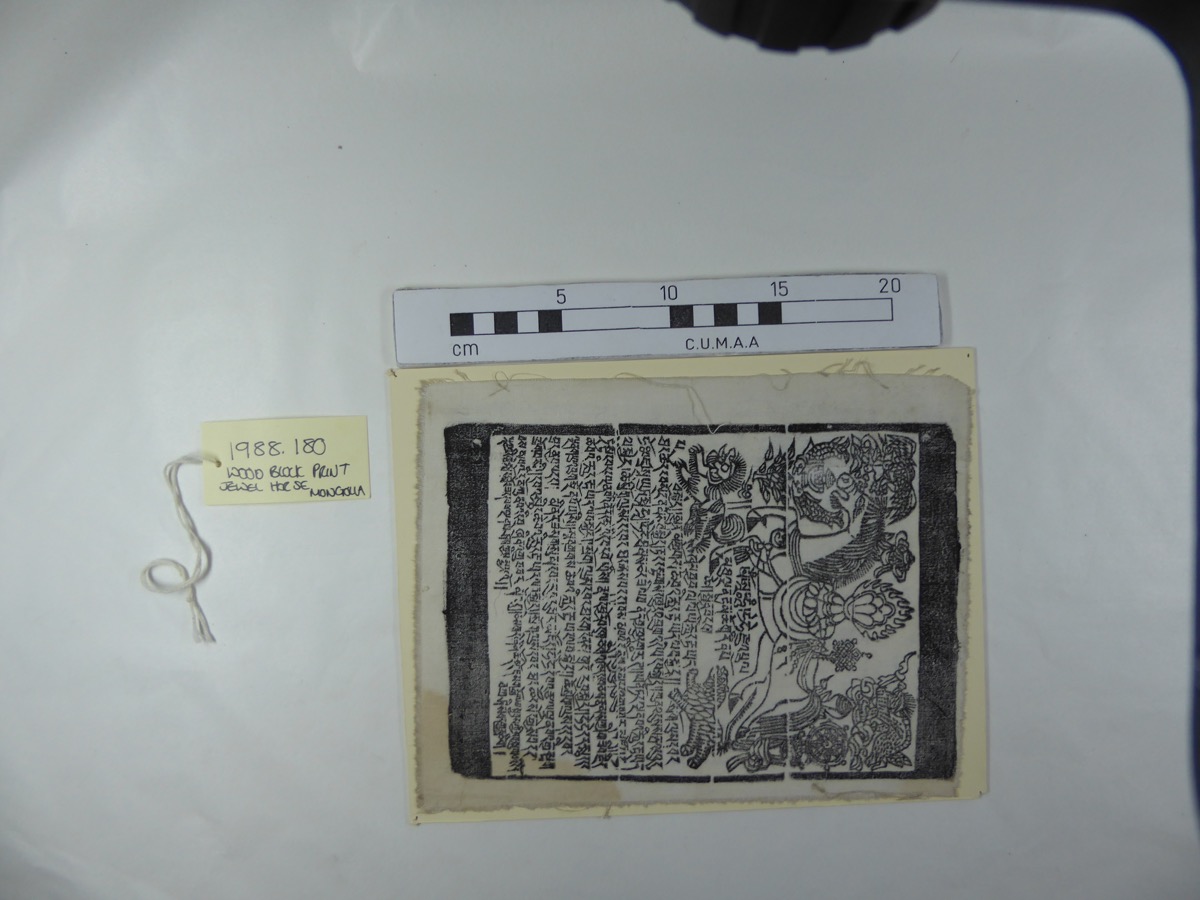
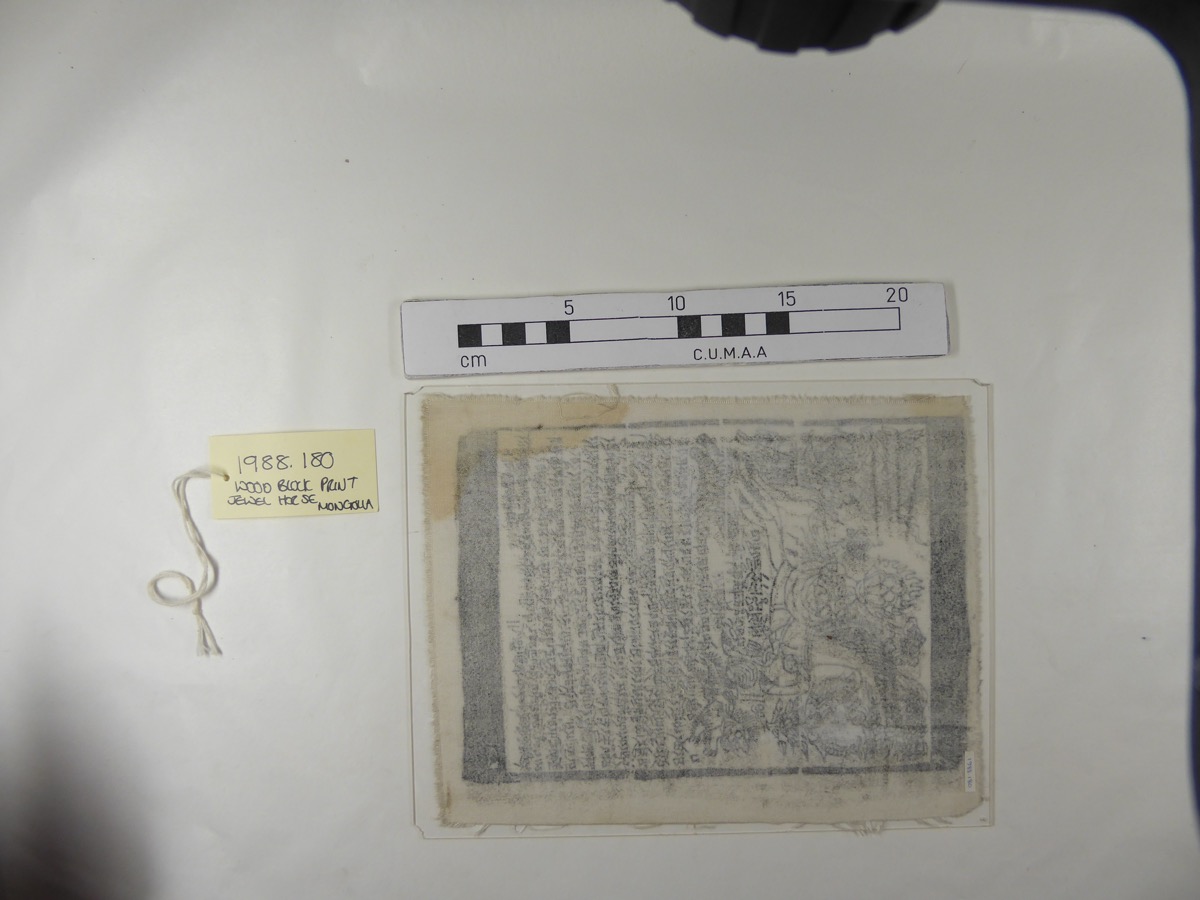
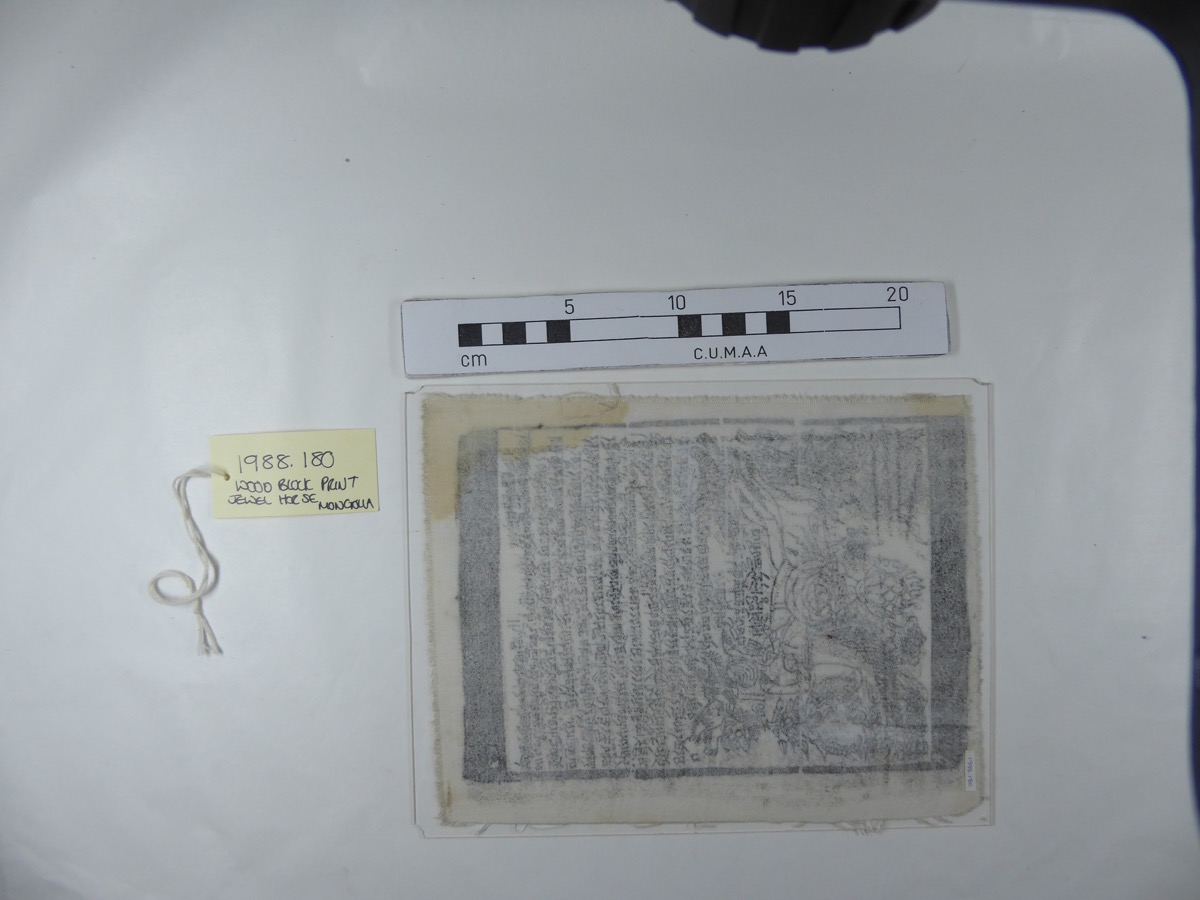
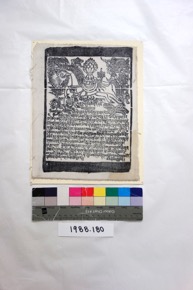
Wind horse - wood block print on white cloth.
Place
Asia; East Asia; China; Inner Mongolia; Hohhot [Huhehot]
Period
Source
Humphrey, Caroline (Dr) [collector]
Department
Anth
Reference Numbers
1988.180
Cultural Affliation
Material
Cloth
Local Term
kei mori; xii mor'
Measurements
209mm x 254mm
Events
Context (CMS Context)
See Humphrey file; Collected by: Humphrey.Dr.Caroline in 1987: There are several varieties of wind horse, but they are all printed by wood block on white cloth, and most consist of a tarni (incantation) in Tibetan script, with, above it, a ' jewel horse' (erdeni mori). A small wind horse such as this one is used ritually in two ways. It can be suspended from a rope (zel) hung between the two posts supporting the yurt. Alternatively it is attached to a stick (forked, or a cross) and inserted in the ground or in the stones at an oboo (ritual cairn). In either case the act of putting up the wind horse is called ' x. m. sergee' - ' the wind horse inspires' , the idea being that the horse inspires one' s spirit. Such an act confers merit. There is another ritual which is also called ' x. m. sergee-' even though it is not obligatory to set up a flag at it. In order to bring luck and success, the person collects a number of small stones from a river bed (golyn chuluu). The number should equal the years of the person' s age. He/she should take the stonesup to the top of a hill, pull out a few hairs from his/her own head, burn the hairs, and then place them, with the stones on top, on the summit of the hill. This is done on a Red Horse day, which occurs about once every two months, and usually beforea big enterprise. But in any case, it should be done once a year. This is perhaps like making one' s own tiny oboo. To take stones from the bottom of a hill and place them on an ' oboo' is a meritorious act. This is because, the stones in a cairn naturally roll down the hill, and in the course of time an ' oboo' will be flattened and collapse. Only people can bring the stones up again, and take care of an ' oboo' . The o. is the site of the dwelling of the ' lord of the land' (gazaryn ezen). If one takes food or money from offering which other people have made at the ' oboo' , one must obligatorily repay by bringing up a stone for the cairn. The horse is surrounded by four animals (' dorben xuchten' - the four powerful ones) and 8 holy objects. The four animals are (from top left clockwise): ' garuda' (mythical bird); ' luu' (dragon); ' bars' (tiger); ' arslan' (lion). The 8 holy objects are two fishes (xoyor zagas, i.e. ' arga bilig xoyor' = yin & yang); ' bumba' (sacred water container); ' olzii' (endless knot); ' dung' (mother-of-pearl shell); ' the wheel of dharma' ' the lotus' and the standard (' tug'). The last of these is not clearly visible on this example, but " it should be there" . The horse bears on its back the wish-granting jewel (chandman'). The translation of the ' tarni' (incantation) is in Dr Humphrey' s file
Event Date 2/3/1988
Author: maa
Description (CMS Description)
Wood block print on white cloth; Good; Whole; Incantation; Jewel Horse
Event Date 2/3/1988
Author: maa
Context (CMS Context)
Exhibited: On display in the Maudslay Hall, in Drawer A, under Case 41, Mongolia from 1990- 2015/8/26.
Event Date 26/8/2015
Author: Rachel Hand
FM:80014
Images (Click to view full size):