Accession No
1988.178
Description
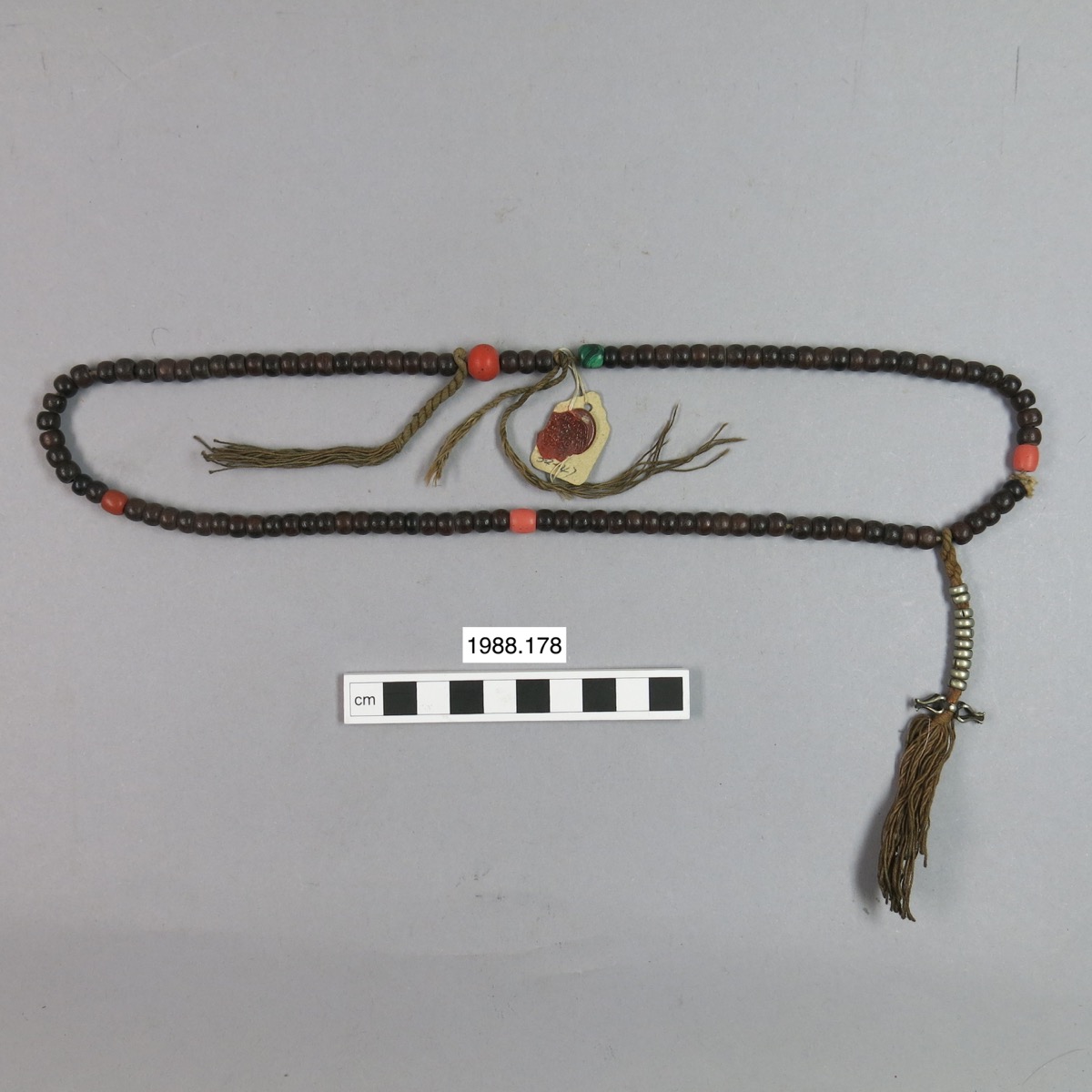
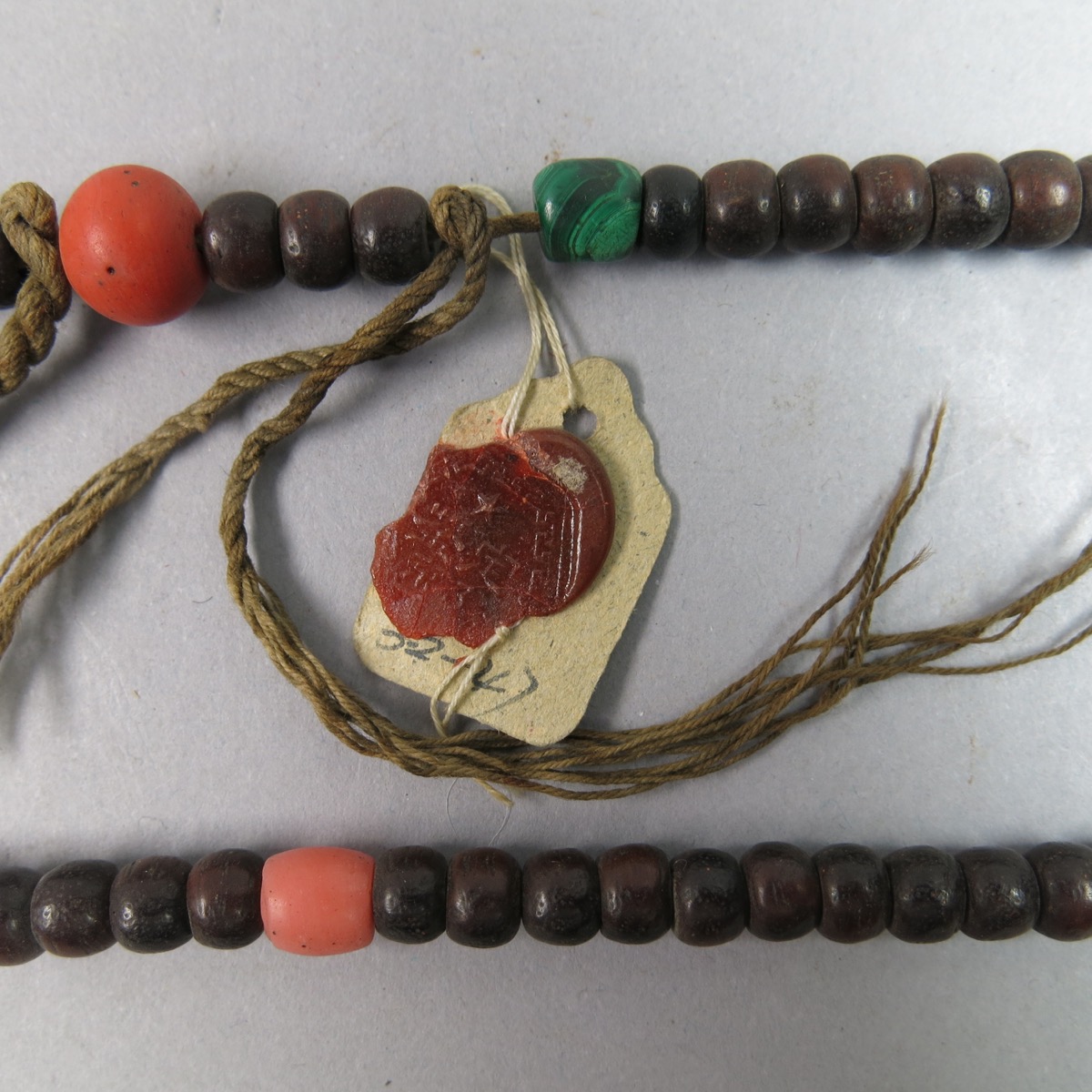
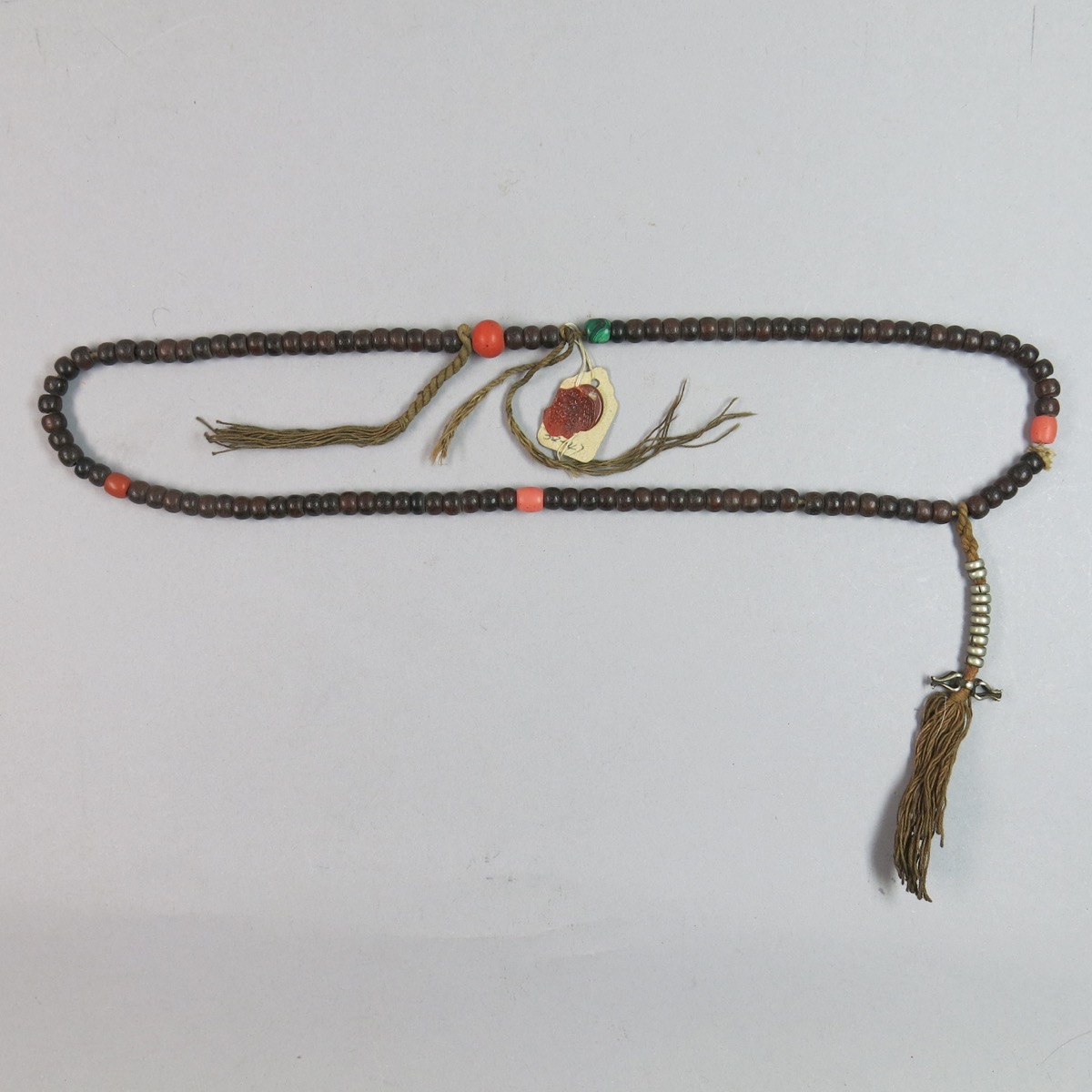
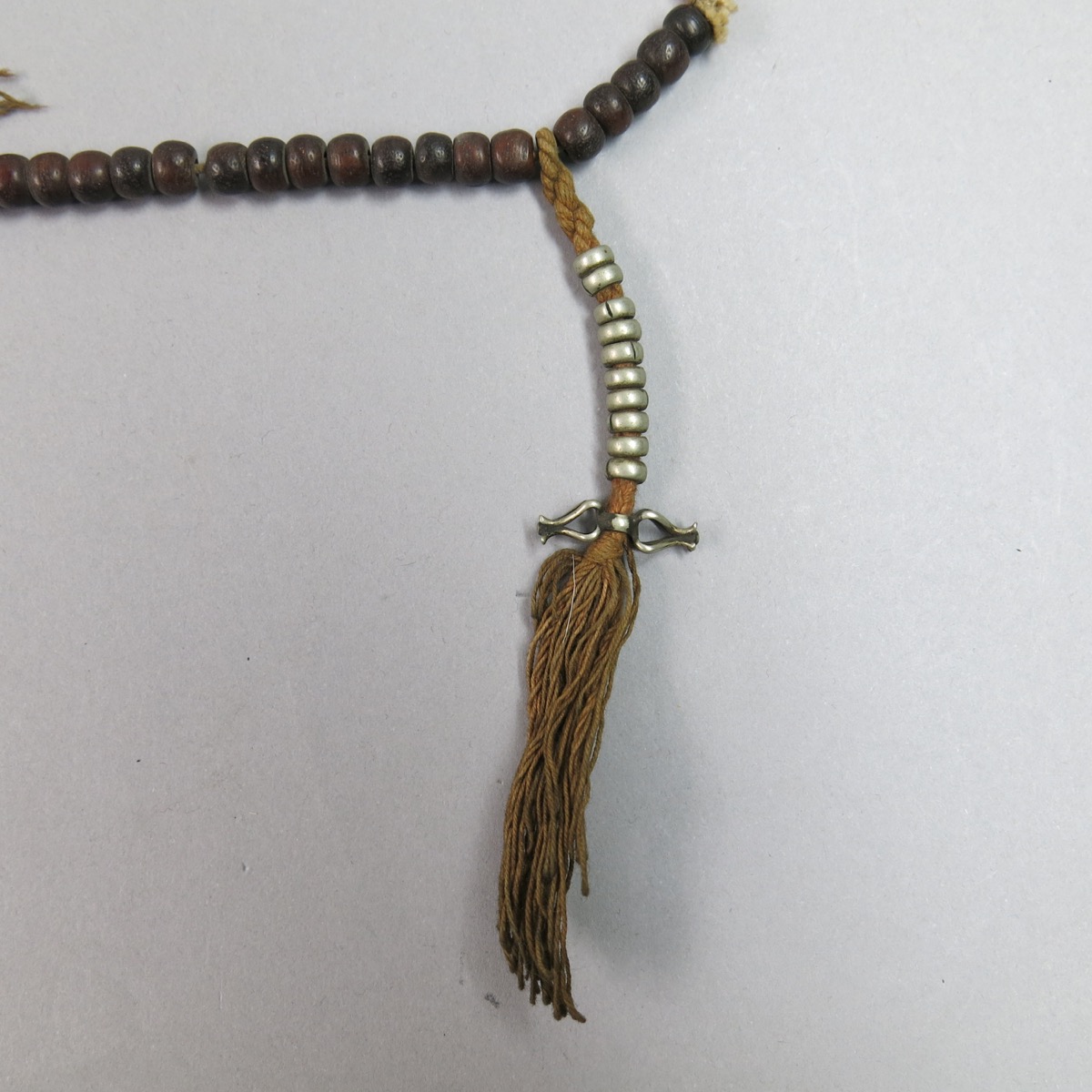
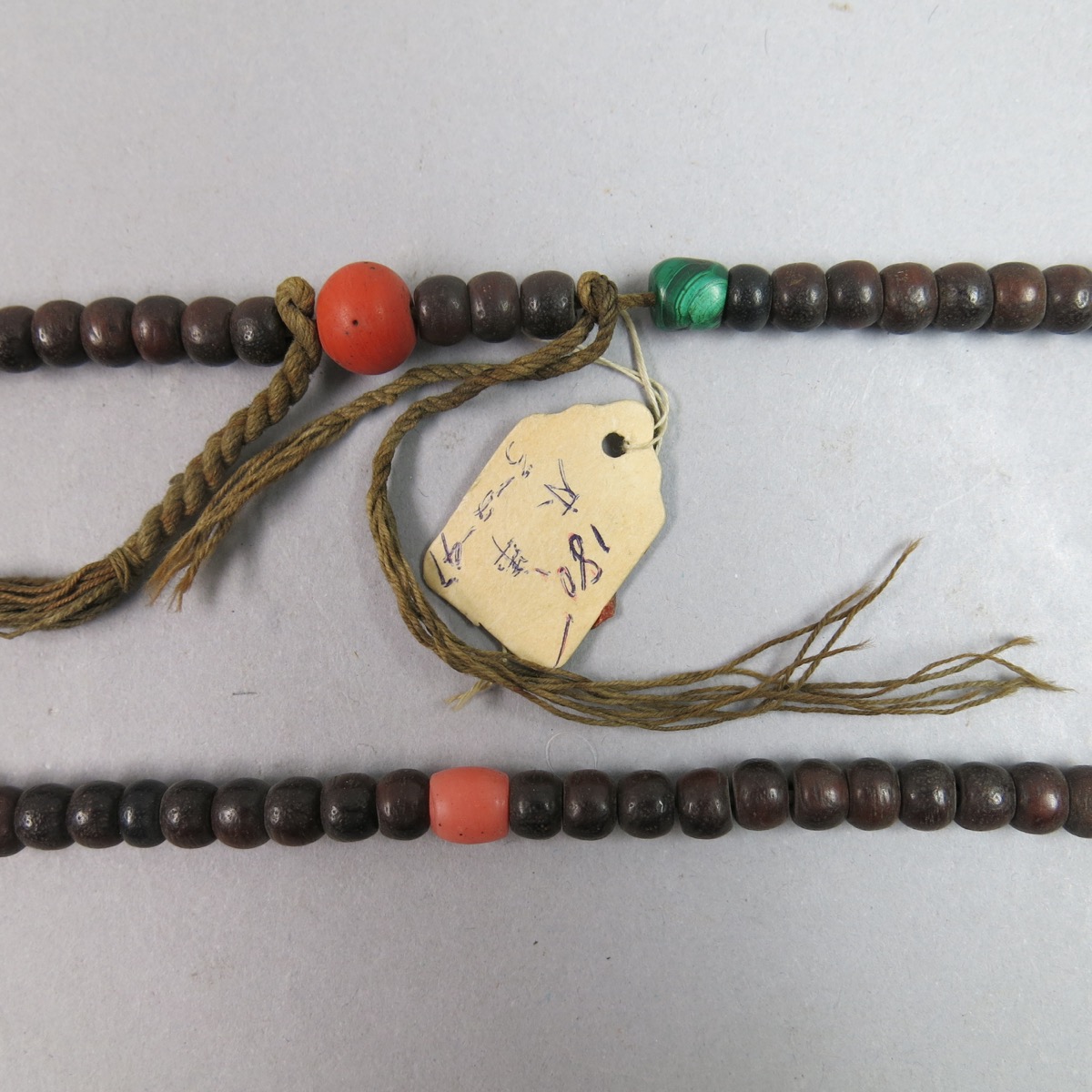
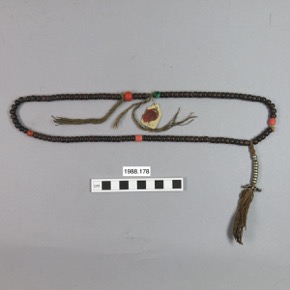
Erkh; Erikh. Rosary of wooden beads, comprising a loop of brown beads, with four orange beads and one blue bead. At one end of the loop is a loose section of cord, with white beads and a tassel at the end.
Place
Asia; East Asia; China; Inner Mongolia; Hohhot [Huhehot]
Period
20th century
Source
Humphrey, Caroline (Dr) [field collector]
Department
Anth
Reference Numbers
1988.178
Cultural Affliation
Material
Wood; Plant; Fibre
Local Term
Erikh [Mongolia]; Erkhe [Inner Mongolia]; Erkh ['classical Mongol'; Catalogue card]
Measurements
Events
Context (Field collection)
Collected and donated by Dr. Caroline Humphrey in 1987.
Event Date 1987
Author: Flo Sutton
Context (Production / use)
catalogue card reads: 'Rosary ('erkh', classical Mongol). These rosaries are used for saying Buddhist prayers. The most common prayer is called 'mani' (Tibetan 'ma ni', Sanskrit 'mani'), being the syllables 'Om mani padme hum'. The beads are counted by being rolled between the thumb and first finger of either hand (usually the right hand) and pushed down the string after each prayer. A rosary of normal size has 108 beads, but there are also smaller ones of 21 beads, used for prayers to goddesses such as the Green Tara and the White Tara. Rosaries are made of woods, and superior ones are made of seeds, coral or are made of celluloid or plastic. Old rosaries of precious stones such as coral have become fashionable as women's necklaces. A rosary should not be just left carelessly as it falls. It should be left coiled up in a high place, or else it should be carried on the body, either wound round the right wrist, or worn round the neck. To aid in counting there are four extra beads of different colour (in this case coral and turquoise) called 'khuis' (bud of flower). These are placed every 28 beads along the string. At the beginning there is a larger bead (here a round coral) called 'tolgoi' (head). The 'tolgoi' should have, although this one does not, one or two smaller beads tied behind it. Counting starts from the bead after the 'tolgoi', going up to it, and then the rosary is turned round and counted backwards. The turquoise is there to show which side of the 'tolgoi' you started. The small silver beads are used to count large numbers. There are ten of these, and at the end is tied an 'ochir' ('thunderbolt'), with the symbolic meaning of protection, and the blocking off of luck which might otherwise escape from the end of the string. Saying 100,000,000 prayers is known as 'dunchuur'. A person who has done this gains great religious merit, and in folk belief also become 'nom chadaltai' (lit. 'powerful in magic powers ('shid', from Sanskrit 'siddhi'). Such a person can cure small illnesses, avert bad luck, etc. by saying spells ('tarni' from Sanskrit 'dharani'). Some people also use rosaries to tell fortunes and in divination, for example to find a lost animal or object, to predict whether a journey will be successful, or to find out the cause of an illness. In this case, the rosary is taken in both hands, and the beads are simultaneously counted up from both sides, up to the 'tolgoi', then a prayer or spell ('tarni') is recited and the result of the divination is pronounced. Such a rosary-diviner ('ekhieer mergeldeg khun') is said to be possessed with spell-power ('tarni chadal orshdog'). Other methods of divination in Mongolia are: by dice, by using 49 stones from 49 streams, and by reading the cracks on sheeps' shoulder blades. Rosaries are precious possessions, passed down in families, usually from women to other women and from men to men. This rosary was obtained in Huheot, Inner Mongolia, China, in August 1987. The seal is an official government stamp, showing that this is genuine. The above information was obtained from a Mongolian citizen of the People's Republic of Mongolia'
Event Date 2/3/1988
Author: maa
Description (Physical description)
Rosary of wooden beads; Good; Whole
Event Date 2/3/1988
Author: maa
Context (Amendments / updates)
During the MIASU Cosmopolitical Heritage Project, 2023, Naranchimeg Jukov, Curator and Researcher at National Museum of Mongolia, and Daruhan Peng, Lecturer at Inner Mongolia University updated the 'local terms' to reflect language in both Mongolia and Inner Mongolia.
Event Date 22/2/2023
Author: Flo Sutton
Description (Physical description)
Erkh; Erikh. Rosary of wooden beads, comprising a loop of brown beads, with four orange beads and one blue bead. At one end of the loop is a loose section of cord, with white beads and a tassle at the end.
Event Date 9/2/2023
Author: Flo Sutton
FM:80013
Images (Click to view full size):