Accession No
1988.175
Description
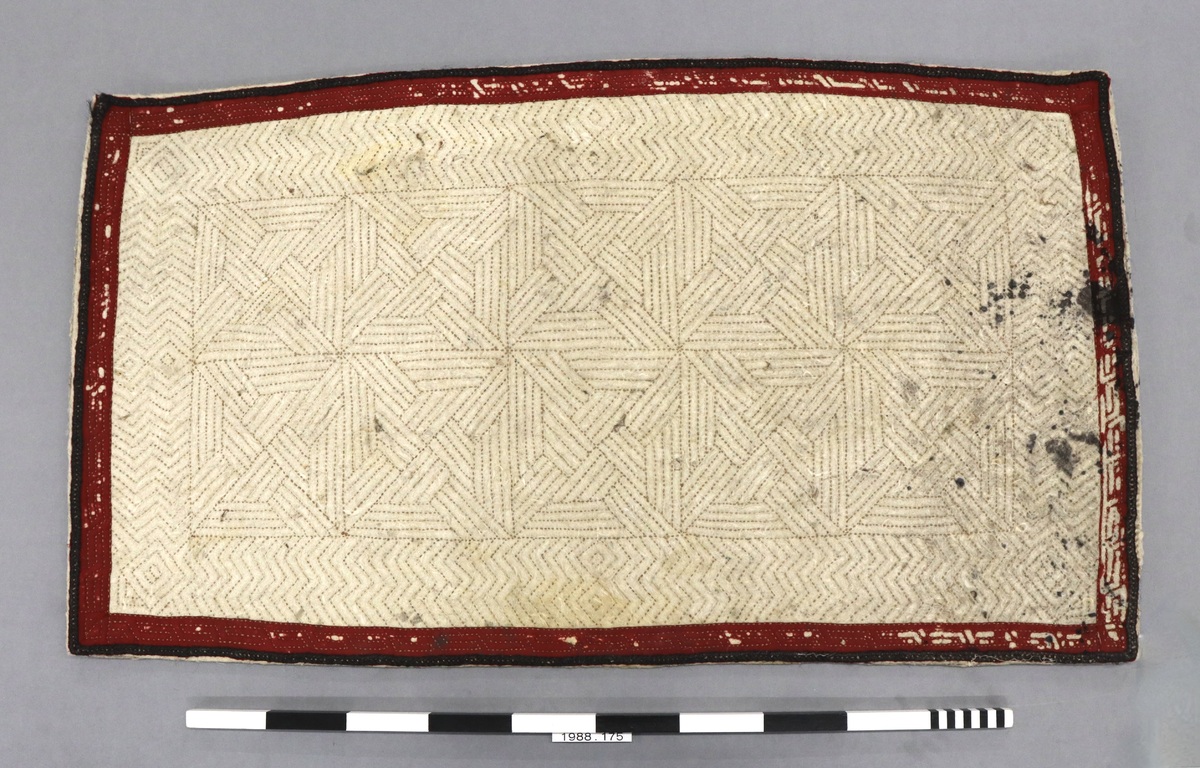
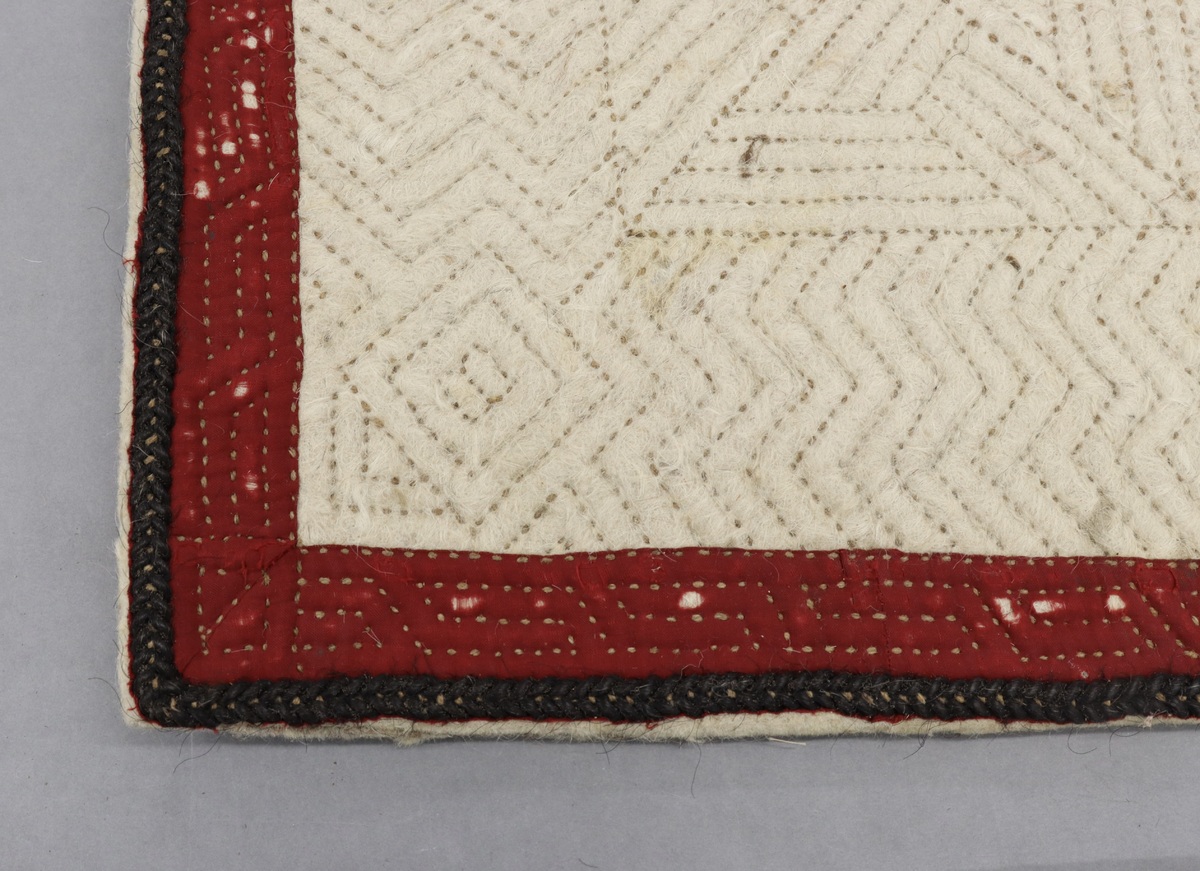
Shirdeg. Rug is made of two layers of sheep's wool. Black braided edge followed by a red cotton appliqué border with the centre of plain wool; the bottom felt is of brownish wool, but the top one is best quality (Mongol writing)Akhaar Khuragny nos-lambs wool shorn in the second (i.e. autumn) shearing; the decorative needle work is done with camel hair thread, which is called ernos (lit. 'male hair'). The edges have a sewn-on rim of black plaited horse hair. The pattern round the edge is called Tagantai khee ((Hard palate pattern'). Other patterns used are Davkhar Alkhan Khee: (double hammer pattern) and Dang Alkhan Khee (hammer pattern).
Place
Asia; East Asia; Mongolia; Ulaanbaatar
Period
Source
Humphrey, Caroline (Dr) [field collector]
Department
Anth
Reference Numbers
1988.175
Cultural Affliation
Material
Sheep Wool; Cotton
Local Term
shirdeg
Measurements
755mm x 15mm x 1317mm
Events
Context (Field collection)
Collected by Dr.Caroline Humphrey in 1987.
Event Date 1987
Author: Diana Serediuc
Context (Production / use)
Formerly used for sleeping on or as a front door, but now used as a rug.
Event Date 1988
Author: maa
Context (Amendments / updates)
The piece had idno 1988.174 attached to it. This number however does not correspond to this Mongolian rug. The description of 1988.175 however does correspond to this object.
Event Date 11/4/2005
Author: Diana Serediuc
Description (Physical description)
Classical Mongol felt rug. Felt rug (shirdeg); classical mongol (Mongol writing). This rug is made of two layers of sheeps wool. The bottom felt is of brownish wool, but the top one is best quality (Mongol writing)Akhaar Khuragny nos-lambs wool shorn in the second (i.e. autumn) shearing. The decorative needle work is done with camel hair thread, which is called ernos (lit. "male hair", i.e. long hairs from under the camels chin, from the top of the humps, and from just above the knees; camels hair from other parts of the body, which is shorter and woolier, is called emnos, "female hair). The rug has an applique surround made of red cotton cloth. This has a sewn-on rim of black plaited horse hair. Sometimes plaits made from ox tails are used as an alternative. The pattern round the edge is called Tagantai khee ("Hard palate pattern"). Other patterns used are Davkhar Alkhan Khee: (double hammer pattern) and Dang Alkhan Khee (hammer pattern). The Shirdeg is a relatively small one (Goyolyn), usually put on the floor of the tent in front of the bed these days. Formerly, such rugs were used for sleeping on. Even today, a wrestler is supposed to sleep on a shirdeg rather than a bed on the night before a fight-the touch of the wool is supposed to provide some kind of beneficial massage for the muscles. Smaller felt rugs, for one person to sit on, are called Olbog. Larger ones, often curved on one side, are used as carpeting for the tent. Formerly, Mongols used felt rugs as the front door to their Yurts, and this can still sometimes be seen in Western Mongolia. In Central and Eastern Mongolia wooden doors are now used. The felt door used to be slightly wider than the door space and rolled up on the lintel. Felt rugs are made by women, but they are now becoming very rare, as the work is difficult and time-consuming. Genuine Mongol felt rugs are made of white felt, with camel wool decorations, but the Kazakhs of West Mongolia make felt rugs of brightly-dyed wool, with curved designs, and large applique decorations in red cotton. This rug was obtained in Ulan-Bator, August 1987.
Event Date 13/5/2005
Author: maa
Conservation (Freezing)
CON.2024.6040 | Freezing
Event Date 11/10/2024
Author: Kirsty Kernohan
Context (Other)
Dr. Caroline Humphrey is a doctor in Department of Social Anthropology, Cambridge.
Event Date 30/9/2024
Author: Diana Serediuc
Description (Physical description)
Accession register for 1988.175 notes: 'Natural wool with red cotton cloth applique surround; Good; Whole; tagantai khee; dang alkhan khee.'
Event Date 30/9/2024
Author: Diana Serediuc
Description (Physical description)
Shirdeg. Rug is made of two layers of sheep's wool. Black braided edge followed by a red cotton appliqué border with the centre of plain wool; the bottom felt is of brownish wool, but the top one is best quality (Mongol writing)Akhaar Khuragny nos-lambs wool shorn in the second (i.e. autumn) shearing; the decorative needle work is done with camel hair thread, which is called ernos (lit. 'male hair'). The edges have a sewn-on rim of black plaited horse hair. The pattern round the edge is called Tagantai khee ((Hard palate pattern'). Other patterns used are Davkhar Alkhan Khee: (double hammer pattern) and Dang Alkhan Khee (hammer pattern).
Event Date 30/9/2024
Author: Diana Serediuc
Context (References)
Chabros, Krystyna, the Mongol Rug, Oriental Carpet and Textile Studies, volume 3.
Event Date 30/9/2024
Author: Diana Serediuc
FM:80012
Images (Click to view full size):