Accession No
Z 8017 B
Description
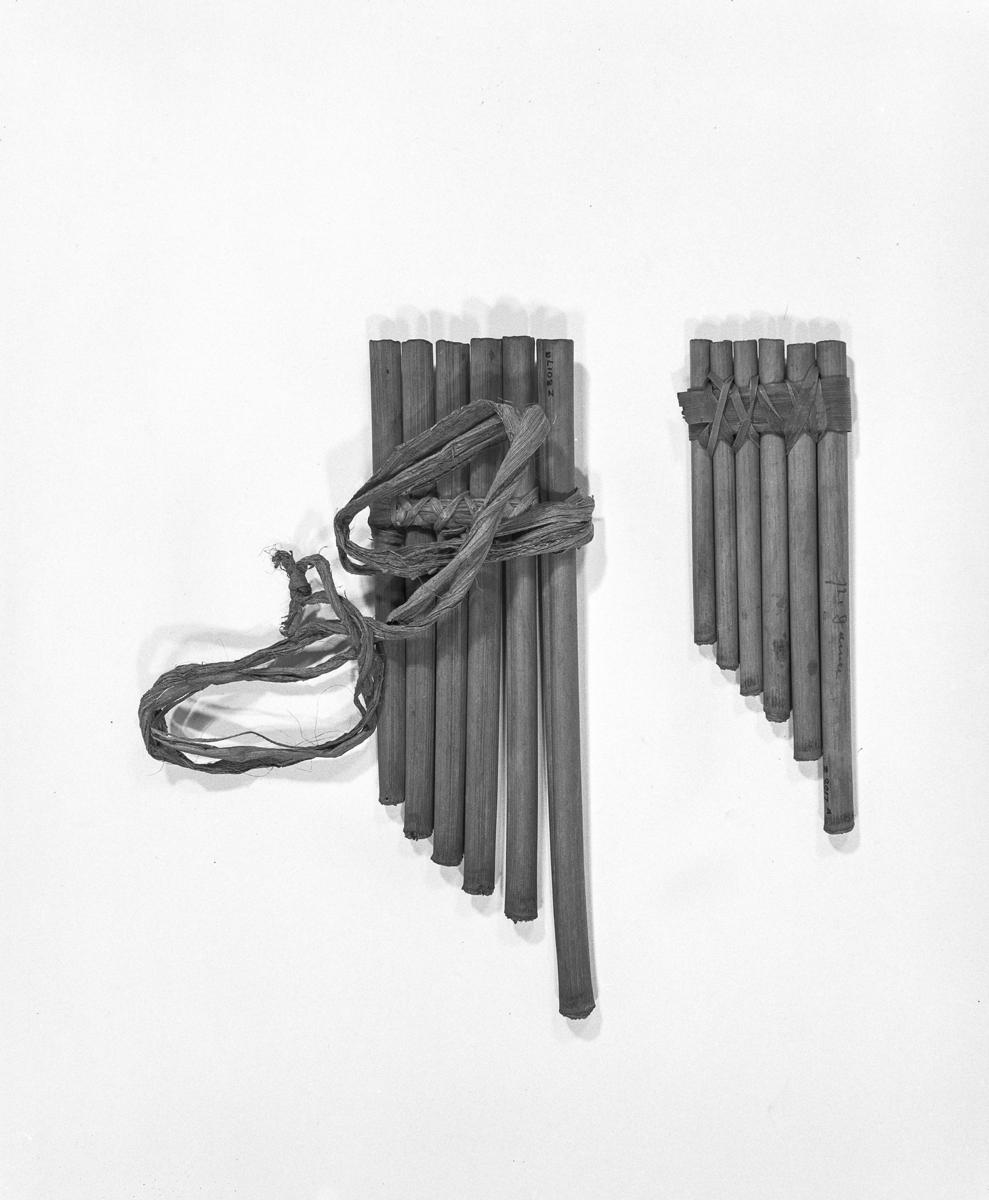
Cane pan pipe with six pipes
Place
Oceania; Australasia; Australia; Queensland; Torres Strait: Oceania; Melanesia; New Guinea; Papua New Guinea; Papuan Gulf; Kiwai Island
Period
late 19th century
Source
Haddon, Alfred Cort (Dr) [collector and donor]
Department
Anth
Reference Numbers
Z 8017 B
Cultural Affliation
Material
?Bamboo; ?Reed
Local Term
piago [Eastern Islands]
Measurements
Events
Context (CMS Context)
Probably introduced by Melanesian mission teachers. piago is the eastern Torres Straits name; Collected by: Haddon, Dr A.C. in ? 1898;
Event Date 27/8/1986
Author: maa
Description (CMS Description)
Card 1: 2 Pan pipes.
Card 2: Two specimens, one possibly made of young bamboo, one of a type of reed.
B: The instrument has six pipes
Event Date 27/8/1986
Author: maa
Description (Physical description)
Instrument labelled Z 8017 B has 6 cane pipes and is bound a third of the way down with a thin strip of leaf with the individual pipes secured in a criss-cross fashion with strips of plant fibre. A longer length of plan leaf, potentially acting as a suspension cord is attached to the binding.
Event Date 18/3/2021
Author: rachel hand
Context (Amendments / updates)
Potentially collected in Kiwai given the description of the 6 pipes noted in Haddon (ed.)
Kiwai now added to the place field
Event Date 18/3/2021
Author: rachel hand
Context (References)
Research: Examination of all Haddon material in British and Australian Museums By Moore.
Moore, David R. (1984) The Torres Strait Collections of A.C. Haddon. London: British Museum Publications Ltd, cf. p. 94, no. 582, Z 8025, which notes 'Probably introduced by Melanesian mission teachers".
Moore only illustrates one set of panpipes, Z 9596, and gives 'Piago' as the eastern Torres Strait name
Event Date 18/3/2021
Author: rachel hand
Context (References)
'I was assured in Mer that pan-pipes were formerly made, but I have never seen an old specimen. It is worth noting that I was informed that one kind of pan-pipes was introduced many years ago by some Tanna men (New Hebrides) who landed at Ugar in Mer from a three-masted ship. We collected in Kiwai Island' five pan-pipes, piago, which have six pipes, the longest and shortest pipes of the largest and smallest specimens are 195, 112 mm. and 128, 88 mm. The pipes are bound together by a broad banana-leaf band, to which each pipe is lashed (fig. 24G A). We may take these as typical. One Miriam specimen has six pipes which are fastened together by two narrow cane bands, the longest pipe (fig. 246 B) is 135 mm. and the shortest 76 mm. The other has only four pipes, 105 mm. — 85 mm., and a single band; but I lay no stress on this specimen as perhaps the Tanna men introduced a new form of lashing.
We obtained several flutes, pupui (W.), hurar (E.), from Mer; these were made of bamboo or reed and range fnjm 425 to 735 mm. in length. The tube is so cut as to have a node left at one end which is perforated, a short distance from it are two holes in the barrel; there is a V-shaped notch at the other I'lid (fig. 247) on the same side as the holes. One specimen has no nick'
Haddon, A.C. (ed.) (1908) Reports of the Cambridge Anthropological Expedition to Torres Straits, Vol. IV Arts and Crafts. Cambridge: Cambridge University Press, p. 282, cf. pl. 246.
Event Date 18/3/2021
Author: rachel hand
FM:79391
Images (Click to view full size):