Accession No
1935.968 E
Description
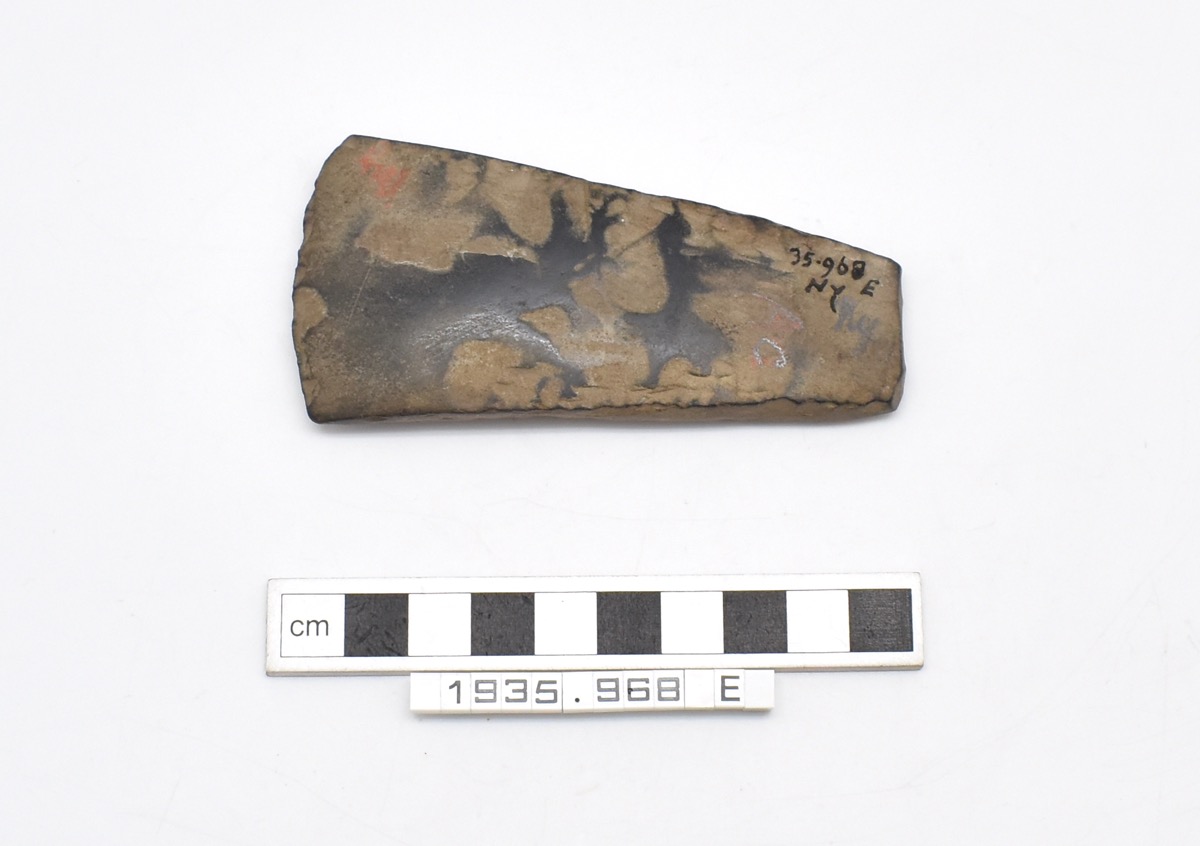
Batu Lintar. Axe made of a partially polished black stone with chipped surface. Flat butt end, flat sides which converge towards a curved cutting edge and a rectangular cross-section.
Place
Asia; Southeast Asia; Malaysia; Peninsular Malaysia; Pahang; River Tembeling; Nyong
Period
Neolithic
Source
Noone, Herbert Vander Vord [collector]
Department
Arch
Reference Numbers
1935.968 E
Cultural Affliation
Material
Stone
Local Term
batu lintar
Measurements
48mm x 10mm x 98mm
Events
Context (Analysis)
Batu Lintar is the native word for stone implements, which in English means thunder bolt.
Event Date
Author: Alana Edgeworth
Context (Found together / assemblage)
The collection of stone implements is split in three sections, Axe form (1935.968), Adze form (1935.969-70) and Gouge form (1935.971).
Event Date
Author: maa
Description (Physical description)
Axe forms are distinguished by plane of working edge lying between the two planes of the implement.
Event Date 1935
Author: maa
Context (Analysis)
Cf: Barton, Huw. (2013). ‘Myanmar and Malasia’ In Hicks, D. and Stevenson, A. (eds.), World Archaeology at the Pitt Rivers Museum: A Characterization. Archaeopress. pp. 517-524
Event Date 12/10/2023
Author: Alana Edgeworth
Description (Physical description)
Batu Lintar. Axe made of a partially polished black stone with chipped surface. Flat butt end, flat sides which converge towards a curved cutting edge and a rectangular cross-section.
Event Date 12/10/2023
Author: Alana Edgeworth
FM:79224
Images (Click to view full size):