Accession No
1937.335
Description
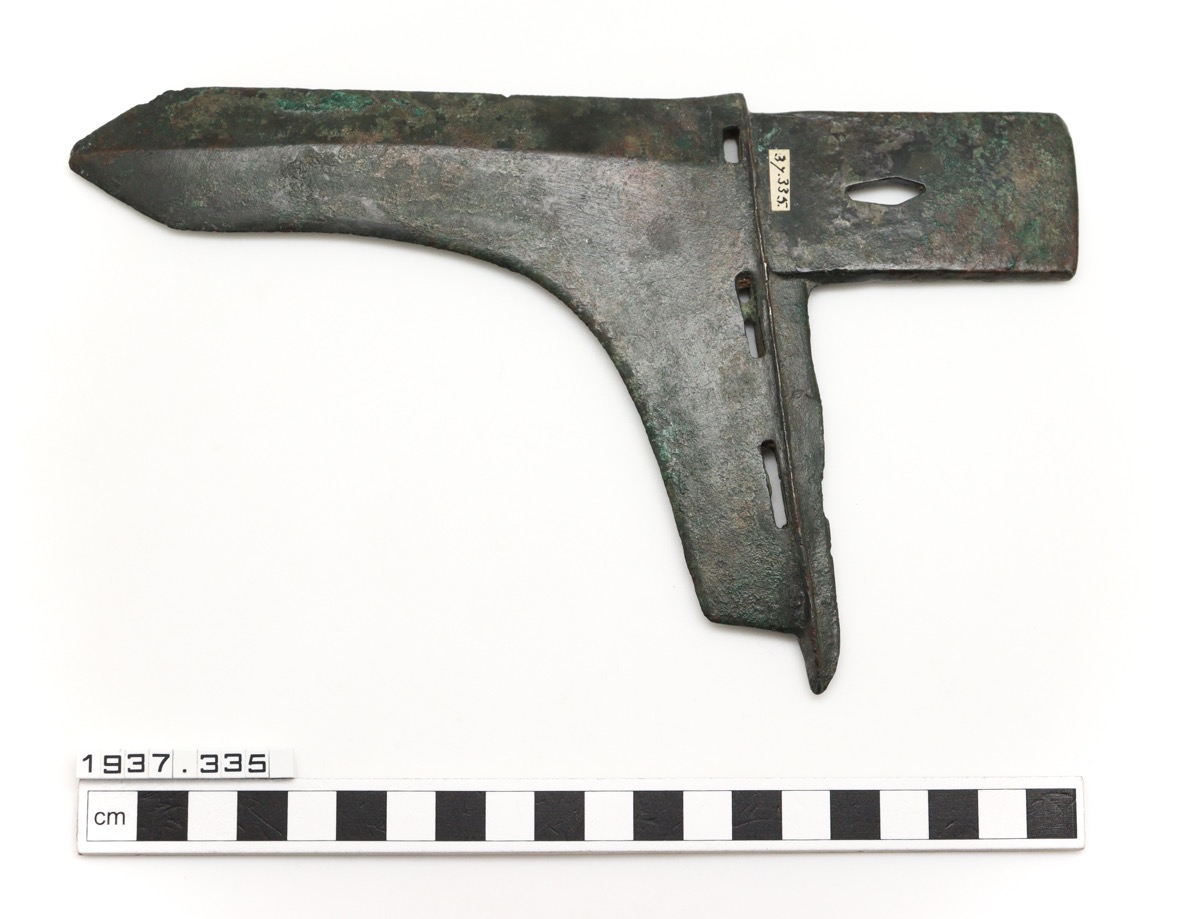
Gē. Copper alloy dagger-axe. Rectangular tang with a roughly diamond-shaped lashing hole, connecting to the projecting edge of the blade (called ‘hu’) via a lower lug. Three lashing holes along the straight edge of hu. The blade has no bevels but a midrib from point to base on both sides. Glossy patina and copper corrosion present.
Place
Asia; East Asia; China
Period
?Han Dynasty
Source
Clarke, Louis Colville Gray [donor]
Department
Arch
Reference Numbers
1937.335
Cultural Affliation
Material
Metal; Copper Alloy; ?Bronze
Local Term
Gē
Measurements
127mm x 11mm x 206mm
Events
Description (Physical description)
Bronze halberd; 'KO'
Event Date 1937
Author: maa
Description (Physical description)
Copper alloy, probably bronze, dagger-axe sometimes referred to as a halberd or 'Ko'. The dagger-axe is a type of pole weapon that was in use from the Shang dynasty until the Han dynasty in China. It consists of a dagger-shaped blade, with a slotted tang, which would allow it to be hafted to a wooden pole [not present].
Event Date 19/6/2019
Author: ashleigh griffin
Context (Analysis)
The dagger-axe (Chinese: 戈; pinyin: gē; Wade–Giles: ko; sometimes confusingly translated to "halberd") or ge is a type of pole weapon that was in use from the Shang dynasty until the Han dynasty in China. It consists of a dagger-shaped blade, mounted by its tang to a perpendicular wooden shaft. The earliest dagger-axe blades were made of stone. Later versions used bronze. Jade versions were also made for ceremonial use. There is a variant type with a divided two-part head, consisting of the usual straight blade and a scythe-like blade.
Event Date 19/6/2019
Author: ashleigh griffin
Context (Analysis)
Dated to the Han Dynasty, which dates from '202 BC–9 AD and 25 AD–220 AD'.
Event Date 19/6/2019
Author: ashleigh griffin
Description (Physical description)
Gē. Copper alloy dagger-axe. Rectangular tang with a roughly diamond-shaped lashing hole, connecting to the projecting edge of the blade (called ‘hu’) via a lower lug. Three lashing holes along the straight edge of hu. The blade has no bevels but a midrib from point to base on both sides. Glossy patina and copper corrosion present.
Event Date 30/10/2023
Author: Jodi Zhang
FM:65518
Images (Click to view full size):