Accession No
Z 46216.114
Description
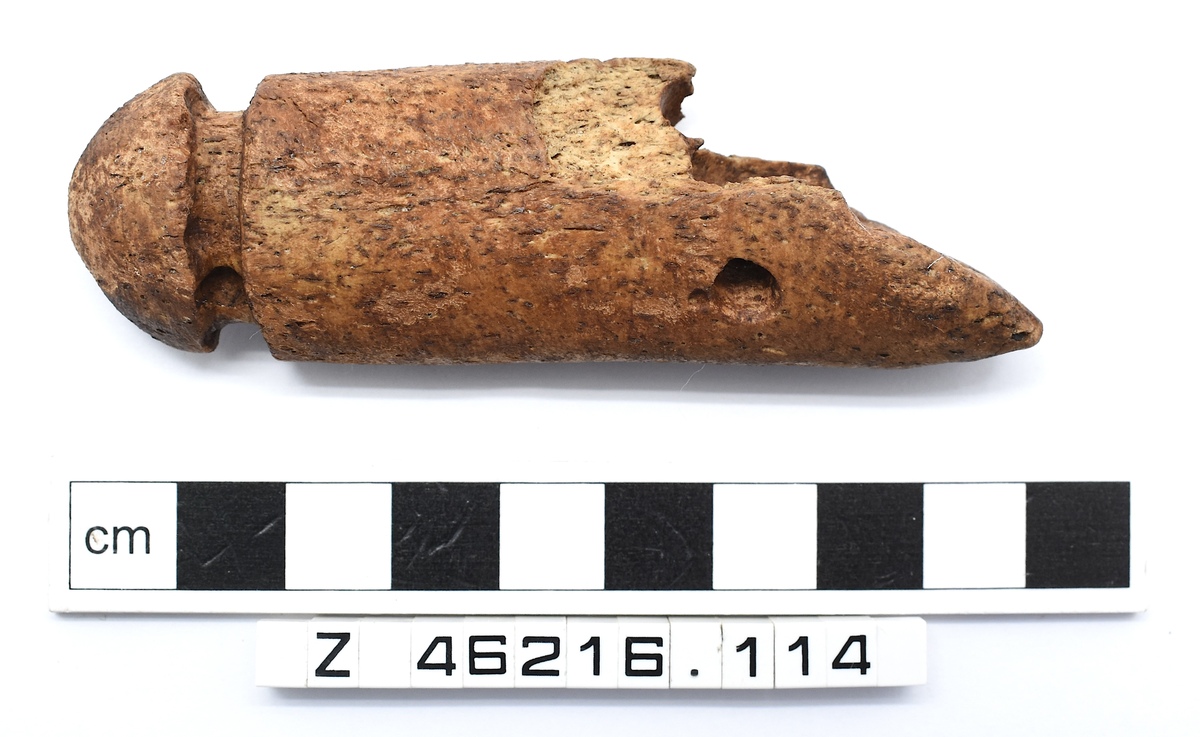
Incomplete bone handle. Formed of a shaft with semicircular cross-section; at one end is a domed terminus and ntwo notches and a grooved band with shallow holes that do not perforate through, is cut out from the shaft on the flat face. The other end is broken off at a perforation, but incorporates a perforation through the face and one on the side.
Place
Arctic; North America; Canada; Nunavut; Fisher Strait; Walrus Island
Period
?Thule ?Inuit
Source
Rowley, Graham Westbrook [excavator]; British Canadian Arctic Expedition
Department
Arch
Reference Numbers
Z 46216.114; W.I a117 [Excavation no.]
Cultural Affliation
Material
Bone
Local Term
Measurements
89mm
Events
Description (Physical description)
Bone handle
Event Date
Author: maa
Context (Field collection)
House Ia. Excavated by Graham Rowley, British Canadian Arctic Expedition, in August 1936. See archive for excavation notebook and correspondence (XA/1/23 and XA/1/8).
Event Date 1936
Author: maa
Description (Physical description)
?Harpoon socket.
Event Date 2/3/2001
Author: Clare McKenna
Context (References)
Rowley, G. (2007). Cold Comfort: My Love Affair with the Arctic. 2nd edition. Montreal: McGill-Queen’s University Press.
Event Date 2007
Author: Clare McKenna
Context (Amendments / updates)
When this collection (Z 46216 – Z 46219) was registered, it had lost association with its excavation site and was tentatively listed as from Southampton Island. In March 1993 it was seen by Graham Rowley, who wrote a note on the box list reading: ‘I believe this material is what I dug on Walrus Island in August 1936’. The excavation number format, with the prefix of ‘W’, also appears to confirm this. Therefore, the Place field has been updated accordingly.
Event Date 12/9/2024
Author: Jan-Henrik Hartung
Description (Physical description)
Incomplete bone handle. Formed of a shaft with semicircular cross-section; at one end is a domed terminus and ntwo notches and a grooved band with shallow holes that do not perforate through, is cut out from the shaft on the flat face. The other end is broken off at a perforation, but incorporates a perforation through the face and one on the side.
Event Date 17/9/2024
Author: Clare McKenna
FM:27941
Images (Click to view full size):