Accession No
Z 45220 A
Description
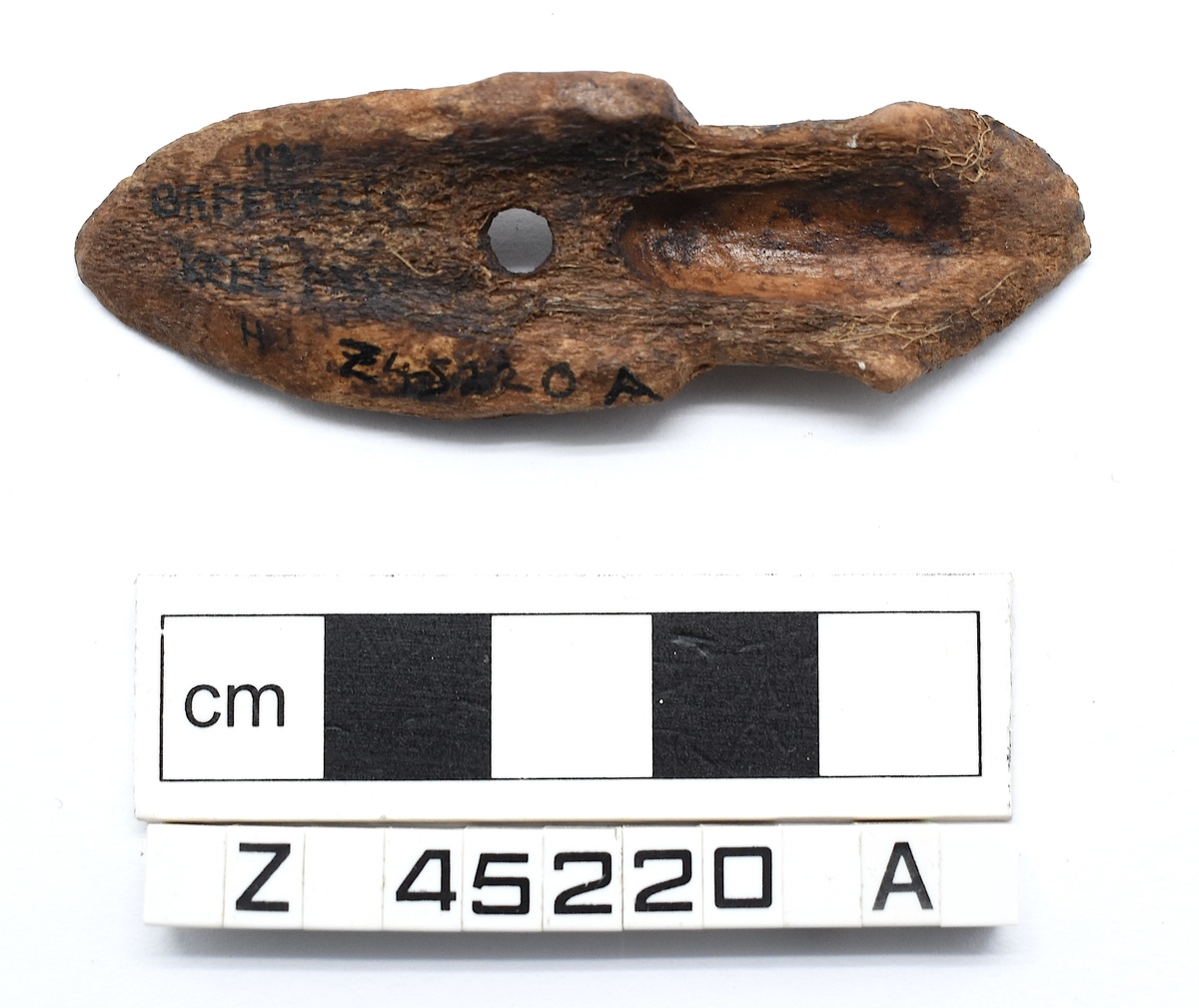
Harpoon head or caribou antler. It has a slightly curved triangular tip with a central countersunk perforation; a grooved band for lashing with a cylindrical hollow on the reverse face for socketing; it ends in a bevelled, triangular point.
Place
Arctic; North America; Canada; Nunavut; Baffin Island; Keel Bay
Period
?Thule ?Inuit
Source
Lethbridge, Thomas Charles [excavator and donor]; 1937 Wordie Expedition
Department
Arch
Reference Numbers
Z 45220 A
Cultural Affliation
Material
Antler
Local Term
Measurements
64mm
Events
Description (Physical description)
Accession Register: 'Harpoon Head.'
Event Date
Author: Clare McKenna
Context (Found together / assemblage)
According to Lethbridge (1939, pp. 230-231), the 'single autumn hut' found at Keel Bay 'was standing on an older one' and the objects recovered were from the 'earlier occupation layer [Thule]'.
Event Date 9/1937
Author: Imogen Gunn (admin)
Context (Field collection)
Hut I. Excavated in September 1937 by Thomas Lethbridge during the 1937 Cambridge Expedition to North West Greenland and the Canadian Arctic, led by James Mann Wordie. See MAA photo collection for photographs; see the University Library for excavation notebook (MS Add.9258/3).
Event Date 9/1937
Author: maa
Context (References)
Lethbridge, T.C. (1938). ‘Appendix II: Eskimo Archaeology’ in J.M. Wordie, et al. ‘An Expedition to North West Greenland and the Canadian Arctic in 1937’. The Geographical Journal, vol. 92(5). pp 385-418
Event Date 1938
Author: Clare McKenna
Context (References)
Lethbridge, T.C. (1939) ‘Archaeological Data from the Canadian Arctic’, The Journal of the Royal Anthropological Institute of Great Britain and Ireland, vol. 69(2), pp. 187–233. Fig. 27, 3
Event Date 1939
Author: Clare McKenna
Description (Physical description)
?Toggle part of harpoon.
Event Date 5/2/2001
Author: maa
Description (Physical description)
Harpoon head or caribou antler. It has a slightly curved triangular tip with a central countersunk perforation; a grooved band for lashing with a cylindrical hollow on the reverse face for socketing; it ends in a bevelled, triangular point.
Event Date 9/9/2024
Author: Clare McKenna
FM:27374
Images (Click to view full size):