Accession No
1894.8.2
Description
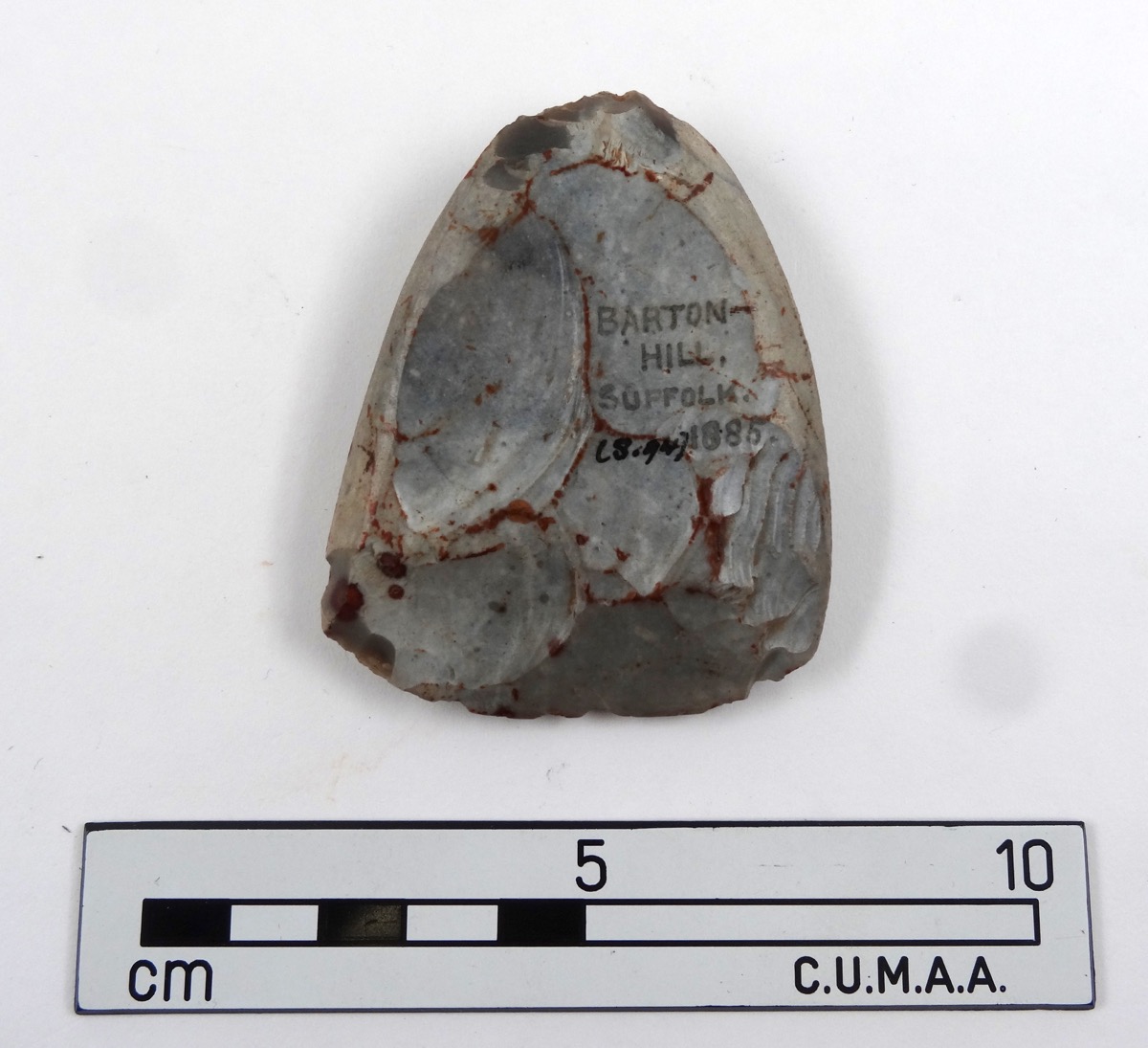
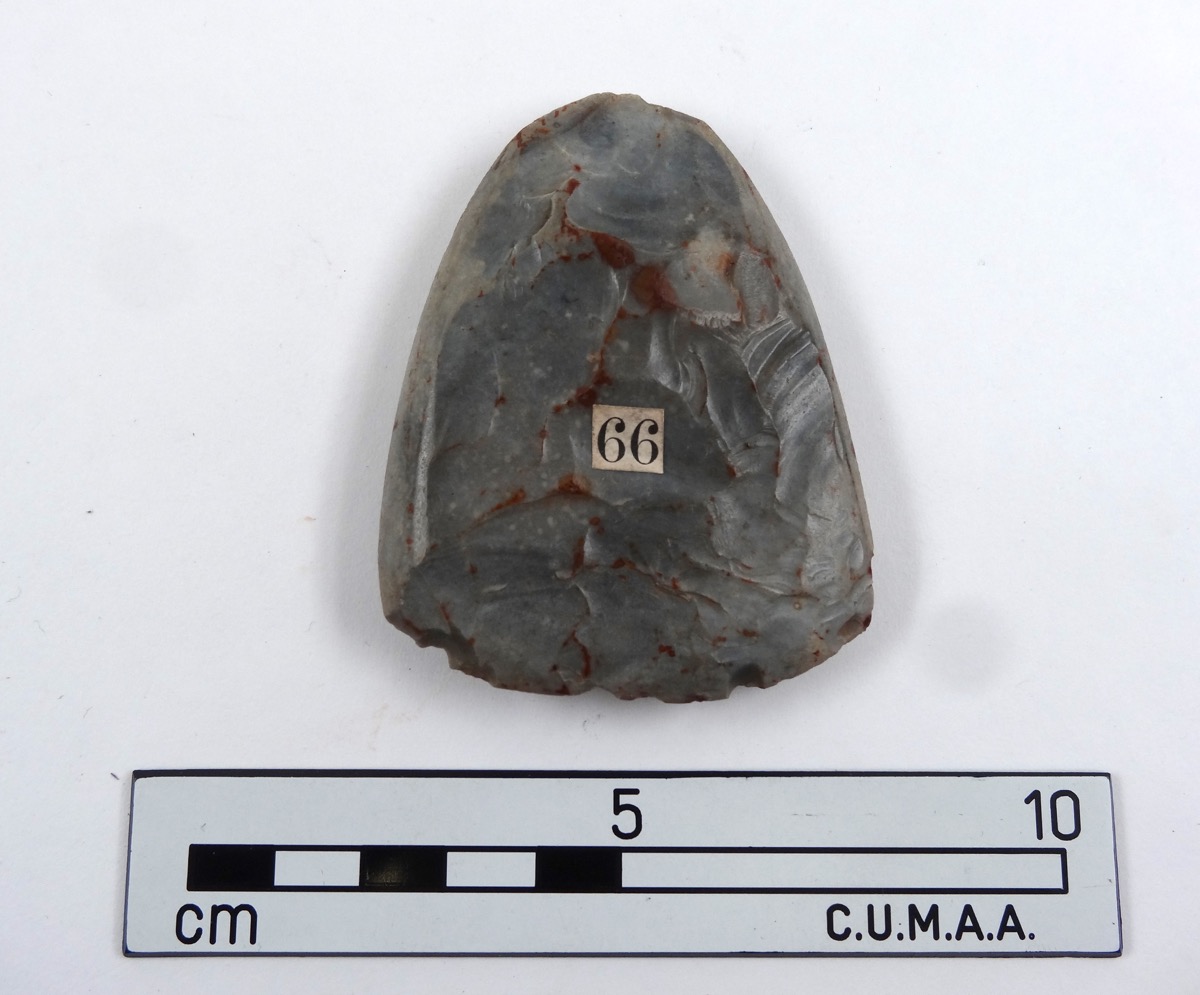
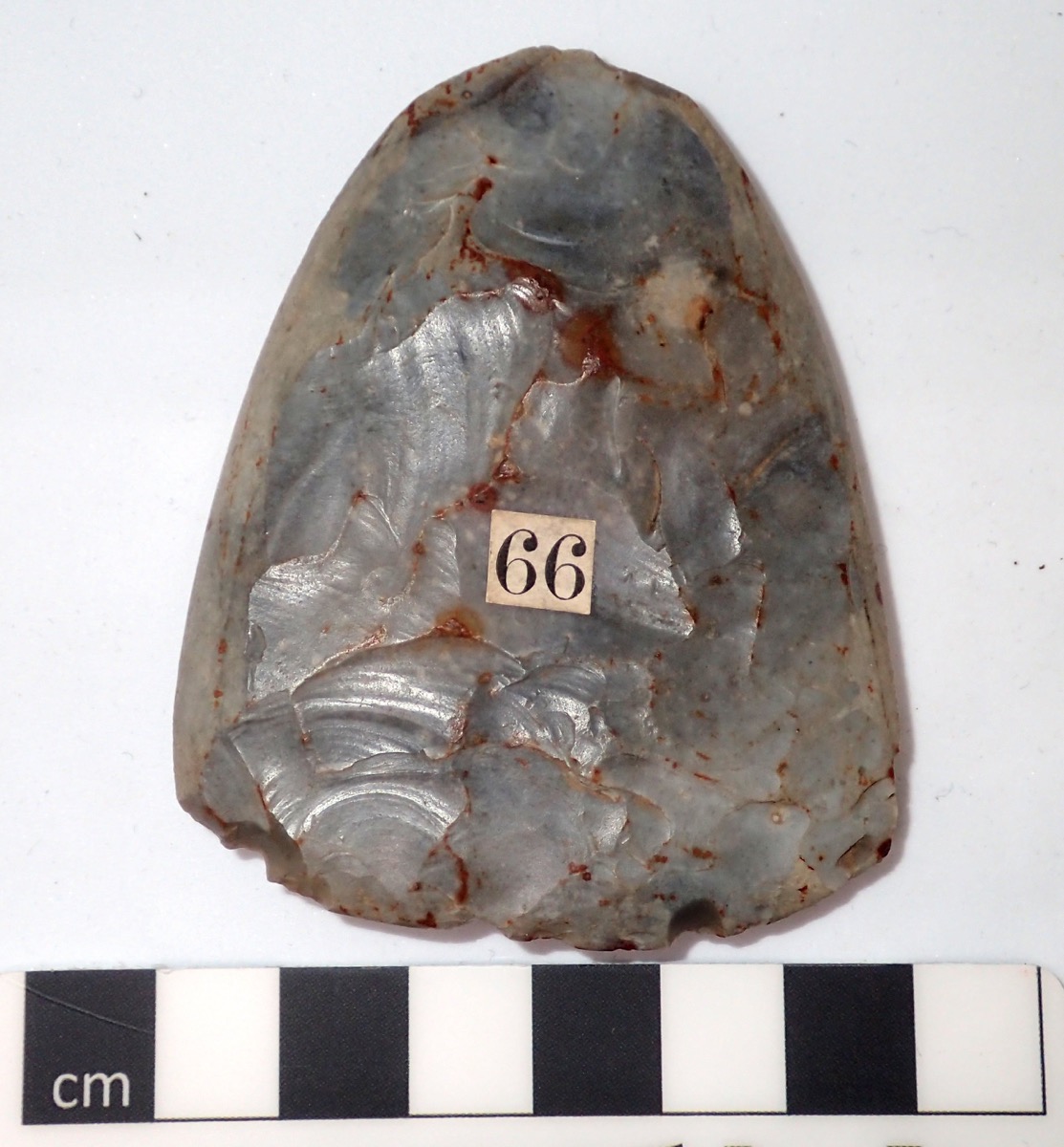
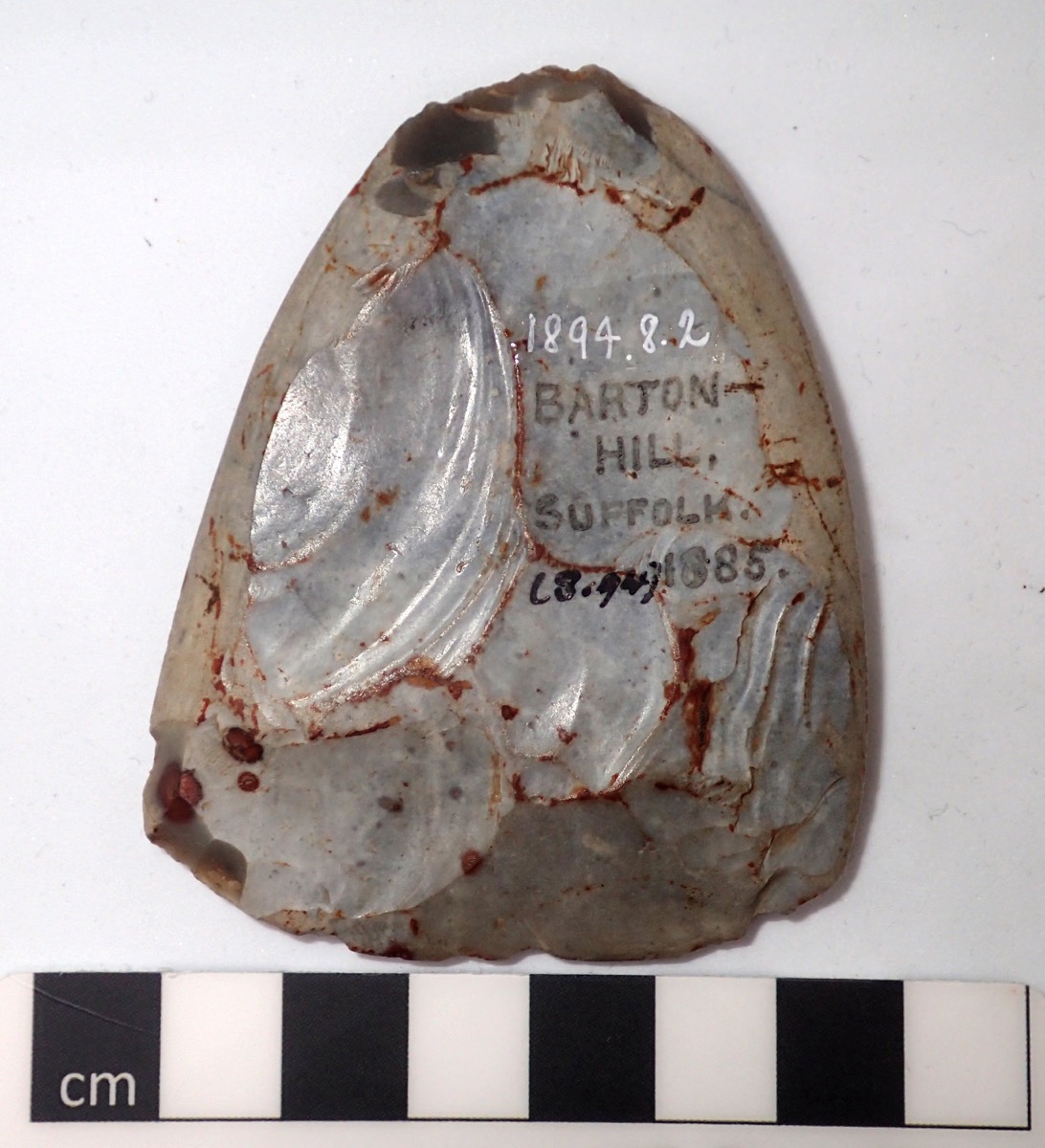
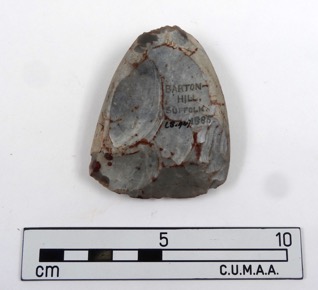
Discoidal knife. This piece is a triangular shaped flint tool that has been bifacially worked. It was made from a grey, blueish flint with two polished edges. This artefact has an isosceles triangular shape.
Place
Europe; British Isles; England; Suffolk; Mildenhall; Barton Hill
Period
Late Neolithic
Source
Wright, Arthur G. [collector]; ?Evans, John (Sir) [collector]
Department
Arch
Reference Numbers
1894.8.2; MAA: AR 1894.54; ?66; ?99
Cultural Affliation
Material
Stone
Local Term
Measurements
51mm x 71mm x 12mm
Events
Context (Other owners)
Metzeger (2017): Bought from Gathercole by CAS.
Event Date
Author: Eleanor Wilkinson
Context (Related Documents)
For Melissa Metzger's Crowther-Beynon Grant report see Doc.485 in MAA's archive.
Event Date
Author: Eleanor Wilkinson
Description (Labels & Markings)
Label affixed to object reads: '66' or '99'
Event Date
Author: Amy Dolben
Description (Labels & Markings)
Marked in black ink: 'LS [or 8].947'
Event Date
Author: Imogen Gunn (admin)
Description (Labels & Markings)
Object has been marked in black ink: 'BARTON HILL, SUFFOLK. 1885'.
Event Date 1885
Author: Amy Dolben
Context (Field collection)
Collected in 1885.
Event Date 1885
Author: Imogen Gunn (admin)
Description (Physical description)
Rather fine, smallish and with chipped cutting edge and bifacial polishing on both edges; Chipped Polished
Event Date 1894
Author: maa
Description (Physical description)
Accession register: 'Small triangular celt with ground sides'.
Event Date 1894
Author: Imogen Gunn (admin)
Context (Auction / Sale)
In a letter from Arthur G Wright to von Hügel dated 3 March 1894, Wright appears to reference this object as part of a larger negotiation for a purchase of a batch of stone tools. He notes that 'the triangular knife is a rare type', as part of a bid for a higher purchase price. He does not say where he obtained the object, which was possibly in another collection prior to Wright's ownership of it, as the object is marked 1885. The letter and others as part of the larger negotiation can be found in the Correspondence Archive for 1894.
Event Date 3/3/1894
Author: Imogen Gunn (admin)
Context (References)
Clark, J. (1929). 'Discoidal Polished Flint - their typology and distribution'. Proceedings of the Prehistoric Society of East Anglia 6 (1). p. 41-54. Number 51 in the Index.
Event Date 1929
Author: Eleanor Wilkinson
Context (References)
Lewis, J. (2005). Monuments, Ritual, and Regionality. BAR British Series 401.
Event Date 2005
Author: Eleanor Wilkinson
Context (Amendments / updates)
The way in which this object is marked 'BARTON HILL, SUFFOLK 1885' is very similar to the way objects collected by Sir John Evans were marked. Although Evans' most distinctive marker is a label, many of his objects were also marked directly onto the object in what appears to be the same hand as this. It is possible, therefore, that this object was at one stage owned by Sir John Evans and was later owned by Arthur G Wright, probably for the purpose of selling it on. Evans has therefore been tentatively added as a Source.
Event Date 17/10/2017
Author: Imogen Gunn (admin)
Context (Amendments / updates)
The database record gave Place as 'Barton Mill', but the object and catalogue card both give 'Barton Hill'. Therefore this has been updated accordingly.
Event Date 22/3/2017
Author: Amy Dolben
Description (Physical description)
Metzger (2017): This piece is a triangular shaped flint tool that has been bifacially worked. It was made from a grey, blueish flint with two polished edges. This artefact has an isosceles triangular shape. This tool has manufacturing features located on its surface; such as a step fracture (a flake that ends abruptly with a 90-degree break causing the entire flake to not be removed), a hinge fracture (a flake that breaks and leaves a 'rolling out' effect). There is some edge damage to the tip of the artefact; this damage is most likely post-depositional.
Event Date 9/2017
Author: Eleanor Wilkinson
Context (Analysis)
In September 2017 Melissa Metzger, PhD candidate at the University of Bradford, studied a number of polished discoidal knives for their Crowther-Beynon Grant. They supplied further descriptions, measurements, contextual information and bibliographic references. These fields have been updated accordingly. They also suggested a date of Late Neolithic.
Event Date 9/2017
Author: Eleanor Wilkinson
Context (Analysis)
Metzger (2017): This artefact fits into the Type II or Type II category of Polished-edge Discoidal Knife. This category has three types (Type I- circular or D-shaped, Type II- triangular, and Type III- broad leaf to lozenge). These artefacts show polished edges and should fit into one (or two) of those types. This artefact classification might has functioned as wood or claying working tools. This artefact was found at Barton Hill, Mildenhall.
Event Date 9/2017
Author: Eleanor Wilkinson
Context (Amendments / updates)
The Period field previously stated Neolithic. This has been updated to Late Neolithic from information from Melissa Metzger, see Analysis.
Event Date 15/6/2020
Author: Eleanor Wilkinson
FM:21874
Images (Click to view full size):