Accession No
1905.176
Description
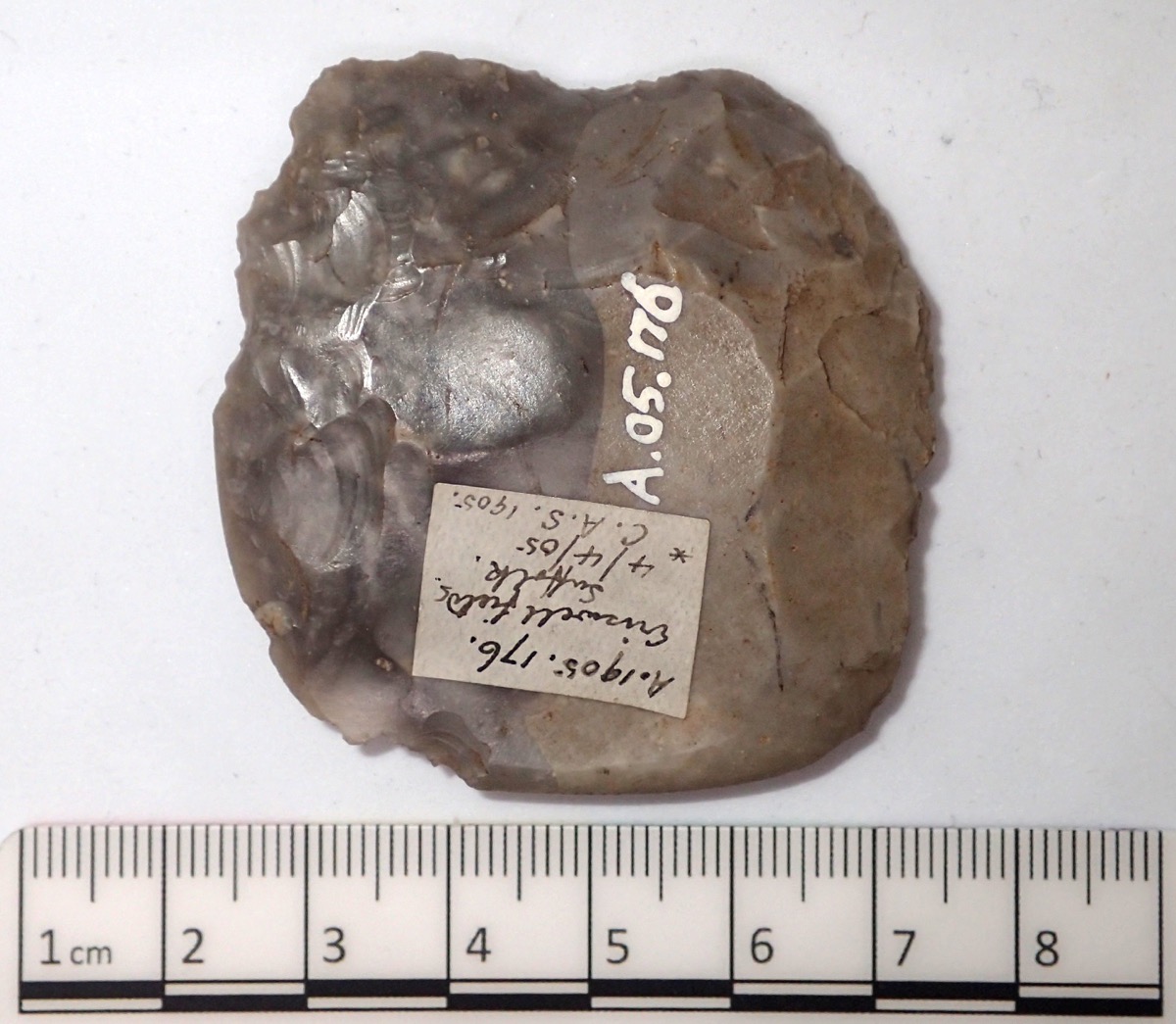
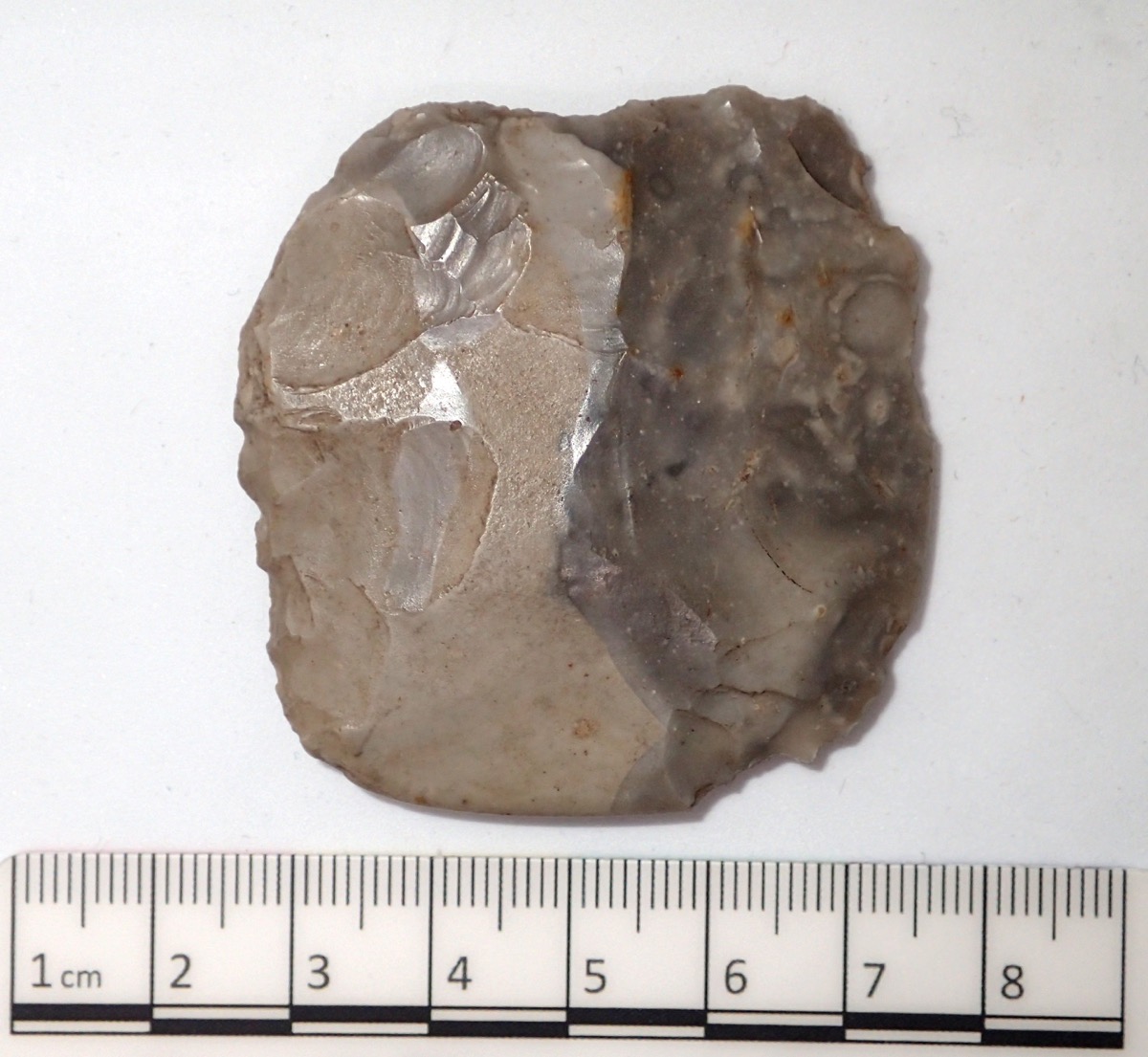
Discoidal knife. This artefact is an oval shaped flint tool that has been bifacially worked. It was made from a grey flint that is mottled with a darker grey.
Place
Europe; British Isles; England; Suffolk; Eriswell
Period
Late Neolithic
Source
Cambridge Antiquarian Society [monetary donor]
Department
Arch
Reference Numbers
1905.176; MAA: AR 1905.60
Cultural Affliation
Material
Stone; Flint
Local Term
Measurements
49mm x 9mm x 48mm
Events
Context (Related Documents)
For Melissa Metzger's Crowther-Beynon Grant report see Doc.485 in MAA's archive.
Event Date
Author: Eleanor Wilkinson
Context (Auction / Sale)
Metzger (2017): Cambridge Antiquarian Society gave money to purchase this artefact.
Event Date
Author: Eleanor Wilkinson
Description (Labels & Markings)
Handwritten label affixed to object reads: 'A.1905.176. Eriswell Fields, Suffolk. 4/4/05. *C.A.S. 1905'
Event Date 1905
Author: Imogen Gunn (admin)
Description (Physical description)
Squarish grey flint scraper/knife
Event Date 1905
Author: maa
Context (Field collection)
Collected on 4/4/1905 from Eriswell fields.
Event Date 4/4/1905
Author: Imogen Gunn (admin)
Context (References)
Clark, J. (1929). 'Discoidal Polished Flint - their typology and distribution'. Proceedings of the Prehistoric Society of East Anglia 6 (1). p. 41-54.
Event Date 1929
Author: Eleanor Wilkinson
Context (References)
Lewis, J. (2005). Monuments, Ritual, and Regionality. BAR British Series 401.
Event Date 2005
Author: Eleanor Wilkinson
Description (Physical description)
Squarish grey flint knife with one ground edge.
Event Date 20/10/2017
Author: Imogen Gunn
Context (Analysis)
Metzger (2017): This artefact fits in with Type I of the Polished-edge Discoidal Knife classification. This classification has three types (Type I- circular or D-shaped, Type II- triangular, and Type III- broad leaf to lozenge) and show polished edges. This artefact classification might has functioned as wood or claying working tools. This artefact was found in Eriswell fields in Suffolk.
Event Date 9/2017
Author: Eleanor Wilkinson
Context (Analysis)
In September 2017 Melissa Metzger, PhD candidate at the University of Bradford, studied a number of polished discoidal knives for their Crowther-Beynon Grant. They supplied further descriptions, measurements, contextual information and bibliographic references. These fields have been updated accordingly. They also suggested a date of Late Neolithic.
Event Date 9/2017
Author: Eleanor Wilkinson
Description (Physical description)
Metzger (2017): This artefact is an oval shaped flint tool that has been bifacially worked. It was made from a grey flint that is mottled with a darker grey. This artefact is an irregular oval shape that is bifacially worked. There is limited edge polished from manufacturing. There is some edge damage, but it is difficult to tell whether it was from use or post- depositional. There is evidence to support tool reduction, but manufacture did not go as planned as there are step fractures (a flake that ends abruptly with a 90-degree break causing the entire flake to not be removed) and multiple flake scars.
Event Date 9/2017
Author: Eleanor Wilkinson
Context (Amendments / updates)
The Period field previously stated Neolithic. This has been updated to Late Neolithic from information from Melissa Metzger, see Analysis.
Event Date 15/6/2020
Author: Eleanor Wilkinson
FM:21383
Images (Click to view full size):