Accession No
1914.74
Description
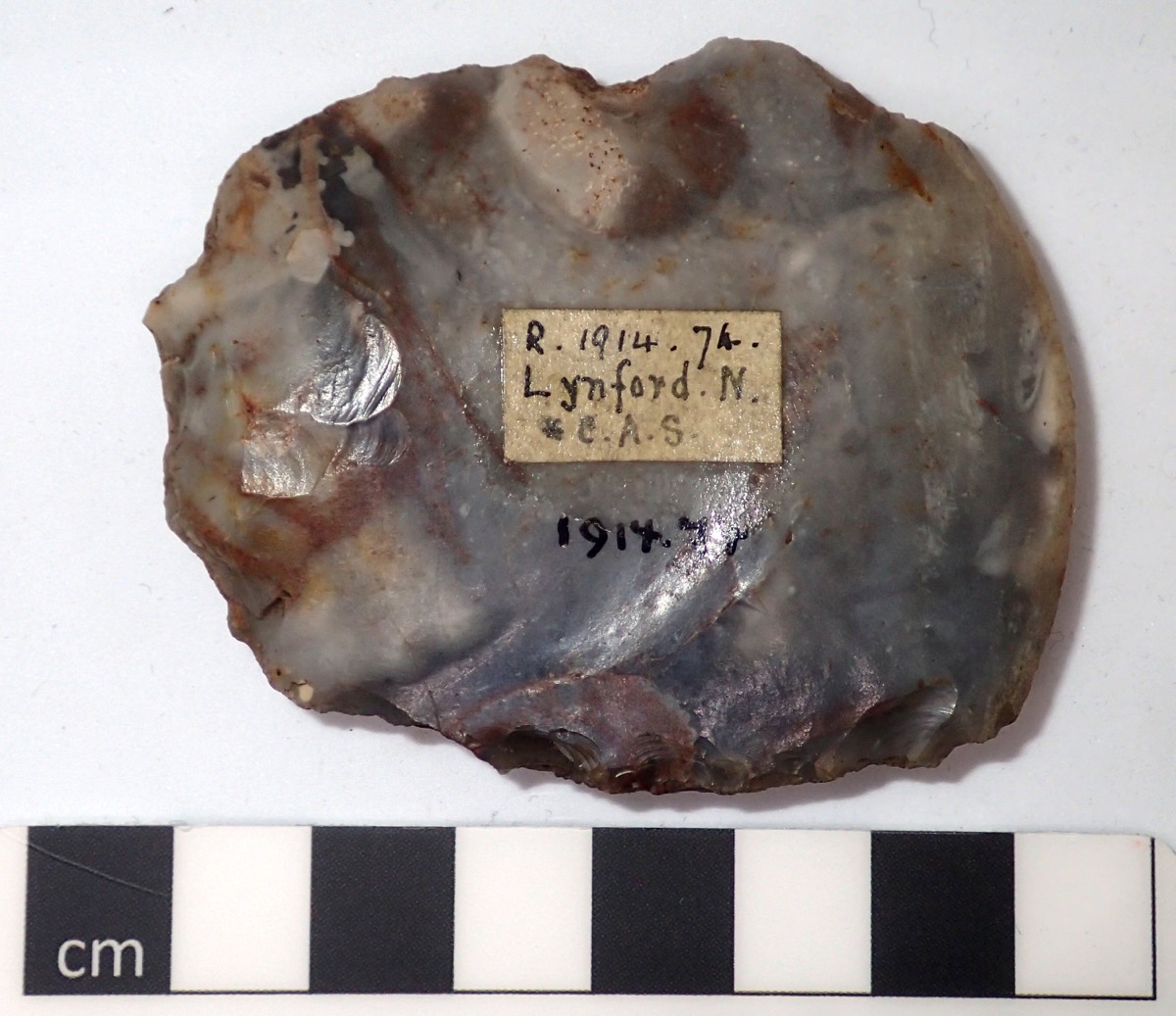
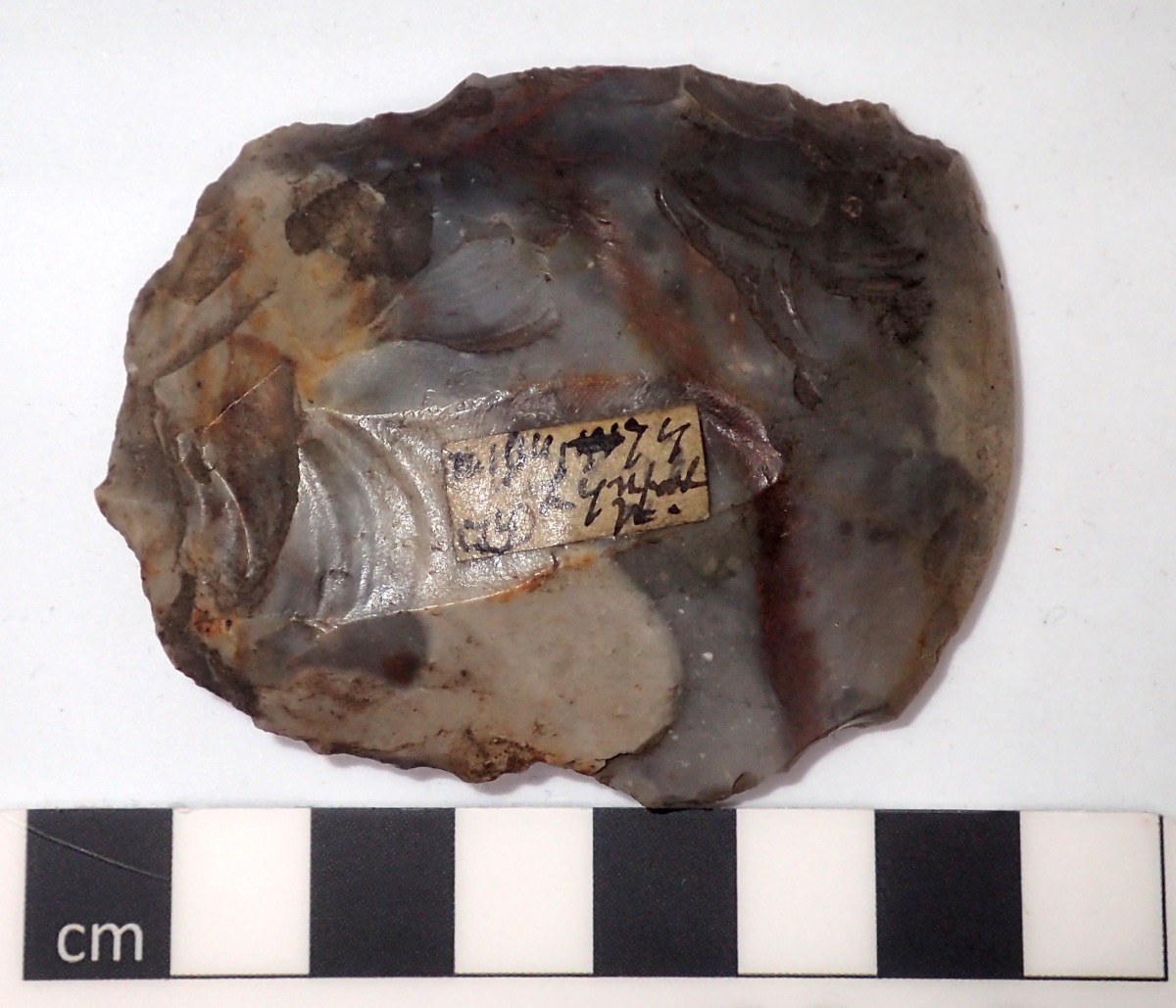
Discoidal Beaker knife. This artefact has an irregular oval shaped flint tool that has been bifacially worked. It was made from a grey, blueish flint. It has only one polished edge.
Place
Europe; British Isles; England; Norfolk; Lynford
Period
Late Neolithic
Source
Cambridge Antiquarian Society [monetary donor]
Department
Arch
Reference Numbers
1914.74; MAA: AR 1914.74
Cultural Affliation
Material
Stone; Flint
Local Term
Measurements
65mm x 49mm x 12mm
Events
Context (Amendments / updates)
For Melissa Metzger's Crowther-Beynon Grant report see Doc.485 in MAA's archive.
Event Date
Author: Eleanor Wilkinson
Description (Physical description)
Flint; Stone Beaker Knife
Event Date 1914
Author: maa
Description (Physical description)
Accession register: 'partially gorund [knife], roughly oval with convex back and edge ground at one end only (2".6 x 2").'
Event Date 1914
Author: Imogen Gunn (admin)
Context (References)
Clark, J. (1929). 'Discoidal Polished Flint - their typology and distribution'. Proceedings of the Prehistoric Society of East Anglia 6 (1). p. 41-54.
Event Date 1929
Author: Eleanor Wilkinson
Context (References)
Lewis, J. (2005). Monuments, Ritual, and Regionality. BAR British Series 401.
Event Date 2005
Author: Eleanor Wilkinson
Context (Analysis)
In September 2017 Melissa Metzger, PhD candidate at the University of Bradford, studied a number of polished discoidal knives for their Crowther-Beynon Grant. They supplied further descriptions, measurements, contextual information and bibliographic references. These fields have been updated accordingly. They also suggested a date of Late Neolithic.
Event Date 9/2017
Author: Eleanor Wilkinson
Description (Physical description)
Metzger (2017): This artefact has an irregular oval shaped flint tool that has been bifacially worked. It was made from a grey, blueish flint. It has only one polished edge. This artefact has an irregular shape that could be due to manufacturing or post-depositional causes. There is a bulb of percussion left, which indicates this piece was made from a flake. There is only one polished edge, which is opposite the bulb.
Event Date 9/2017
Author: Eleanor Wilkinson
Context (Analysis)
Metzger (2017): This artefact fits in the Type I of the Polished-edge Discoidal Knife classification. This classification has three types (Type I- circular or D-shaped, Type II- triangular, and Type III- broad leaf to lozenge) and show polished edges. This artefact classification might has functioned as wood or claying working tools. This artefact was found in Lynford, Norfolk.
Event Date 9/2017
Author: Eleanor Wilkinson
Context (Amendments / updates)
The Period field previously stated Neolithic. This has been updated to Late Neolithic from information from Melissa Metzger, see Analysis.
Event Date 15/6/2020
Author: Eleanor Wilkinson
FM:19799
Images (Click to view full size):