Accession No
1948.1205
Description
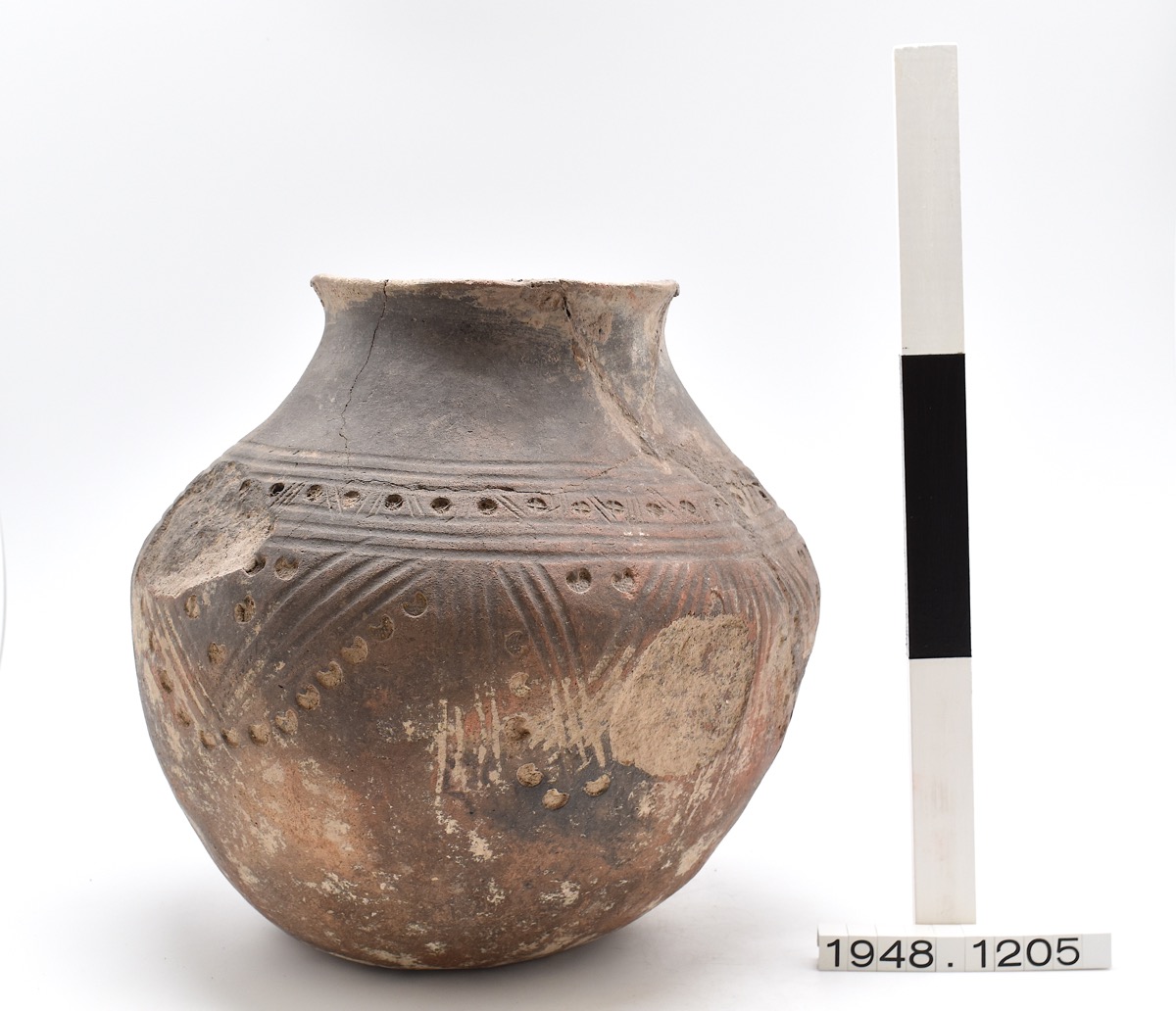
Globular pot with high everted rim and flat base. Decorated around the neck with a row of stamps bound between three horizontal parallel grooves. Decorated across shoulder with pendant triangles made from eight diagonal grooves and containing stamps. Between each pendant triangle is a set of four or five vertical grooves. Two types of stamp used. Possible heat spalling at upper body. Partially reconstructed from sherds.
Place
Europe; British Isles; England; Cambridgeshire; Little Wilbraham; Streetway Hill
Period
Anglo Saxon 6th century
Source
Neville, Richard Cornwallis (4th Lord Braybrooke) [excavator]
Department
Arch
Reference Numbers
1948.1205
Cultural Affliation
Material
Ceramic; Pottery
Local Term
Measurements
220mm
Events
Description (Labels & Markings)
Printed label adhered to pot reads: 'Little Wilbraham'
Event Date
Author: Louise Puckett
Context (Field collection)
Excavated in 1851.
Event Date 1851
Author: maa
Context (References)
Neville, Richard C. (1852). Saxon Obsequies: Illustrated by Ornaments and Weapons Discovered by the Hon. RC Neville, in a Cemetery Near Little Wilbraham, Cambridgeshire, During the Autumn of 1851. J. Murray. Pl. XXIX (top Right).
Event Date 1852
Author: Louise Puckett
Context (Related Documents)
Stamps are illustrated on reverse of Catalogue Card.
Event Date 1948
Author: Imogen Gunn (admin)
Description (CMS Description)
Cremation urn. Red brown ware. Globular body. Flattened Base. Concave neck. Plain, slightly everted, rim. Above shoulder, parallel lines enclosing row of cruciform stamp design and diagonal lines. Below shoulder, chevron grooves design, bordered with crecentic stamps. Anglian type
'Reconstructed using ?Plaster of Paris to line the vessel and hold it together. S-J Harknett 26/3/2001'
Event Date 22/4/1987
Author: maa
Description (Physical description)
Globular pot with high everted rim and flat base. Decorated around the neck with a row of stamps bound between three horizontal parallel grooves. Decorated across shoulder with pendant triangles made from eight diagonal grooves and containing stamps. Between each pendant triangle is a set of four or five vertical grooves. Two types of stamp used. Possible heat spalling at upper body. Partially reconstructed from sherds.
Event Date 10/12/2020
Author: Louise Puckett
FM:19211
Images (Click to view full size):