IDNO
N.130985.HNL
Description
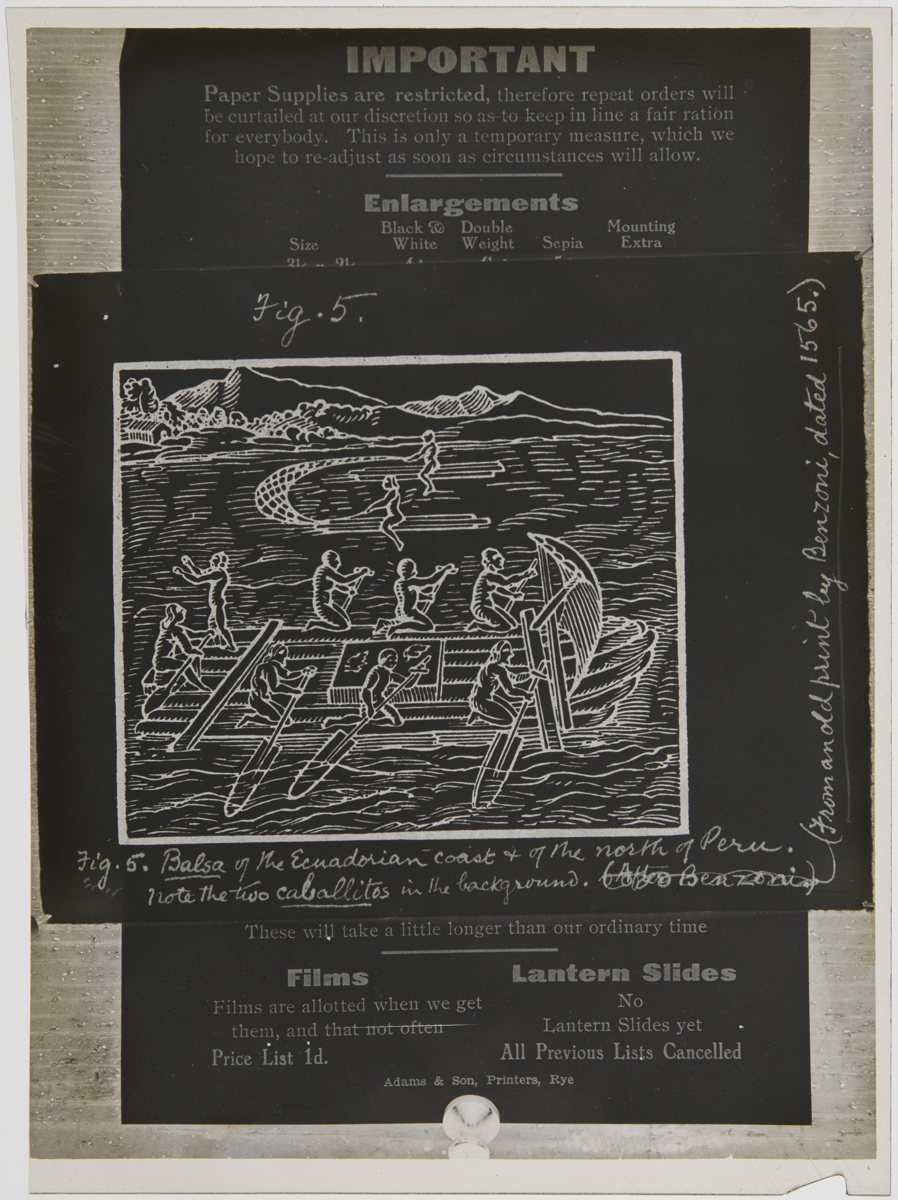
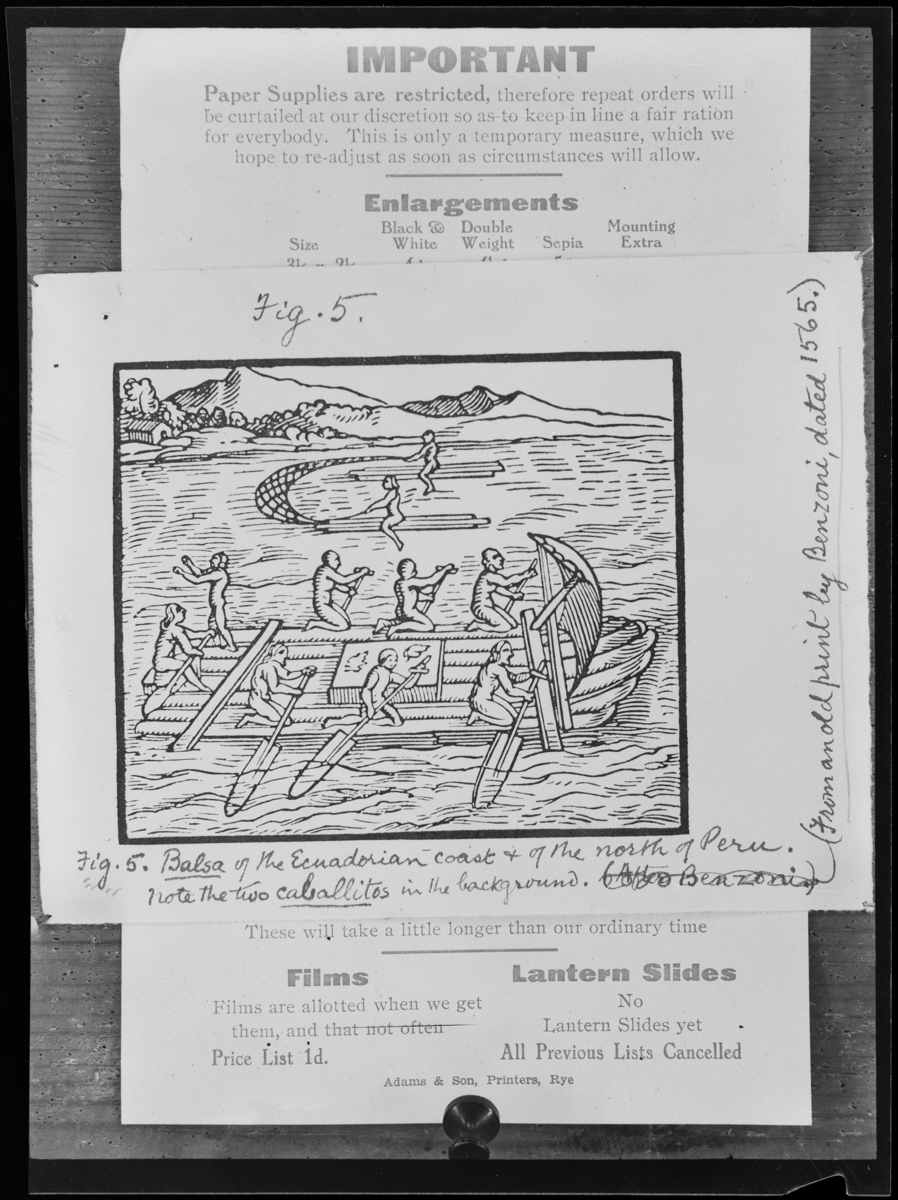
"Fig 5. Balsa of the Ecuadorian coast and of the north of Peru. Note the two caballitos in the background. (After Benzoni). (From an old print of Benzoni dated 1565)." [Hornell's annotation]
Place
S America; Ecuador; Peru
Cultural Affliation
Named Person
Photographer
After Benzoni [Artist]; ?Hornell, James
Collector / Expedition
Hornell, James
Date
1565; ?1924
Collection Name
Hornell Collection
Source
Hornell, Charlotte (Mrs)
Format
Film Negative Black & White
Primary Documentation
Other Information
N.130985.HNL - P.131070.HNL were found unaccessioned in Drawer C.42.2 of the Photo Store, in a cardboard box, now numbered C696/.
N.130985.HNL was found in a white envelope, now numbered C696/1.
Related Archive: James Hornell's papers at University Library, Cambridge, ref 10065 Box 8, contains references to the St. George 10 month South Pacific Scientific Expedition, Summer 1924 - Summer 1925.
A newspaper clipping "St. George for England", from the Trinidad Guardian, Tuesday, May 27, 1924 in the notebook ""St. George" Expedition. Trinidad, Panama and Gorgona. 1924" describes the British Yacht St. George as, "...a beautiful and comfortably fitted up brigantine--rigged craft of 1,000 tons with auxiliary steam power engines, registered at 800 horse power." The St. George was built in the 1890s and was a unit of the Royal Thames Yacht Club. The project cost £50,000, coming from private donations. The endeavour of the voyage was to "enrich the national collections... and arouse the nation's interest in scientific wok which has been neglected".
A newspaper clipping from "Observer", 6/1/24, found in the notebook "Madeira - 1924", as well as the newspaper clipping "St. George for England", from the Trinidad Guardian, Tuesday, May 27, 1924 in the notebook ""St. George" Expedition. Trinidad, Panama and Gorgona. 1924", revealed that the St. George, South Pacific Scientific Expedition was headed by Commander David Blair, R.N.R., F.R.G.S.. The crew members and their jobs included: Major A. J. A. Douglas, F.R.G.S. was in charge of the landing parties. Pay-Lieutenant F. W. Kealey. R.N.V.R. (great-great-grand-nephew of the famous Captain John [sic? James?] Cook) was the organising secretary, Mr. James Hornell (late Director of Fisheries, Madras) was in charge of Ethnology, Dr. Cyril Crossland was in charge of Marine Biology, Mr. P. H. Johnson was in charge of General Biology, Lt.-Col. H. J. Kelsall was in charge of Ornithology, Miss L. E. Cheesman was in charge of Entomology, Mr. Laurence A. M. Riley was in charge of Botany, Mr. Larwence J. Chubb was in charge of Geology, Colonel F. S. Penny acted as Surgeon, Mr. Alfred Duggan (son of Marchioness Curzon of Kedleston) was a member of the party, Messrs. S. L. Eaton and W. Harcourt were the Cinema Operators, and Mr. Dawson served as the Artist completing drawings for the purpose of illustrating books and other forms of literature that would be compiled from the voyage. The itinerary showed the St. George sailed out of Dartmouth on 9th April 1924, reached Madeira by 25 April 1924, and then sailed to Trinidad, the Panama Canal, the Galapagos, the island of Gorgona and Malpelo, Easter Island, Mangareva, Pitcairn, the Austral Islands and Papau. This was followed by Tahiti and the Cork Group for stores, following which the St. George would begin the return trip, visiting several atolls in the Tuamatus, the Marquesas and Cocos Island, before reaching London via the Panama Canal and the Azores by summer 2015. [FC 4/5/2016]
FM:265669
Images (Click to view full size):